

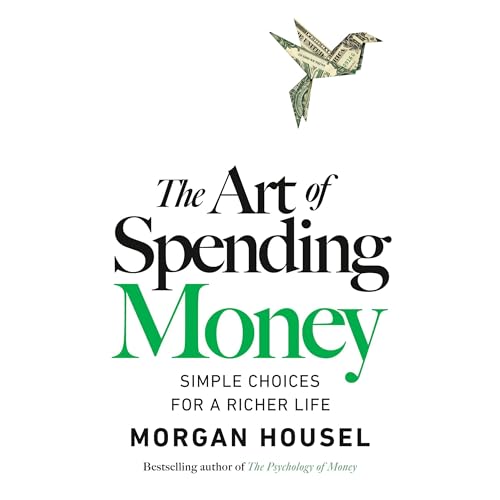
The Art of Spending Money
Simple Choices for a Richer Life
Failed to add items
Sorry, we are unable to add the item because your shopping cart is already at capacity.
Add to Cart failed.
Please try again later
Add to Wish List failed.
Please try again later
Remove from wishlist failed.
Please try again later
Adding to library failed
Please try again
Follow podcast failed
Please try again
Unfollow podcast failed
Please try again
Get 30 days of Standard free
Auto-renews at $8.99/mo after 30-day trial. Cancel anytime

The Art of Spending Money
Narrated by:
Chris Hill
Buy for $19.80
-
Narrated by:
-
Chris Hill
-
By:
-
Morgan Housel
Most of us don’t know how to spend money. We chase things that impress others but leave us cold. Or we save endlessly, afraid to spend on what would actually make life better. We confuse admiration with envy, comfort with excess, and utility with status.
The Art of Spending Money doesn't provide budgets, hacks, or one-size-fits-all solutions. It gives you understanding of how your relationship with money shapes your decisions—and how to reshape it so money works for you.
Morgan Housel’s work has helped millions rethink how they earn, save, and invest. Now he turns his attention to the other side of the equation: how to spend. With insight and warmth, he shows why the most valuable return on investment is peace of mind, why expectations matter more than income, and why doing well with money has less to do with spreadsheets and more to do with self-awareness.
This book isn’t about getting rich. It’s about getting the most out of what you already have—and learning to want what’s worth wanting.
Accolades & Awards
Most Popular
Listeners also enjoyed...




adbl_web_anon_alc_button_suppression_t1
Critic reviews
“The Art of Spending Money is not so much a sequel as the masterful completion of The Psychology of Money. When it comes to unfolding the long and complicated story of our relationship to money in an entertaining and useful manner, Morgan Housel is the GOAT.”
— Chris Davis, chairman of Davis Advisors and board member at Coca-Cola and Berkshire Hathaway
“Storytelling is, without a doubt, the best teaching tool on the planet. As we learned in The Psychology of Money, Morgan Housel is a fabulous storyteller. He’s done it again in The Art of Spending Money, breaking down not only why the impulse to buy is so strong but why purchasing rarely cures the problem we’re trying to solve. If you’re looking to understand how to use your money to make you truly happy, here it is. You’ll never shop the same way again.”
— Jean Chatzky, bestselling author of How to Money and Women With Money
“A book that points out what we all secretly know but none of us want to admit: We have no idea how to spend our money. Essential reading for anyone who wants their money to actually improve their life.”
— Mark Manson, bestselling author of The Subtle Art of Not Giving a F*ck and Everything Is F*cked
“Housel, the author of The Psychology of Money, a book I wish I’d written, has written another book I wish I’d written. In pithy chapters and lapidary prose, he avoids schoolmarmish finger-wagging and sweeping generalizations, instead offering sharp advice.”
— Jason Zweig
— Chris Davis, chairman of Davis Advisors and board member at Coca-Cola and Berkshire Hathaway
“Storytelling is, without a doubt, the best teaching tool on the planet. As we learned in The Psychology of Money, Morgan Housel is a fabulous storyteller. He’s done it again in The Art of Spending Money, breaking down not only why the impulse to buy is so strong but why purchasing rarely cures the problem we’re trying to solve. If you’re looking to understand how to use your money to make you truly happy, here it is. You’ll never shop the same way again.”
— Jean Chatzky, bestselling author of How to Money and Women With Money
“A book that points out what we all secretly know but none of us want to admit: We have no idea how to spend our money. Essential reading for anyone who wants their money to actually improve their life.”
— Mark Manson, bestselling author of The Subtle Art of Not Giving a F*ck and Everything Is F*cked
“Housel, the author of The Psychology of Money, a book I wish I’d written, has written another book I wish I’d written. In pithy chapters and lapidary prose, he avoids schoolmarmish finger-wagging and sweeping generalizations, instead offering sharp advice.”
— Jason Zweig
People who viewed this also viewed...


What I love about this book is its clarity. Housel gives you a simple, honest framework for understanding your relationship with money. And while it’s not a faith-based book, it might be the best resource I’ve found for avoiding the traps that make so many successful people feel like slaves to the wealth they’ve built.
Warren Buffett shared a line that gave me thoughful pause:
He said he has friends with the big homes, private planes, even hospital wings named after them — “but the truth is that nobody in the world loves them.” Then he adds, “If you get to my age and nobody thinks well of you, I don’t care how big your bank account is… your life is a disaster.”
That’s the heartbeat of Housel’s message: you can become rich and still never become wealthy. Because real wealth is love, health, relationships, time, and joy.
If you pair Buffett’s wisdom with Housel’s practical approach, you’ll put yourself on a far better path — one where you can grow a business, build success, and still live a deeply joyful, grounded life.
What’s The Real Art Behind Spending Money Well?
Something went wrong. Please try again in a few minutes.
How to be smart with your money
Something went wrong. Please try again in a few minutes.
It just makes sense
Something went wrong. Please try again in a few minutes.
Don’t buy to show off. Nobody cares much about your dress or possessions.
I will say spending money to advertise yourself & elevate reputation is valuable. But as in all things… in moderation. Buy a nice car but it doesn’t need to be a foreign car or a $200,000+ car. Doesn’t need to be multiple cars either. Don’t be a show off. It can backfire. It’s a fine line between confident & arrogant. Use money to buy friends. But the right one’s not shallow leaches.
Reputation is more valuable than rubies & gold 🤔😌
Timeless Wisdom. Love the perspective & the book is very thought provoking.
Something went wrong. Please try again in a few minutes.
Oh and thank you also for teaching me how to pronounce Ramit Sethi.
Just how applicable this is too so many different areas of life.
Something went wrong. Please try again in a few minutes.