Episodios

  • 434 Thursday Refresh: Greg Shove on Leading Through AI
    Feb 5 2026

    In this episode of Partnering Leadership, Mahan Tavakoli is joined by Greg Shove, CEO of Section and a serial entrepreneur with a deep track record of leading transformative growth. Shove’s leadership journey includes multiple successful pivots, and in this conversation, he brings a uniquely grounded perspective on how AI is fundamentally changing the role of leaders and the structure of modern organizations. From board-level decision-making to frontline productivity, he doesn’t just speculate—he shares what he’s doing inside his own company to lead through the change.

    Greg originally joined Section to turn it from a media startup into a next-gen education company. But when he first used ChatGPT, he knew instantly that business education itself needed to evolve. That insight led to a bold pivot: transforming Section from an online business school into an AI-powered academy focused on accelerating performance and capability at scale. It’s a rare look at what it really takes to lead a high-velocity pivot—one grounded not in hype, but in strategy, execution, and conviction.

    Throughout the conversation, Greg challenges conventional thinking on AI adoption, leadership credibility, and the future of knowledge work. He breaks down why many leaders are stuck in experimentation mode—and what it takes to move into actual transformation. CEOs and boards will find his views on performance, upskilling, and AI decision support to be especially compelling and uncomfortably timely.

    If you're tired of surface-level conversations about AI and want to understand what the shift actually looks like inside a company, this episode delivers. Whether you're leading a small team or a global enterprise, Greg's insights on using AI as a leadership advantage—not just a tech upgrade—will spark new thinking and bold action.


    Actionable Takeaways:

    • You'll learn why Greg believes the greatest leadership returns come not from better execution—but from catching the right wave at the right time.


    • Hear how AI is already matching 90% of the value delivered by human board members—and what that means for your next board meeting.


    • Discover why most corporate training is already obsolete, and how AI can turn learning into personalized, outcome-driven coaching.


    • Hear how Shopify’s CEO linked headcount approvals to AI productivity—and how that kind of thinking will soon become the norm.


    • You'll gain perspective on how to model AI adoption as a leader, and why failing to do so erodes credibility at every level of the organization.


    • Learn Greg’s approach to building AI habits inside leadership teams—and why small, visible systems often matter more than a “transformation plan.”


    • Find out what question every CEO should be asking before making a major decision—and why it might be time to invite AI into the room.


    • Hear why Greg believes business model innovation—not technology—will be the real competitive battleground in the age of AI.


    • Understand the deeper threat AI poses to entry-level jobs and talent pipelines—and why CEOs need to rethink how organizations grow their future leaders.


    • You’ll hear the provocative question Greg uses to challenge his own team—and how it might reshape your own strategy discussions.


    Connect with Greg Shove:

    Greg Shove Website

    Connect with Mahan Tavakoli:

    Mahan Tavakoli Website

    Mahan Tavakoli on LinkedIn

    Partnering Leadership Website


    Más Menos
    57 m
  • 433 Negotiating Without Games: The Four Levers That Create Trust and Higher Deal Value With Todd Caponi
    Feb 3 2026

    Negotiation and sales are often treated as tactical skills. Something leaders do at the end of the process, armed with tricks, pressure, and leverage. In this conversation, Todd Caponi makes the case that this mindset is outdated—and increasingly damaging for leaders operating in a world of transparency, information abundance, and long-term accountability.

    Todd draws on his experience as a former Chief Revenue Officer, his deep study of the history of sales and negotiation, and his latest book, Four Levers Negotiating: The Simple, Counterintuitive Way to Higher Deal Values and Lasting Trust, to challenge conventional wisdom about how deals actually get done. His core argument is simple but provocative: people don’t make decisions because they’re convinced. They decide when they can predict outcomes. And most leadership behaviors unintentionally undermine that predictability.

    The conversation explores why traditional negotiation tactics—holding cards close, creating artificial urgency, treating the deal as the finish line—erode trust precisely when it matters most. Todd explains how many of these practices emerged from a very different economic era and why they fail in today’s interconnected, reputation-driven environment.

    At the center of the discussion is Todd’s Four Levers framework, which reframes negotiation as a leadership system rather than a personality trait. Instead of games and pressure, the framework focuses on transparency, trade-offs, and shared understanding—creating better decisions for both sides and reducing internal friction across leadership teams.

    This episode is not about becoming a better negotiator in the traditional sense. It’s about how leaders create trust, predictability, and long-term value—whether they are working with customers, boards, partners, or their own leadership teams.


    Actionable Takeaways

    • You’ll learn why leaders don’t win decisions by persuading harder—but by helping others predict outcomes more clearly.
    • Hear how treating the deal as an “early milestone,” rather than the finish line, changes how leaders approach trust and accountability.
    • Discover why many pricing and negotiation conflicts inside organizations have less to do with money and more to do with unclear decision logic.
    • Learn how Todd’s Four Levers framework creates flexibility without sacrificing consistency or trust.
    • Hear why fake urgency and short-term pressure often backfire, even when they appear to work in the moment.
    • Explore how transparency speeds up the right decisions while quickly ending the wrong ones.
    • Understand why predictability is an undervalued leadership asset—and how it affects forecasting, resourcing, and alignment.
    • Learn how sharing constraints, rather than hiding them, can turn resistance into partnership.


    Connect with Todd Caponi

    Todd Caponi Website

    Todd Caponi LinkedIn

    Four Levers Negotiating: The Simple, Counterintuitive Way to Higher Deal Values and Lasting Trust


    Connect with Mahan Tavakoli:

    Mahan Tavakoli Website

    Mahan Tavakoli on LinkedIn

    Partnering Leadership Website


    Más Menos
    41 m
  • 432 Leading in a BANI World: Making Sense of Chaos with Bob Johansen and Jamais Cascio
    Jan 27 2026

    In this episode of Partnering Leadership, futurists Bob Johansen and Jamais Cascio join the conversation to explore the ideas behind their new book, The Age of Chaos: A Sense-Making Guide to a BANI World That Doesn’t Make Sense. Both guests bring decades of deep foresight work, scenario planning, and leadership insight—Bob through more than 50 years with the Institute for the Future, and Jamais as the originator of the BANI framework (“brittle, anxious, nonlinear, incomprehensible”). Their combined perspectives create a powerful lens for leaders facing a world where old assumptions and linear playbooks no longer hold.

    Across the discussion, they argue that today’s disruptions are not isolated shocks. They are interconnected, compounding forces that make the environment fundamentally different from the “VUCA world” many leaders were trained for. Johansen and Cascio unpack how brittleness shows up in organizations disguised as efficiency, why anxiety has become a rational and necessary signal, and how nonlinearity rewrites traditional cause-and-effect expectations. They challenge leaders to rethink certainty, decision-making, and the stories they tell inside their organizations.

    At the heart of the conversation is a clear message: leading in a BANI world requires a shift in mindset. The best leaders will cultivate clarity instead of certainty, ask better questions instead of providing fast answers, and build organizations that bend rather than break under pressure. Cascio highlights how empathy, diverse perspectives, and even “useful wrongness” serve as strategic advantages. Johansen pushes leaders to think farther into the future than they are comfortable with—then work backwards to create resilient clarity in the present.

    The episode does not offer easy fixes. Instead, it gives listeners a framework for making sense of complexity, a set of practices to strengthen foresight, and a renewed understanding of the human side of leadership in chaotic times. For CEOs, board members, and senior executives navigating relentless uncertainty, this conversation provides both grounding and a challenge: to lead with more humility, more imagination, and more future-back discipline.

    Actionable Takeaways
    • You’ll learn why “clarity beats certainty” and how leaders who project confidence without openness can miss critical signals in chaotic environments.
    • Hear how to spot brittleness in your systems—and why high efficiency often hides vulnerabilities that collapse under stress.
    • You’ll learn why a healthy level of anxiety is necessary and how leaders can use it to sharpen attention without slipping into dysfunction.
    • Hear how to apply foresight as a leadership practice, using scenarios not to predict the future but to “vaccinate” your organization against emerging risks.
    • You’ll learn why nonlinear environments break traditional planning, and how to cultivate neuro-flexibility and improvisational leadership.
    • Hear how storytelling becomes a strategic tool, helping leaders create meaning, focus attention, and align teams in moments of uncertainty.
    • You’ll learn why cross-generational leadership is becoming a competitive advantage, especially as digital natives bring new skills to nonlinear problem-solving.


    Connect with Bob Johansen and Jamais Cascio

    Book Website

    Institute for the Future

    Jamais Cascio LinkedIn

    Connect with Mahan Tavakoli:

    Mahan Tavakoli Website

    Mahan Tavakoli on LinkedIn

    Partnering Leadership Website


    Más Menos
    58 m
  • 431 What It Takes to Lead When the Rules Keep Changing: Strategy, Identity, and the Real Work of Transformation with Louisa Loran
    Jan 20 2026

    In this episode of Partnering Leadership, Mahan Tavakoli sits down with Louisa Loran, a seasoned executive advisor whose career spans legacy brands, global industrial giants, and one of the world’s most influential technology companies. Louisa brings a rare perspective shaped by leadership roles at Diageo, Maersk, and Google—giving her a front-row seat to how strategy, operating models, and leadership expectations shift across industries and eras.

    The conversation centers on a hard truth many leadership teams avoid: strategy does not fail because leaders lack intelligence or effort—it fails because organizations try to adapt to a changing world without changing how they operate. Louisa challenges the assumption that transformation is about better plans or new tools. Instead, she reframes it as a question of movement, clarity, and leadership conviction in the absence of certainty.

    Drawing from her book, Leadership Anatomy in Motion, Louisa explores how leaders can recognize patterns rather than chase trends, why digitizing the past rarely creates future value, and how AI often exposes deeper strategic blind spots instead of fixing them. She also addresses the uncomfortable leadership work of identity—when leaders must ask whether they are still the right person to lead the next phase of the organization.

    Throughout the discussion, Mahan and Louisa examine collective intelligence, operating model shifts, succession readiness, and the real risks of mistaking activity for progress. This is not a conversation about leadership theory. It is a grounded, experience-based dialogue about what it actually takes to lead when the rules keep changing—and when the cost of waiting is higher than the cost of acting.

    For CEOs, board members, and senior executives navigating uncertainty, this episode offers a candid look at the decisions, questions, and trade-offs that define effective leadership today.


    Actionable Takeaways

    • You’ll learn why Louisa believes she can tell in a single conversation whether a transformation will succeed—and what she listens for.

    • Hear how operating model clarity matters more than strategy decks when organizations face disruption.

    • Discover why many AI investments fail before they start, even when the technology works.

    • Learn how pattern recognition differs from reacting to headlines—and why this distinction matters for long-term relevance.

    • Hear why leadership identity, not just capability, often becomes the hidden constraint in transformation.

    • Explore how collective intelligence can accelerate execution—or quietly stall it—depending on leadership direction.

    • Understand what it means to lead without certainty, and why waiting for clarity can be the most expensive decision.

    • Learn why digitizing existing processes can create the illusion of progress while value quietly shifts elsewhere.


    Connect with Louisa Loran

    Louisa Loran Website

    Louisa Loran LinkedIn

    Leadership Anatomy in Motion: Empowering You to Lead Through Technology and People


    Connect with Mahan Tavakoli:

    Mahan Tavakoli Website

    Mahan Tavakoli on LinkedIn

    Partnering Leadership Website


    Más Menos
    43 m
  • 430 Unwavering Teams: How Leaders Reduce Friction and Build Trust That Lasts with Eric Termuende
    Jan 13 2026

    In this episode of Partnering Leadership, Mahan Tavakoli sits down with Eric Termuende, leadership thinker, speaker, and author of Rethink Work: Finding & Keeping the Right Talent, for a grounded conversation about what actually holds teams together in times of uncertainty.

    Rather than focusing on trends or surface-level engagement tactics, the discussion explores why trust, clarity, and human connection remain the real differentiators for leaders trying to reduce friction and sustain performance. Eric shares practical insights drawn from his work with organizations that have stopped chasing big transformation initiatives and instead focus on small, consistent shifts that compound over time.

    Mahan and Eric examine why many leadership teams feel overwhelmed despite good intentions, and how blind spots, inaction, and excessive control quietly erode trust. The conversation challenges the idea that certainty is required to lead well, replacing it with a more realistic and resilient approach rooted in direction, psychological safety, and shared responsibility.

    The episode also looks at what makes teams “unwavering” when the environment around them is anything but stable. Through concrete examples and memorable stories, Eric illustrates how leaders can build trust that lasts, reduce unnecessary friction, and create conditions where people contribute their best thinking.

    This conversation is especially relevant for CEOs and senior executives who sense that the way work gets done needs to change, but who want practical leadership insight rather than abstract theory.


    Actionable Takeaways

    • You’ll learn why organizations don’t suffer from survey fatigue as much as something far more damaging.
    • Hear how small, intentional “one-degree shifts” outperform large transformation efforts over time.
    • Discover what actually makes teams steady during turbulence, and why trust acts as the stabilizer.
    • Learn why leaders often create friction without realizing it, especially through control and approvals.
    • Hear a real example of how daily, employee-driven improvement can reshape culture and results.
    • Understand why clarity of direction matters more than certainty in today’s leadership environment.
    • Learn how shared language and experiences quietly strengthen connection and execution.
    • Explore how trust in human judgment remains essential even as AI tools become part of everyday work.
    • Hear why relationships, not systems, ultimately determine whether teams adapt or stall.


    Connect with Eric Termuende

    Eric Termuende Website

    Eric Termuende LinkedIn


    Connect with Mahan Tavakoli:

    Mahan Tavakoli Website

    Mahan Tavakoli on LinkedIn

    Partnering Leadership Website


    Más Menos
    37 m
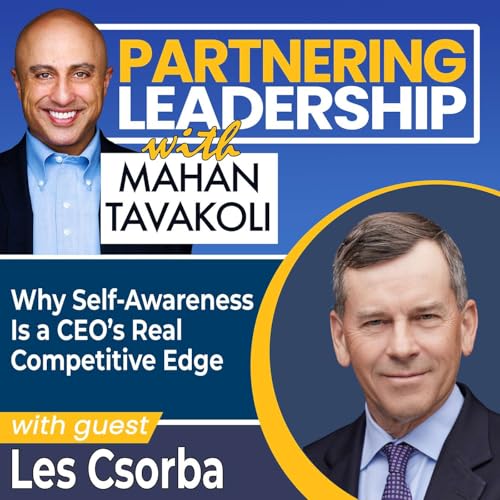
  • 429 Why Self-Awareness Is a CEO’s Real Competitive Edge: Lessons from Les Csorba, Author of Aware
    Jan 6 2026

    In this episode of Partnering Leadership, Mahan Tavakoli speaks with Les Csorba — senior partner at Heidrick & Struggles and author of Aware: The Power of Seeing Yourself Clearly. Drawing on decades advising CEOs, boards, and leadership teams, Les makes a compelling case that self-awareness is not a soft skill but a strategic differentiator. With leaders facing complexity, speed, and pressure unlike anything in recent memory, Les argues that the ability to see yourself clearly has become a true competitive edge.

    Throughout the conversation, Les breaks down why so many successful leaders overestimate their self-awareness — and why that gap grows as they ascend into larger roles. He draws from extensive leadership assessments, behavioral research, and personal experience to show how blind spots quietly shape decisions, team dynamics, and organizational culture. His insights on the “CEO bubble,” the tension between intent and impact, and the way digital validation dulls reflection will resonate with any executive navigating today’s environment.

    The discussion also explores practical ways leaders can strengthen their self-awareness without resorting to vague platitudes or one-time exercises. Les shares stories from his own leadership journey, examples from well-known CEOs, and a grounded perspective on how to build cultures that make honest feedback possible. His framing of courage, humility, and reflection feels less like theory and more like leadership discipline.

    Finally, the conversation touches on timely challenges — from AI’s influence on leader behavior to the importance of understanding one’s “shadow” as a driver of organizational culture. Les brings a balanced, seasoned voice to these issues, offering clarity without overconfidence. For CEOs and senior executives committed to leading with greater impact, this episode offers a set of insights that are as practical as they are thought-provoking.

    Actionable Takeaways
    • You’ll learn why most leaders dramatically overestimate their self-awareness and why the gap between perception and reality grows as responsibilities increase.
    • Hear how to distinguish between internal awareness and external awareness, and why the difference between intent and impact is where many leadership breakdowns occur.
    • You’ll hear why honest feedback rarely reaches the top, and what the best CEOs do to counteract the “bubble” that forms around them.
    • Discover how small habits — reflection, solitude, and the “to-be list” — can sharpen judgment and strengthen leadership presence.
    • Hear how blind spots form and why naming them isn’t enough, and why building a “courage muscle” is essential for behavior change.
    • You’ll learn what leading researchers and leadership assessments reveal about the traits that help executives mobilize, execute, transform, and stay agile.
    • Hear how top leaders like Jamie Dimon, Warren Buffett, and Elon Musk approach their own blind spots — and what that means for every executive who wants to keep growing.
    • Discover why AI makes self-awareness more important, not less, and how understanding your wiring becomes a safeguard against unintended influence.


    Connect with Les Csorba


    Les Csorba Website

    Les Csorba LinkedIn

    Aware: The Power of Seeing Yourself Clearly


    Connect with Mahan Tavakoli:

    Mahan Tavakoli Website

    Mahan Tavakoli on LinkedIn

    Partnering Leadership Website


    Más Menos
    32 m
  • 428 Thursday Refresh: Dr. Bernard Harris, Embracing Infinite Possibilities
    Jan 1 2026

    In this episode of Partnering Leadership, Mahan Tavakoli speaks with Dr. Bernard Harris, a leader whose extraordinary career trajectory—from physician to NASA astronaut to CEO and venture capitalist—offers rare insights into the inner work of leadership. Dr. Harris is the first African American to walk in space, and the author of Embracing Infinite Possibilities: Letting Go of Fear to Find Your Highest Potential. His unique vantage point, shaped by science, space exploration, and C-suite leadership, gives him an extraordinary lens on what really limits potential—not just for individuals, but for teams and entire organizations.

    This is not a conversation about space missions. It's a candid exploration of the hidden forces that hold even the most accomplished leaders back. Dr. Harris shares how fear, false identity, and overachievement can become barriers disguised as success—and how leaders can finally begin to let go. With disarming honesty, he recounts how constant validation once drove his every move, and how shedding that need was key to unlocking deeper effectiveness and personal alignment.

    What makes this episode essential for executive listeners is not just the personal story—it’s the direct application to business and leadership contexts. Dr. Harris talks about leading teams under pressure, confronting blind spots in senior leadership, and what it really takes to receive feedback at the top. His reflections offer a masterclass in self-awareness and intentional leadership, especially for those navigating high-stakes roles where perception often replaces truth.

    Whether you're leading a company, serving on a board, or mentoring the next generation of executives, this episode will challenge you to rethink how you define success, strength, and growth. The conversation isn't about doing more—it’s about uncovering what’s driving your decisions, and whether it’s truly aligned with your values and long-term vision.


    Actionable Takeaways:

    • You’ll learn how Dr. Harris overcame fear—not through toughness, but by reframing what failure really means for leaders.


    • Hear how overachievement can be a trap, even when it’s applauded—especially for those in senior roles.


    • Discover why most CEOs stop getting meaningful feedback—and what to do to get the truth back on the table.


    • Explore the performance identity leaders develop—and how it can silently limit their ability to lead authentically.


    • Find out what happened when Dr. Harris was told by his team: “You’re a micromanager”—and what he did next.


    • Learn why self-awareness is a strategic advantage, not just a personal virtue.


    • Hear Dr. Harris describe how he applies the same mindset that got him into space to running businesses and investing.


    • Explore how internal versus external drivers shape leadership clarity—and how to regain control of your narrative.


    • Understand how success, when unchecked, can become an armor that distances leaders from their teams.


    Connect with Dr. Bernard Harris

    Bernard Harris LinkedIn

    Embracing Infinite Possiblities

    Connect with Mahan Tavakoli:

    Mahan Tavakoli Website

    Mahan Tavakoli on LinkedIn

    Partnering Leadership Website


    Más Menos
    43 m
  • 427 [BEST OF] David Ross on Confronting the Storm - Leadership, Hope, and Navigating Wicked Problems in the Age of Uncertainty
    Dec 30 2025

    In this episode of Partnering Leadership, Mahan Tavakoli sits down with David Ross, VUCA strategist and author of Confronting the Storm: Regenerating Leadership and Hope in the Age of Uncertainty. David is a renowned expert on VUCA (Volatile, Uncertain, Complex, Ambiguous) environments and has spent his career advising organizations on how to thrive amidst complexity and disruption. With a background as an ecologist, David brings a unique perspective to leadership—one that emphasizes the interconnectedness of the issues facing businesses and society today. His deep understanding of wicked problems, those challenges with no straightforward solutions, forms the backbone of this engaging conversation.


    The discussion centers around how leaders must adapt to the rapidly changing business landscape, where traditional approaches no longer work. David argues that the old leadership models—based on control and linear thinking—are ill-suited for the challenges we face today. Instead, he advocates for a more collaborative, emotionally intelligent, and resilient leadership style, one that embraces uncertainty rather than fighting it. He explains how technology, climate change, and societal shifts are creating a world that’s more BANI (Brittle, Anxious, Nonlinear, and Incomprehensible), and what leaders need to do to stay ahead.

    Throughout the episode, David draws on his extensive experience advising CEOs and leadership teams, offering practical insights into how organizations can navigate the unpredictability of today’s environment. He also delves into the importance of hope and optimism, even in times of crisis, and how leaders can turn challenges into opportunities for growth and innovation.


    Actionable Takeaways:


    • You'll learn why traditional leadership models based on control and linear thinking are no longer effective in today's VUCA world—and what you need to replace them with.
    • Hear how embracing uncertainty and fostering resilience can transform how your organization responds to crises and wicked problems.
    • Discover the power of emotional intelligence in leadership and why listening is just as important as speaking in today’s collaborative environments.
    • Find out what David means by a BANI world (Brittle, Anxious, Nonlinear, and Incomprehensible) and how leaders can adapt to thrive in these unpredictable times.
    • Explore the importance of hope and optimism in leadership and how turning crises into opportunities is key to long-term success.
    • Understand why future literacy and foresight are critical tools for leaders looking to anticipate change and guide their organizations through complexity.
    • Learn why David believes that normalcy has left the building and how leaders must evolve to lead effectively in this new reality.
    • Hear David's insights on why collaboration—not isolation—is the future of leadership and how diverse perspectives fuel innovation.
    • Gain insight into why scenario planning is a powerful tool for leaders to prepare for multiple futures and make better strategic decisions.


    Connect with David Ross

    David Ross Website

    Confronting the Storm: Regenerating Leadership and Hope in the Age of Uncertainty

    David Ross LinkedIn

    Connect with Mahan Tavakoli:

    Mahan Tavakoli Website

    Mahan Tavakoli on LinkedIn

    Partnering Leadership Website


    Más Menos
    41 m