Episodios

  • Easter Sunday of the Resurrection of the Lord
    Apr 19 2025
    Easter Sunday of the Resurrection of the Lord c. 33 A.D. The first Sunday after the first full moon that falls on, or after, March 21 Solemnity; Liturgical Color: White or GoldCheckmate!If you want to discover what’s really going on in a story, follow the women. Curious about how the plot of a book, movie, or show is going to resolve itself? Follow the female characters, because the men...and the rest of the story...will soon catch up with them. It is a female disciple, Mary Magdalen, who takes our hand and walks us quickly onto the stage of Easter Sunday. Mary doesn’t go to the tomb on Saturday, because no work can be done on the Sabbath. So early Sunday, while it is still dark, Mary walks alone to the burial garden and sees something, or, more precisely, doesn’t see something, that changes world history. The dead body of Jesus is not on the slab! The stone is rolled away! The tomb is empty! Mary Magdalen is witness one, the first of billions to know that Jesus rose from the dead. Witness one then quickly runs to tell the good news to witness two and three, the Apostles Peter and John. Thus the first links in the endless chain of believers were forged, a strong, enduring chain that has wended its way through history until today.Relegating Jesus’ miracles to the bin of apocryphal but consoling stories, many moderns argue Christ’s most enduring legacy is the verifiable good He did for His fellow men. Yet the Gospels don’t tell us that Jesus went around doing good. They tell us He went around doing miracles. Jesus doesn’t help an old woman carry a load up a hill. He doesn’t dig His hand deep into His pocket and spare some change. Jesus doesn’t offer words of comfort to the sick; He heals the sick. Jesus doesn’t jump into the sea to save the drowning Peter; He walks on the water. Jesus didn’t volunteer in a soup kitchen; He miraculously multiplied bread and fish and distributed food to the masses. And Jesus didn’t save people from the danger of death; He raised them from the dead. Jesus temporarily resuscitated three people, all of whom later died, before He resurrected Himself forever. There was nothing dreamy about the Resurrection. Real people with real names in a real place saw the Resurrected Jesus with real eyes. Easter celebrates the miracle of all miracles, the greatest unexpected result of all time, the indispensable genesis event of Western Civilization.So today we raise a toast to a fresh spring morning two thousand years ago. In a garden moist with dew, with small birds chirping and flowers’ bending toward the dawning sun, in a small, darkened hollow cut into the rock, a dead man, icy cold to the touch, zapped to life. He achingly rose from His stone slab and walked slowly toward the low entrance. He rolled away a heavy stone and stepped out into a new world where death was no longer the master. The ageless, see-saw battle between life and death was resolved in favor of the more powerful. Checkmate! The mind wanders at the beauty of it all.The story is told of the conception of twins. In their first weeks of life they stretch and groan and grow. They are happy to be alive, to be together. They squirm and jostle and explore their cramped watery world. They are curious. They see a life cord tethering them to someone greater and are overjoyed. “How great is our mother’s love that she shares her life with us.” Weeks turn into months in their warm amniotic bath. The twins shift and change. “What does this mean?” Twin One asks. “It means that our life in the womb is ending,” Twin Two responds. “But I don’t want to leave the womb! I am happy here. I want to stay here forever, close to our mother!” “But we have no choice,” Twin Two responds again. “Besides, maybe...just maybe, there is life after birth.” Twin One: “But how can that be? The sac will break, the cord will be severed, and we’ll be cut off from our source of life. And besides, there’s evidence that others were here before us, and none has ever come back to tell us that there is life after birth. No, this is the end.” Twin Two begins to despair, “If life in the womb ends in death, what’s its purpose? It’s meaningless! Maybe...maybe we don’t even have a mother...maybe we just made her up.” Twin One: “But we must have a mother. How else did we get here? How else do we stay alive?”And so the last days in the womb were filled with questioning and deep fear about the future. The moment of birth came at an hour they did not expect. The twins were emotional, wondering about the unknown, uncertain if they would ever see each other, or their mother, again. The transition was painful. They struggled. They heard screams. All that they knew disappeared. And then… light! Shocking bright whiteness. Their eyelids slowly peeled from their skin, and they gazed in confused wonder at a new world around them. Their life-source, their great mother, wept when they were placed in her ...
    Más Menos
    7 m
  • April 4: Saint Isidore, Bishop & Doctor
    Apr 3 2025
    April 4: Saint Isidore, Bishop & Doctor
    c. 560–636
    Optional Memorial; Liturgical Color: White
    Patron Saint of the internet

    There was little he did not know

    The vast colonial ambitions of Spain in the sixteenth and seventeenth centuries went hand in hand with equally epic Catholic missionary efforts. This unity of purpose, these shared goals, with civil and ecclesiastical resources and powers working in concert, was the natural consequence of a country with a total unity of identity. Today’s saint was a singularly important, if remote, source for that powerful concurrence of Iberian theology, culture, art, and language which, after centuries of gestation, became the Spanish juggernaut that conquered and evangelized a hemisphere in the 1500s.

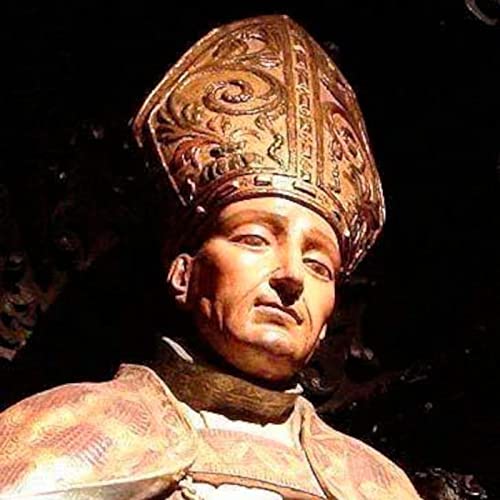
    As a youth, Isidore received an excellent classical education in the Roman tradition, similar to the classical learning Saint Augustine imbibed two centuries before him and utilized to such great effect. Yet Isidore not only learned a great deal, he also remembered it and was uncommonly dedicated to his intellectual pursuits, writing numerous weighty tomes. The breadth and depth of his learning were without equal in his time. It was simply said that Isidore, Archbishop of Seville, knew everything. He is considered by many to be the last of the Latin Fathers of the Church, those early Christian theologians whose writings are the gold standard for all subsequent theologians.

    His knowledge was put to good use. As the Roman world, which had dominated Spain for so many centuries, slowly crumbled away in the fifth and sixth centuries, Visigothic (Western Goths) tribes overran Spain. Like their Gothic cousins in Central Europe, the Visigoths were Arians, and Arians were heretics. They denied that Christ was consubstantial with the Father and accepted all that flowed from that erroneous starting point. Saint Isidore played an important role in the assimilation of the Visigoths to Nicene Catholicism after one of their Kings abandoned Arianism. Theological unity having been achieved, the old Roman culture of Iberia slowly blended with Visigothic culture to form something new—Spain. Saint Isidore was, then, a nation builder, because he was first a Church builder. And he built the Church not just through his massive erudition but also through effective headship in calling and guiding Church synods, by establishing liturgical unity through the Mozarabic Rite, and by encouraging scholarship and learning through the Cathedral schools he mandated in every diocese.

    Saint Isidore’s most enduring work is his Etymologies (or Origins), an enormous compendium of universal knowledge. It was the standard encyclopedia in Medieval libraries and continued to be utilized as late as the Renaissance. No author’s manuscripts were more widely copied in the Middle Ages than Isidore’s. Although Saint Isidore was not a creative thinker in the same class as Saint Augustine or the Eastern Fathers of the Church, his mind was such a vast storehouse of knowledge that Pope Saint John Paul II named him the Patron Saint of the Internet.

    After a long reign as Archbishop of Seville, in his last days Saint Isidore prepared for death by wearing sackcloth and ashes, confessing his faults to his people in church, and asking their forgiveness. He died in his late seventies in 636, just four years after Mohammed, the founder of Islam, died in Saudi Arabia. About seventy-five years after their deaths, Muslim armies crossed the strait of Gibraltar from North Africa and began the long conquest which obliterated the Visigoths. The Spanish reconquest of their nation would take centuries until, in 1492, the last Muslim stronghold, Granada, fell. Both sides were inspired by faith more than patriotism. Both sides fought. Both sides thought they were right. In the end, the nation Isidore created was the stronger and drove Mohammed’s heirs back over the waters to Africa. Isidore’s enormous legacy was a Catholic nation, and it prevailed.

    Saint Isidore, you used your education and knowledge to great effect to evangelize a people. Help all who seek your intercession to unite their learning with zeal for the good of the Church and the many peoples it serves.
    Más Menos
    6 m
  • Friday of the Passion of the Lord (Good Friday)
    Apr 18 2025
    Friday of the Passion of the Lord (Good Friday)
    c. 33 A.D.
    Triduum; Liturgical Color: Red

    No one knew love looked like this

    One of the most famous Greek sculptures in the world, a larger-than-life marble statue of a female, reigns over a monumental staircase in the Louvre. A soft, unfelt breeze ripples through the thin, flowing sheets that wrap her frame. Two expansive, articulated wings sweep elegantly back from her torso, giving the impression that she has just floated down from on high and landed softly on the prow of an invisible ship. Though now headless, the statue’s sense of movement is so vivid that one can still “see” her neck craning, her jaw jutting, and her eyes looking carefully downward as she settles to ground. She moves and yet she is still. She is “Winged Victory,” Nike, the Greek goddess of victory.

    Victory in battle, conquest in war, and success in sport are typically celebrated with a blast of trumpets, gold medals hung around the neck, ticker-tape parades, a crowning with laurels, or the placing of an elegant statue like “Winged Victory” to serenely personify triumph over one’s enemies. Jesus Christ changed all that. He changed what victory looked like. Jesus climbed a different podium to win a different type of victory over man’s greatest enemy.

    On Good Friday, the God of the Living descended into the depths of human experience to conquer death. His victory parade was the carrying of the Cross on His tender shoulders up the hill of Calvary, where His hands were nailed to a splintery timber. He was raised on high by centurions for mockery, not exaltation. He then died a slow, agonizing death as His thorax sunk lower and lower and His diaphragm sucked less and less air into His lungs. It was not fast and clean. It took three hours. No one knew it at the time, but this was the new look of love in the Christian age, this was the new victory pose. Not laurels, but thorns. Not trumpets, but screams. Not medals, but scars. On Good Friday, Christ redefined victory. The victor is not prideful or strong, but humble, meek, wrecked, injured, and dead. Pain in the non-Christian world, whether in the past or today, has no redemptive power or reward. It is just mindless and arbitrary suffering. At best, it is stoicism.

    In the person of Jesus Christ, God does not explain human suffering. Instead, He gives it meaning. And giving meaning to something is a type of answer, although not a solution. We do not go to a funeral to solve a problem. We go simply to be present, to share the family’s sorrow. Sharing is a powerful response. It is more satisfying and profound to give something meaning than to make it disappear. The answer of Jesus Christ to human suffering is to share it. His answer is empathy. He suffers, dies, and is buried. No one can point a finger at God and say, “You don’t know what it’s like!” He certainly does know what it’s like! Jesus could have saved the world by cutting Himself shaving. But He didn’t. He experienced more than was necessary, because it was more fitting that God share every single human experience except sin. God drinks the common cup of human suffering to the dregs.

    Jesus did not die full of years. He died young, like many tragic heroes. Christ’s death gives hope to all who are preyed upon by loneliness, depression, fear, illness, anxiety, confusion, sin, and shame. In His death, Jesus does not just tell us but shows us that all these things can be conquered when united to Him. Jesus did not leave us a book but a life. And that life continues to be shared with us in word and sacrament, in its fullness, in the Catholic Church.

    God did not die on the Cross so that artists could sculpt Him. God died for a higher reason. He died for us. In Christ, the gift and the giver, the priest and the sacrifice, merge, and the result is life. As in marriage, so also in the Trinity, self-gift merges in generative love and creates life. So we etch that powerful reminder of Christ’s life-generating gift of self—the Crucifix—into our tombstones and place it high in our churches. This universal symbol of redemptive love even hangs from fine chains on our necks. In hoc signo vinces. Christ is our new winged Victory, not with two glorious wings spreading out in a proud gesture of triumph, but with His two thin bloody arms pinned to the Cross. He hangs there in agony, gasping for air, and heroically waits for Sunday to come.

    Crucified Lord, in Your passion and death, You walked for us the hard path to new life. You exited life through the door of death and so give us hope that the end is the beginning, that loss is gain, that defeat is victory, and that death is life.
    Más Menos
    7 m
  • Thursday of Holy Week (Holy Thursday)
    Apr 2 2026
    Thursday of Holy Week (Holy Thursday)
    c. 33 A.D.
    Triduum; Liturgical Color: White

    No last will and testament has been as heeded as Christ’s

    From the moment Christ first uttered the words at the Last Supper on Holy Thursday evening, the Church has never ceased to be faithful to them: “Do this in memory of me.” These words of a man about to die, if not a dying man, were a commandment more than a request, marching orders more than a mission statement. And everyone in that upper room understood exactly what He meant. No last will and testament of any man has ever been as faithfully fulfilled as these last words of Christ. What Christ ordered to be done has been done, and continues to be done, every day, throughout the world, by every single priest who stands at an altar and recites the words of consecration in persona Christi.

    The world has never moved on from Christ and never will. He is not in the world’s rear-view mirror. He is here, He is present, He is alive. And in every tight corner of the globe, from a tidy Polish village to a rambling Filipino city, from a Palestinian monastery hugging a sun-baked cliff to an Argentinian parish in a sprawling suburb, the Mass makes Him real because it is done in memory of Him. Literally every minute of every day, Mass is celebrated across the globe in a ceaseless offering to God the Father. “From the rising of the sun to its setting,” in a thousand tongues, priests bend slightly over their chalices and the white linens covering their altars and carefully repeat a chain of words in a cadence known to all the faithful: “Take this, all of you, and eat of it…Take this all of you, and drink from it…This is my Body…This is my Blood.” No words are more familiar. None! Not Shakespeare’s, not Caesar’s, not Lincoln’s. The everlasting words of the cross-cultural and cross-generational Christ simply have no equal.

    If we expect from the Church the sacraments, we will never be disappointed. If we receive from the Church more than the sacraments, we should rejoice. The Last Supper fulfills and completes the Jewish Passover sacrifice ordered by God of Moses and the Jews in Egypt. The Last Supper, at the same time, prefigures in an unbloody way the physical sacrifice Christ would make on the morrow on the hill of Calvary. In the Last Supper, Christ also gives priests the perennial form for the Holy Sacrifice of the Mass. The Last Supper, then, is a composite act of Jewish and Christian ritual, of Old and New Testament theology, of historical and spiritual realities all packed into one dense liturgical act which the Church presents anew at every Mass. The Mass is the Christian work of art par excellence. It is the public act which never stops showing. It is the magnet which pulls mankind through the doors of thousands of churches every morning, noon, and night.

    We do this in memory of Him because God deserves worship as a matter of justice, not charity. We do this in memory of Him because He ordered us to do so. We do this in memory of Him because it prefigures what we will hopefully do in heaven for eternity. And we do this in memory of Him for a thousand million reasons locked in the quiet places of a thousand million hearts: For Jill to come back home. So that Robert survives the war. In thanksgiving for a good husband. So that a pain in the gut not be what it might be. In gratitude for the rain that saved the crops. At a king’s crowning, a convict’s death, or the bond of marriage. For the shocked just after the martyrs’ mangled bodies were dragged out of the arena over the blood-stained sand. In thanksgiving because my father did not die of cancer, and in remembrance of my cousin who did. For the fireman who couldn’t find his way out of the building, for the barren woman, for the anniversary of an aged couple, or for the nation on its birthday. There is no end of reasons.

    Month after month, year after year, century after century, until the sands of time run out, the voice of the Lord on Holy Thursday echoes over the waters and down the halls of time: “Do this in memory of me.” *

    Lord Jesus Christ, Your total physical gift of self on Good Friday began internally at the Last Supper. May the faithful often profit from Your priestly ministry by receiving Your body and blood consecrated on Your sacred altars by those who share in Your one priesthood.

    *See “The Shape of the Liturgy” by Dom Gregory Dix for a similar reflection on the Holy Eucharist.
    Más Menos
    6 m
  • April 2: Saint Francis of Paola, Hermit
    Apr 1 2026
    April 2: Saint Francis of Paola, Hermit
    1416–1507
    Optional Memorial; Liturgical Color: White
    Patron Saint of Calabria, mariners, and naval officers

    He lived a perpetual Lent

    The first followers of Saint Francis of Assisi were known as the “Mendicants from Assisi.” Yet as the group attracted men and women from all over Italy and beyond, a new name, not specific to Assisi, was needed. Saint Francis named his brotherhood the Ordo Fratrum Minorum (O.F.M.). This is typically translated from the Latin as the Order of Friars Minor, implying that there is an Order of Friars Major. A better translation might be the Order of Lesser Brothers. Saint Francis wanted himself, and all of his brothers, to be less in everything—less prideful, less well known, less wealthy, and less well nourished than anyone else.

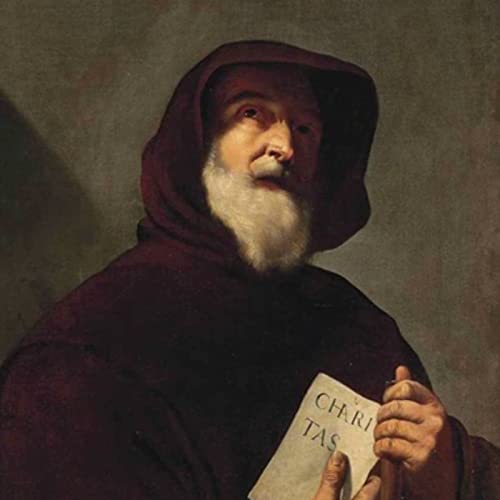
    Today’s saint, the Padre Pio of his era, was a holy priest from the town of Paola in Southern Italy. He was baptized as Francis by his parents when, after several years of going childless, they made a vow to name any son that might be born to them in the great saint’s honor. Francis of Paola was worthy of his namesake from a young age. His parents took special care with his religious upbringing and brought him to live for a year in a Franciscan monastery when Francis was just twelve. The young Francis developed a reputation for holiness even when just a teen. By the age of twenty, he was living as a hermit in a cave near Paola when local men began to gather around him. The fledgling group adopted the name “the Hermits of Brother Francis of Assisi,” a name later changed to the “Friars Minims,” or just “Minims,” meaning  “less” or “least,” in the spirit of the “Lesser Brothers” that Saint Francis of Assisi had founded centuries before.

    Francis of Paola desired humility, nothingness, and total self-abnegation. He and his followers lived a perpetual Lent. All Minims took the usual vows of poverty, chastity, and obedience. But they also took a special fourth vow to abstain, all year long and all life long, from meat, eggs, butter, cheese, milk, and all dairy products. The fast never ended. This was mortification on a heroic scale. Vegetarianism, much less veganism, was a step beyond what Saint Francis of Assisi himself had lived. Saint Francis of Assisi ate what was set before him, including meat. He even criticized vegetarian brothers who refused meat, saying such an attitude questioned God’s providence and presumed the future, when a brother should instead gratefully accept whatever dish was placed on the table before him.

    Francis of Paola’s veganism was united to a strict moral code, a community life built around the Sacraments, and a deep spirituality centered on Jesus Christ. To be “one with nature” does not mean to be morally ambiguous or to break with religious traditions. A diet should not be a creed. Saint Francis was organic in that he lived one with God, with nature, with his religious brothers, and with the Church. Francis was perennially concerned with the moral laxity of the Church of his era, and purposefully fasted and did penance in reparation for its sins. While Francis of Assisi lived austerely and suffered debilitating illnesses, he was nevertheless cheerful and animated in his dealings with others. No one ever accused Francis of Paola of being ebullient. He was a fully armed spiritual warrior of the most serious kind. He went barefoot. He slept on a board. He was a desert father without the sand.

    After a very long life of fasting, prayer, miracle working, and wide fame for his holiness even outside of Italy, Saint Francis of Paola died in France. His order had by then spread throughout Europe. His reputation for sanctity was such that he was canonized in 1519, only twelve years after his death. In 1562 Protestant Calvinists in France unsealed his tomb and found his body incorrupt. They then desecrated the saint, scattering his remains. Saint Francis of Paola, after sacrificing everything in life, was not allowed to rest in peace. He was strewn about like trash, ensuring that only trace relics of him remained. Saint Francis wanted to be treated as the least of all. His desire was fulfilled both in life and in death.

    Saint Francis of Paola, you lived an integrated life deeply united to God, nature, and your fellow man. Intercede before the Trinity in heaven on our behalf, assisting us to grow closer to God through death to self, through prayer, and through a deep attachment to Christ.
    Más Menos
    6 m
  • Palm Sunday of the Passion of the Lord
    Apr 12 2025
    Palm Sunday of the Passion of the Lord
    c. 33 A.D.
    The Sunday before Easter
    Solemnity; Liturgical Color: Red

    Beginning with the end we understand His greatness

    One way to understand a book, or to watch a movie, is to begin at the end. To read, or watch, backwards allows every character and plot twist to be interpreted in light of their conclusions. Working backwards removes much of the drama and tension from a story, of course, but it also makes the story perfectly intelligible. No slow unwinding of the plot, no “whodunit,” no surprise around the corner, and no unexpected deaths. Skipping to the end makes the entire narrative clear, with prior knowledge infusing prior meaning into the story as it unfolds.

    The Gospels of Matthew, Mark, Luke, and John are essentially Passion narratives with extended introductions. There is plenty of evidence that the end of Christ’s life, particularly his last seventy-two hours, were well remembered by His disciples, the events being repeated in great detail until they were ultimately written down. The Evangelists eventually supplemented these often-repeated Passion narratives with further details about Christ’s life which had occurred long before Holy Week. These prior narratives are often inconsistent across the Gospels, emphasize diverse aspects of Christ’s life, and omit or add details in a seemingly arbitrary manner. What are very consistent, however, are the Passion narratives. Their vivid details are, without doubt, the heart and soul of the story of Jesus Christ.

    On Palm Sunday we begin with the end. We read our way backwards. It is not possible for any Christian to think of Jesus Christ divorced from how His earthly life ended. Even the earliest Christian writings were composed from a post-Resurrection perspective. The “real” Jesus of history did not have miracles placed on Him like ornaments on a Christmas tree. His miracles were not later adornments hung on His human frame to lend Him credibility. The “real” Jesus is not the simple carpenter lurking in the shadows behind the Christ of Faith created by later generations. There are scant biblical references to Jesus’ occupation as a carpenter, or to His simple and humble existence in a provincial town. There is a massive amount of biblical evidence, on the contrary, that Jesus suffered, died, and rose from the dead. And this biblical evidence is buttressed by an abundance of postbiblical testimony and the universal witness of an army of Apostles, saints, and martyrs.

    All of this means that the “real” Jesus is the Christ of faith! The “real” Jesus did suffer, die, and rise from the dead! The “real” Jesus is not found in the subtext of the Gospels—He is found in the text of the Gospels! And those texts are indisputably ancient. In other words, the narrative read at Mass on Palm Sunday is the oldest, truest, and most well-remembered portion of one of the most fully preserved and extraordinary documents from the ancient world—the New Testament.

    Our faith is rooted in history, a miraculous history. The Passion of Jesus Christ is not a parable, analogy, or metaphor. It is not a story meant to teach us a lesson apart from its facts. It is not a morality play whose actors mean to teach a lesson. The Passion of Christ is theologically significant because it is historically true. If it were not historically true, it would have no significance beyond its power to inspire as a story. But every culture already has myths to inspire its people, or at least mythical figures whose superhuman qualities model greatness. The story of Christ is so much more. It is the true story of a God-man who was betrayed by a friend, suffered calumny from His enemies, was publicly humiliated, made to carry the instrument of His own execution, and then was left to die, naked on a rough-hewn tree.

    This story is not sad by analogy to another story. It is sad in and of itself. This is the story we hear every Palm Sunday. This is how a great man’s life came to an end. It is also the story of how the Son of God conquered death and opened the gates of heaven to all who not only believe in Him but who belong to Him through the Catholic Church.

    Lord of the Passion, You suffered calumny and humiliation, You bore the Cross and did not complain. Intercede before Your heavenly Father that we may bear whatever crosses we must with fortitude. Without Your grace, we are no better than Godless pagans, in search of frivolous signs to lend meaning to life.
    Más Menos
    6 m
  • March 25: Annunciation of the Lord
    Mar 24 2025
    March 25: Annunciation of the Lord
    Solemnity; Liturgical Color: White

    The flutter of a wing, a rustling in the air, a voice, and the future began to begin

    The Feast of the Annunciation is the reason why we celebrate Christmas on December 25. Christmas comes exactly nine months after the Archangel Gabriel invited the Virgin Mary to be the Mother of God, an event we commemorate on March 25. The dating of these Feast Days, although interesting, is of minor importance compared to their theological significance. It is fruitful to reflect upon the incarnation of Jesus Christ in the womb of the Virgin Mary as the antecedent to the explosion of joy, caroling, gift giving, eating, drinking, love and family unity that surrounds the birth of the Savior. Perhaps Mary had a sort of private and internal Christmas at the moment of the Annunciation. Maybe she felt the fullness of the world’s Christmas joy inside of her own heart when she realized she had been chosen to be the Mother of God.

    God could have become man in any number of creative ways. He could have incarnated Himself just as Adam was in the book of Genesis, by being formed from the clay and having the divine breath blown into his nostrils. Or God could have slowly backed down to earth on a tall golden ladder as a twenty-five-year-old man, ready to walk the highways and byways of Palestine. Or maybe God could have taken flesh in an unknown way and just been found, like Moses, floating in a basket by a childless young couple from Nazareth as they enjoyed a Sunday picnic along the Jordan River.

    The Second Person of the Trinity chose, however, to become man like we all become man. In the same way that He would exit the world through the door of death before His Resurrection, as we all have to do, He also entered the world through the door of human birth. In the words of the early Church, Christ could not redeem what He did not assume. He redeemed everything because He took on human nature in all of its breadth, depth, complexity and mystery. He was like us in all things save sin.

    The incarnation of the Second Person of the Trinity was a self-emptying. It was God becoming small. Imagine a man becoming an ant while retaining his human mind and will. The man-turned-ant would appear to be like all the ants around him, and would participate in all of their ant activities, yet still think at a level far above them. There was no other way to do it. The man had to learn through becoming, not because insect life was superior to his own, but because it was inferior. Only through descending, only through experience, could the man learn what was below him. All analogies limp, but, in a similar way, the Second Person of the Trinity retained His infused divine knowledge while reducing Himself to a man and learning man life, doing man work, and dying a man death. By such a self-emptying, He dignified all men and opened to them the possibility of entering into His higher life in Heaven.

    The Church’s tradition speculates that one reason the bad angels may have rebelled against God was the besetting sin of envy. They may have discovered that God chose to become man instead of the higher form of an angel. This envy would have been directed at the Virgin Mary as well, that Vessel of Honor and Ark of the Covenant who bore the divine choice. God not only became man, we must remember, but did so through a human being, one prepared from her conception to be perfect. March 25 is one of only two days of the year when we kneel at the recitation of the Creed at Mass. At the words “...by the Holy Spirit was incarnate of the Virgin Mary and became man” all heads bow and all knees bend at the wonder of it. If the story of Christ is the greatest story ever told, today is its first page.

    O Holy Virgin Mary, we ask your intercession to make us as generous as you in accepting the will of God in our lives, especially when that will is expressed in mysterious ways. May you be our example of a generous response to what God desires of us.
    Más Menos
    6 m
  • March 23: Saint Turibius of Mogrovejo, Bishop
    Mar 23 2026
    March 23: Saint Turibius of Mogrovejo, Bishop 1538–1606 Optional Memorial; Liturgical Color: Violet (Lenten Weekday) Patron Saint of Latin American Bishops and native people’s rights He died in the field six thousand miles from home Today’s saint was the second Archbishop of the second most important city in Spain’s Latin American empire in the 1500s. Lima, Peru, stood only behind Mexico City in importance to the Spanish Crown during the pinnacle of its colonial ambitions. So when Lima’s first Archbishop died in 1575, the King of Spain, not the Pope, searched for a suitable candidate to send over sea and land to replace him. The King found his man close at hand, and he was more than suitable to the task. Turibius of Mogrovejo was a learned scholar of the law who held teaching and other posts in Spain’s complex of Church and civil courts. Yet for all his learning, piety, faith, and energy, there was one huge obstacle to him being a bishop. Turibius was not a priest. He was not even a deacon. He was a very good, albeit unmarried, layman. The arrangement for centuries between Spain and the Holy See was that the Spanish Crown chose bishops while the Pope approved, or rejected, them. So after the Pope approved the appointment, over the candidate’s fierce objections, Turibius received the four minor orders on four successive weeks, was ordained a deacon and then ordained a priest. He said his first Mass when he was over forty years old. About two years later, Turibius was consecrated as the new archbishop, and then sailed the ocean blue, arriving in Lima in May 1581. Archbishop Turibius was extraordinarily dedicated to his episcopal responsibilities. He exhausted himself on years-long visits to the parishes of his vast territory, which included present day Peru and beyond. He acquainted himself with the priests and people under his care. He convoked synods (large Church meetings) to standardize sacramental, pastoral, and liturgical practice. He produced an important trilingual catechism in Spanish and two native dialects, learned to preach in these indigenous dialects himself, and encouraged his priests to be able to hear confessions and preach in them as well. Archbishop Turibius’ life also providentially intersected with the lives of other saints active in Peru at the same time, including Martin de Porres, Francisco Solano, and Isabel Flores de Oliva, to whom Turibius gave the name Rose when he confirmed her. She was later canonized as Saint Rose of Lima, the first saint born in the New World. Saints know saints. Archbishop Turibius was a fine example of a counter-reformation bishop, except that he did not serve in a counter-reformation place. That is, Peru was not split by the Catholic versus Protestant theological divisions wreaking such havoc in the Europe of that era. Saint Turibius implemented the reforms of the Council of Trent, not to combat heretics, but to simply make the Church healthier and holier, Protestants or no Protestants. From this perspective, the reforms of Trent were not a cure but an antidote. If Turibius’ energy and holiness were motivated by any one thing besides evangelical fervor, it was his desire to make the Spanish colonists of Peru recover the integrity of their own baptisms. The indigenous population needed authentic examples of Christian living to respect and emulate, and few Spanish colonialists provided such models of right living. Saint Turibius’ greatest enemy, then, was simply original sin, which returns to the battlefield every time a baby is born. After exhausting himself through total dedication to his responsibilities, Saint Turibius fell ill on the road and died at age sixty-seven in a small town far from home. His twenty-four years as Archbishop were a trial of strength. He had baptized and confirmed half a million souls, had trekked thousands of miles on narrow paths made for goats, had never neglected to say Mass, and did not accept any gifts in return for what he gave. Turibius was canonized in 1726 and named the Patron Saint of Latin American Bishops by Pope Saint John Paul II in 1983. Perhaps his unforeseen ordination explains his sustained fervor and drive. What came late was valued for having come at all. He bloomed late and bloomed beautifully, becoming the Spanish equivalent of his great contemporary, the Italian Saint Charles Borromeo. If a visitor searches for the tomb of the saintly Archbishop in the Cathedral of Lima today, he will not find it. There are only fragments of bones in a reliquary. His reputation for holiness was immediate and his relics were distributed far and wide after his death. He is in death as widely shared as he was in life, all the faithful wanting just a piece of the great man. In January 2018, Pope Francis prayed before the relics of Saint Turibius in Lima and invoked his memory in a talk to Peru’s bishops. Saint Turibius did not, Pope Francis said, shepherd his diocese from behind a desk but was “a ...
    Más Menos
    7 m