

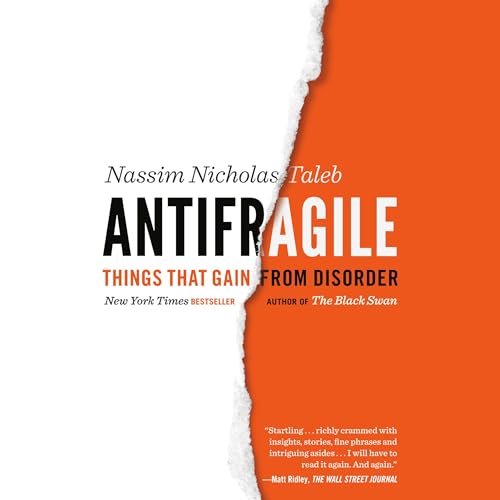
Antifragile
Things That Gain from Disorder
No se pudo agregar al carrito
Solo puedes tener X títulos en el carrito para realizar el pago.
Add to Cart failed.
Por favor prueba de nuevo más tarde
Error al Agregar a Lista de Deseos.
Por favor prueba de nuevo más tarde
Error al eliminar de la lista de deseos.
Por favor prueba de nuevo más tarde
Error al añadir a tu biblioteca
Por favor intenta de nuevo
Error al seguir el podcast
Intenta nuevamente
Error al dejar de seguir el podcast
Intenta nuevamente
Obtén 30 días de Standard gratis
$8.99 al mes después de que termine la prueba. Cancela en cualquier momento

Antifragile
Narrado por:
Joe Ochman
Compra ahora por $20.25
-
Narrado por:
-
Joe Ochman
Nassim Nicholas Taleb, the bestselling author of The Black Swan and one of the foremost thinkers of our time, reveals how to thrive in an uncertain world.
Just as human bones get stronger when subjected to stress and tension, and rumors or riots intensify when someone tries to repress them, many things in life benefit from stress, disorder, volatility, and turmoil. What Taleb has identified and calls “antifragile” is that category of things that not only gain from chaos but need it in order to survive and flourish.
In The Black Swan, Taleb showed us that highly improbable and unpredictable events underlie almost everything about our world. In Antifragile, Taleb stands uncertainty on its head, making it desirable, even necessary, and proposes that things be built in an antifragile manner. The antifragile is beyond the resilient or robust. The resilient resists shocks and stays the same; the antifragile gets better and better.
Furthermore, the antifragile is immune to prediction errors and protected from adverse events. Why is the city-state better than the nation-state, why is debt bad for you, and why is what we call “efficient” not efficient at all? Why do government responses and social policies protect the strong and hurt the weak? Why should you write your resignation letter before even starting on the job? How did the sinking of the Titanic save lives? The book spans innovation by trial and error, life decisions, politics, urban planning, war, personal finance, economic systems, and medicine. And throughout, in addition to the street wisdom of Fat Tony of Brooklyn, the voices and recipes of ancient wisdom, from Roman, Greek, Semitic, and medieval sources, are loud and clear.
Antifragile is a blueprint for living in a Black Swan world.
Erudite, witty, and iconoclastic, Taleb’s message is revolutionary: The antifragile, and only the antifragile, will make it.
Includes a bonus PDF of supplemental charts and graphics
Please note that that bleeps in the audio are intentional and are as written by the author. No material is censored, and no audio content is missing.
Praise for Antifragile
“Ambitious and thought-provoking . . . highly entertaining.”—The Economist
“A bold book explaining how and why we should embrace uncertainty, randomness, and error . . . It may just change our lives.”—Newsweek
Los oyentes también disfrutaron:




adbl_web_anon_alc_button_suppression_c
Reseñas de la Crítica
“Ambitious and thought-provoking . . . highly entertaining.”—The Economist
“A bold book explaining how and why we should embrace uncertainty, randomness, and error . . . It may just change our lives.”—Newsweek
“Revelatory . . . [Taleb] pulls the reader along with the logic of a Socrates.”—Chicago Tribune
“Startling . . . richly crammed with insights, stories, fine phrases and intriguing asides . . . I will have to read it again. And again.”—Matt Ridley, The Wall Street Journal
“Trenchant and persuasive . . . Taleb’s insatiable polymathic curiosity knows no bounds. . . . You finish the book feeling braver and uplifted.”—New Statesman
“Antifragility isn’t just sound economic and political doctrine. It’s also the key to a good life.”—Fortune
“At once thought-provoking and brilliant.”—Los Angeles Times
“[Taleb] writes as if he were the illegitimate spawn of David Hume and Rev. Bayes, with some DNA mixed in from Norbert Weiner and Laurence Sterne. . . . Taleb is writing original stuff—not only within the management space but for readers of any literature—and . . . you will learn more about more things from this book and be challenged in more ways than by any other book you have read this year. Trust me on this.”—Harvard Business Review
“By far my favorite book among several good ones published in 2012. In addition to being an enjoyable and interesting read, Taleb’s new book advances general understanding of how different systems operate, the great variation in how they respond to unthinkables, and how to make them more adaptable and agile. His systemic insights extend very well to company-specific operational issues—from ensuring that mistakes provide a learning process to the importance of ensuring sufficient transparency to the myriad of specific risk issues.”—Mohamed El-Erian, CEO of PIMCO, Bloomberg
“A bold book explaining how and why we should embrace uncertainty, randomness, and error . . . It may just change our lives.”—Newsweek
“Revelatory . . . [Taleb] pulls the reader along with the logic of a Socrates.”—Chicago Tribune
“Startling . . . richly crammed with insights, stories, fine phrases and intriguing asides . . . I will have to read it again. And again.”—Matt Ridley, The Wall Street Journal
“Trenchant and persuasive . . . Taleb’s insatiable polymathic curiosity knows no bounds. . . . You finish the book feeling braver and uplifted.”—New Statesman
“Antifragility isn’t just sound economic and political doctrine. It’s also the key to a good life.”—Fortune
“At once thought-provoking and brilliant.”—Los Angeles Times
“[Taleb] writes as if he were the illegitimate spawn of David Hume and Rev. Bayes, with some DNA mixed in from Norbert Weiner and Laurence Sterne. . . . Taleb is writing original stuff—not only within the management space but for readers of any literature—and . . . you will learn more about more things from this book and be challenged in more ways than by any other book you have read this year. Trust me on this.”—Harvard Business Review
“By far my favorite book among several good ones published in 2012. In addition to being an enjoyable and interesting read, Taleb’s new book advances general understanding of how different systems operate, the great variation in how they respond to unthinkables, and how to make them more adaptable and agile. His systemic insights extend very well to company-specific operational issues—from ensuring that mistakes provide a learning process to the importance of ensuring sufficient transparency to the myriad of specific risk issues.”—Mohamed El-Erian, CEO of PIMCO, Bloomberg
Continuar la serie


Las personas que vieron esto también vieron:


Superb work of scholarship
Se ha producido un error. Vuelve a intentarlo dentro de unos minutos.
Would you recommend this audiobook to a friend? If so, why?
I like Taleb's books, that's because I like his story.But this time I don't get it. The story gets lost when a annoying beep makes me lose my train of thought.
Is this recording defective?
Or am I missing something here.
I'll try to ask for my money back.
Any additional comments?
I always go for unabridged.Should I now also find out if the book was messed up by beepling idiots?
Somehow it's defective. Containing annoying beeps.
Se ha producido un error. Vuelve a intentarlo dentro de unos minutos.
Necessity for anyone who wants to make decisions
Se ha producido un error. Vuelve a intentarlo dentro de unos minutos.
Fundamentally correct
Se ha producido un error. Vuelve a intentarlo dentro de unos minutos.
Wisdom quantified. Unbridled thought.
Se ha producido un error. Vuelve a intentarlo dentro de unos minutos.