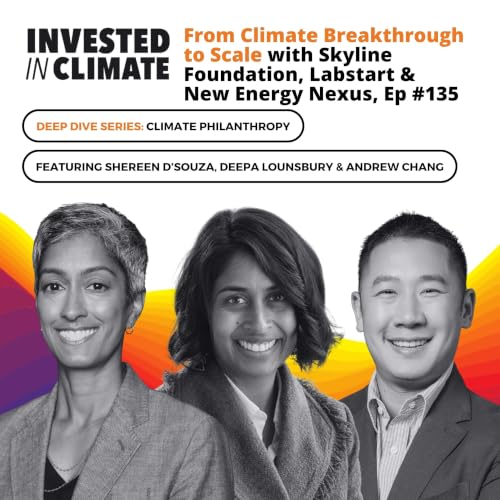
Invested In Climate Podcast Por Jason Rissman arte de portada

Invested In Climate

Invested In Climate

De: Jason Rissman
Escúchala gratis

OFERTA POR TIEMPO LIMITADO

$0.99/mes durante los primeros 3 meses. Consulta términos y condiciones.
Invested in Climate hosts conversations with leading thinkers to help our listeners do more to address the climate crisis through their Work, Investments, Learning, Lifestyle and Activism. People everywhere, communities, governments and all sectors of the economy are mobilizing to address climate change. The scale of this global action is unprecedented. Never before have so many people dedicated so much energy, creativity and capital to addressing a shared, global threat. Will it be enough? What else is needed? And, most importantly, what can you do? We all have a part to play, so let’s go.Copyright 2026 Jason Rissman Economía Finanzas Personales Gestión y Liderazgo Liderazgo
Episodios
  • Activating Climate Capital at Scale: Conduit's Unconventional Playbook, Ep #136
    Jul 14 2026
    The climate transition will require trillions of dollars of investment, but many of the biggest opportunities still face structural financing barriers because our financial system was not designed for a challenge of this scale and complexity. As investors, entrepreneurs, and institutions work to accelerate the transition, there is a growing need for new financial models that can bridge those gaps and unlock capital more effectively.Today, we’re joined by Bob Zulkoski of Conduit Capital, a firm taking a very different approach to climate finance. Rather than building one big fund, Conduit is creating platforms designed to unlock private capital at scale — from financing energy-efficiency upgrades in commercial real estate, to launching climate-transition SPACs, to developing a new blended-finance vehicle aimed at helping impact investment managers bridge what Bob calls the “Pioneer Gap.” Bob calls the model radical collaboration, and the goal is not just to invest well, but to prove new models that others can replicate.On today’s episode, we cover:1:19 – Framing the Climate Finance Challenge and Introducing Bob Zulkoski2:34 – What Is Conduit Capital? Vision and Radical Collaboration3:48 – Replication as Theory of Change: Paving the Way for Competition5:23 – Business Model: Non‑Concessionary, Patient, Impact at Scale6:41 – Introducing Sustainable Credit Partners (SCP) and Mid‑Market CRE8:09 – The Retrofit Problem: Aging Buildings, Spiking Energy Costs, Brown Discount10:04 – SCP’s Lending Model: Easier, Cheaper, Faster for Borrowers11:34 – Underwriting + GreenGen Partnership and Education Role13:55 – SCP Traction: Origination Targets, Pipeline, Institutional Capital16:02 – Loan Sizes, Typical Collateral, and Brown Discount Mitigation16:48 – Three “Superpowers”: Market Familiarity, GreenGen + Climate First Bank, Moody’s19:53 – Who Else Should Do This? Scaling via Competition and Green CLOs22:48 – Introducing Climate Transition SPACs and Market Backdrop23:01 – Rethinking SPACs: Tool for Climate Transition and Valuation Gaps27:37 – First SPAC: Energy Transition Special Opportunities and Target Sectors29:48 – Why Regenerative Agriculture Belongs in Climate SPACs32:19 – Defining the Pioneer Gap vs. Missing Middle/Valley of Death35:30 – The Pioneer Gap Impact Platform Fund and Alliance Structure37:50 – Blended Finance Stack: Catalytic, Mezzanine, and Market Capital39:08 – Why This Is the “Best of Times” for Climate Investing41:40 – Closing ReflectionsResources MentionedSustainable Credit Partners (SCP)GreenGenMoody’s Investors Service Climate First BankC‑PACE (Commercial Property Assessed Clean Energy) Climate Transition Special Opportunities SPACSpring Lane CapitalPioneer Gap Alliance & Pioneer Gap Impact Platform Fund Connect with usBob ZulkoskiJason RissmanKeep up with Invested In ClimateSign up for our NewsletterSubscribe for our Other Future NewsletterLinkedInInstagramIf you like what you hear, subscribe and rate to support the show! Have feedback or ideas for future episodes, events, or partnerships? Get in touch!
    Más Menos
    42 m
  • From Climate Breakthrough to Scale with Skyline Foundation, LabStart & New Energy Nexus, Ep #135
    Jun 23 2026
    Climate philanthropy does far more than fund advocacy and conservation—it bridges critical funding gaps for breakthrough technologies that traditional, financially driven investors often overlook. In this special episode, we continue our ongoing Climate Philanthropy series in partnership with the Skyline Foundation to explore how non-profit support accelerates the climate tech pipeline.Shereen D’Souza (Climate Solutions Portfolio Lead at Skyline Foundation) sits down with two powerhouse CEOs from her grantee portfolio, Deepa Lounsbury of LabStart and Andrew Chang of New Energy Nexus, to discuss what it really takes to move climate innovation from a university lab to global deployment.Why This Episode MattersBringing a "hard tech" climate startup from initial lab concept to commercial scale takes an average of 10 years, and every single step of that journey faces a unique "valley of death." Because scaled deployment looks drastically different depending on the geography, supporting entrepreneurs requires a highly specialized ecosystem.This conversation highlights how philanthropy strategically funds distinct, critical phases of the lab-to-market pipeline to scale viable climate solutions faster.On today’s episode, we cover:0:58 – Why climate philanthropy & Skyline partnership3:35 – LabStart vs. New Energy Nexus focus4:09 – Guest intros: Deepa (LabStart) & Andrew (New Energy Nexus)4:46 – Deepa’s background in climate, VC, and CalSEED6:20 – What LabStart does & “deep climate tech” focus8:02 – Andrew’s overview of New Energy Nexus global model9:43 – Programs: bootcamps, grants, CalSEED, and global south focus11:16 – What it looks like to be a New Energy Nexus entrepreneur11:54 – Philippines rooftop solar opportunity: Solar Innovation Program12:48 – Pakistan rooftop solar boom and Climate Innovation Pakistan13:40 – CalSEED structure and impact in California13:58 – What it looks like to be a LabStart entrepreneur14:55 – LabStart Discover and Launch phases15:54 – Why philanthropy is needed in climate tech innovation18:36 – Philanthropy in the global south and hyperlocal impact22:10 – LabStart success story: architect-turned-3D housing founder24:32 – Additional LabStart founders and outcomes25:25 – How much philanthropic capital is needed27:17 – IEA investment gap and catalytic examples from Indonesia29:43 – Why fund new technologies vs. only deployment32:06 – How country pathways shape New Energy Nexus engagement33:02 – California deployment example: ThermoShade33:58 – Indonesia fishermen & electric motorboats case: Volto Sea34:51 – Pakistan PakPlug EV charging app35:22 – What else the ecosystem needs: Andrew on subnational governments37:34 – What else the ecosystem needs: Deepa on IP & ecosystem gaps41:02 – Five-year vision & asks: Deepa and LabStart43:49 – Five-year vision & asks: Andrew and New Energy Nexus47:26 – Closing thanks from ShereenResources MentionedInvested in Climate: Climate Philanthropy seriesSkyline FoundationLabStartNew Energy NexusProject DrawdownJamil WyneCalSEED Solar Innovation ProgramClimate Innovation Pakistan CalTestBedAusTestbedThermoShade Swap Energy Xuraya Volto SeaPakPlug Schmidt Family Foundation Boundless EarthAtlassian Foundation California Energy Commission (CEC) New York State Energy Research and Development Authority (NYSERDA)Mubadala Investment Company (Abu Dhabi) Australian Renewable Energy Agency (ARENA)International Energy Agency (IEA)Elemental ImpactActivate Renewables FirstConnect with usShereen D’SouzaDeepa LounsburyAndrew ChangJason RissmanKeep up with Invested In ClimateSign up for our NewsletterSubscribe for our Other Future NewsletterLinkedInInstagramIf you like what you hear, subscribe and rate to support the show! Have feedback or ideas for future episodes, events, or partnerships? Get in touch!
    Más Menos
    48 m
  • Investing in the Supply Chain behind Renewables with MUUS, Ep #134
    Jun 9 2026
    Today, we’re diving into a part of the climate transition that doesn’t get nearly as much attention as solar panels, electric vehicles, or AI: the materials, minerals, and manufacturing systems that make modern civilization possible. Steel alone accounts for roughly 7–8% of global greenhouse gas emissions, and the energy transition is driving unprecedented demand for critical minerals, advanced materials, and domestic manufacturing capacity. These sectors offer incredible investment opportunities, and that’s the focus of my guest, Kavita Patel. Kavita is a portfolio manager for venture investment for MUUS & Company (MUUS), the family office of TIGER 21 Founder and Chairman, Michael Sonnenfeldt, and his family.We discuss opportunities ranging from critical mineral recycling to next-generation building materials, what she’s learned investing through the ups and downs of climate tech, and why she believes some of the most compelling opportunities today may be hiding in sectors many investors overlook.We also explore where climate capital is flowing, where it may be underinvesting, and how investors can think rigorously about both financial returns and real-world climate impact.I learned a lot from this conversation, and I think you will too. Here we go. On today’s episode, we cover:01:12 – Introducing guest: Kavita Patel of MUUS & Company02:35 – Kavita’s background and path into climate investing05:24 – From BlackRock and ESG to climate venture07:19 – What is MUUS & Company? Climate thesis and focus areas09:35 – Why critical minerals, materials, and domestic manufacturing11:30 – Is materials & mining underhyped for investors? Market overview13:17 – Venture timelines in hardware and industrial innovation15:13 – Portfolio example #1: Nth Cycle’s critical minerals recycling18:28 – Mining’s environmental impact and why focus on recycling20:08 – Portfolio example #2: InventWood as a low‑carbon steel replacement22:53 – No green premium: solving top pain points in B2B climate tech23:03 – Where climate capital is flowing vs. where it should go25:22 – What Kavita has learned from founders through market cycles29:01 – Common fundraising pitfalls for climate founders32:20 – Building the capital stack: partners, family offices, and non‑dilutive capital35:15 – Measuring impact: MUUS’ use of the Crane tool38:16 – Closing thoughts Resources MentionedMUUS & Company (MUUS)TIGER 21Nth Cycle (critical minerals refining & recycling)Trafigura (metals & commodities trading group)InventWood (wood-based high‑performance material)CRANE – Carbon Reduction Assessment for New EnterprisesInternational Energy Agency (IEA)Connect with usKavita PatelJason RissmanKeep up with Invested In ClimateSign up for our NewsletterSubscribe for our Other Future NewsletterLinkedInInstagramIf you like what you hear, subscribe and rate to support the show! Have feedback or ideas for future episodes, events, or partnerships? Get in touch!
    Más Menos
    39 m
adbl_web_anon_alc_button_suppression_t1
Todavía no hay opiniones