

Why We Work
No se pudo agregar al carrito
Solo puedes tener X títulos en el carrito para realizar el pago.
Add to Cart failed.
Por favor prueba de nuevo más tarde
Error al Agregar a Lista de Deseos.
Por favor prueba de nuevo más tarde
Error al eliminar de la lista de deseos.
Por favor prueba de nuevo más tarde
Error al añadir a tu biblioteca
Por favor intenta de nuevo
Error al seguir el podcast
Intenta nuevamente
Error al dejar de seguir el podcast
Intenta nuevamente
Obtén 30 días de Standard gratis
$8.99 al mes después de que termine la prueba. Cancela en cualquier momento

Why We Work
Narrado por:
Barry Schwartz
Compra ahora por $11.24
-
Narrado por:
-
Barry Schwartz
-
De:
-
Barry Schwartz
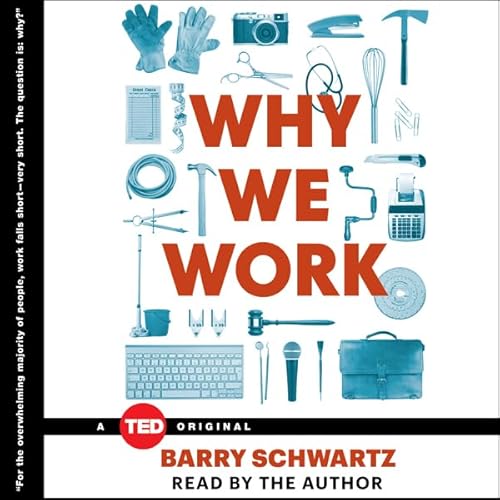
Why do we work? The question seems so simple. But Professor Barry Schwartz proves that the answer is surprising, complex, and urgent.
We’ve long been taught that the reason we work is primarily for a paycheck. In fact, we’ve shaped much of the infrastructure of our society to accommodate this belief. Then why are so many people dissatisfied with their work, despite healthy compensation? And why do so many people find immense fulfillment and satisfaction through “menial” jobs? Schwartz explores why so many believe that the goal for working should be to earn money, how we arrived to believe that paying workers more leads to better work, and why this has made our society confused, unhappy, and has established a dangerously misguided system.
Through fascinating studies and compelling anecdotes, this book dispels this myth. Schwartz takes us through hospitals and hair salons, auto plants and boardrooms, showing workers in all walks of life, showcasing the trends and patterns that lead to happiness in the workplace. Ultimately, Schwartz proves that the root of what drives us to do good work can rarely be incentivized, and that the cause of bad work is often an attempt to do just that.
How did we get to this tangled place? How do we change the way we work? With great insight and wisdom, Schwartz shows us how to take our first steps toward understanding, and empowering us all to find great work.
Los oyentes también disfrutaron:


adbl_web_anon_alc_button_suppression_c
Las personas que vieron esto también vieron:


New believes give new hopes for modern generations
Se ha producido un error. Vuelve a intentarlo dentro de unos minutos.
groundbreakingly subversive
Se ha producido un error. Vuelve a intentarlo dentro de unos minutos.
better as it goes on....
Se ha producido un error. Vuelve a intentarlo dentro de unos minutos.
Particularly at large industrial companies, we need to consider that the company does more than just make profits for its investors. Ultimate efficiency, where employee engagement is reduced to doing exactly and precisely the instructed task leads to disengaged employees who have no vested interest in improvement of their condition which in turn leads to reduced innovation and higher worker turnover. Mr. Schwartz's suggestions to develop committed employees would benefit all businesses.
I rated the performance 3 stars because the audio levels varied considerably and made it distracting to have to adjust the volume frequently to accommodate.
All corporate execs should get this message
Se ha producido un error. Vuelve a intentarlo dentro de unos minutos.
Good book for those interested in learning social sciences
Se ha producido un error. Vuelve a intentarlo dentro de unos minutos.