


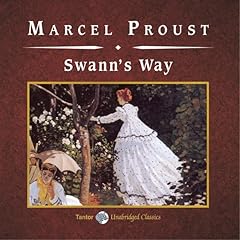
Swann's Way
No se pudo agregar al carrito
Add to Cart failed.
Error al Agregar a Lista de Deseos.
Error al eliminar de la lista de deseos.
Error al añadir a tu biblioteca
Error al seguir el podcast
Error al dejar de seguir el podcast
Obtén 30 días de Standard gratis

Swann's Way
Compra ahora por $28.14
-
Narrado por:
-
George Guidall
Swann’s Way is the first and best-known part of Proust’s monumental work, Remembrance of Things Past. Often compared to a symphony, this complex masterpiece is ideally suited for audio. Listening lets you appreciate anew the incredible beauty of Proust’s language and the uniqueness of his style. The novel’s narrator, Marcel, finds the true meaning of experience in memories stimulated by some random object or event. He recalls his childhood, and eventually reconstructs the story of Monsieur Swann and his passion for Odette, a beautiful, but socially inferior woman. Marcel’s waking reverie gives rise to fascinating questions about the meaning of time. Swann’s Way, with its long passages of intricate introspection, becomes much more accessible and enjoyable with George Guidall’s lucid narration.—Includes an exclusive interview with Mary Ann Caws, Distinguished Professor of English, French, and Comparative Literature at CUNY.
Public Domain (P)1999 Recorded Books, LLCLos oyentes también disfrutaron:


Reseñas editoriales
Recorded Books has selected a narrator who makes Proust light-going, if that's imaginable. George Guidall draws us into the banter and gossip of the provincial French bourgeoisie; he makes us feel as if we were at the table with Marcel's family or sharing the parlor with Monsieur Swann's coterie. More impressive still is the ease with which he handles even the most difficult exposition. Try, for instance, Guidall's rendition of "Combray," a complex meditation on Marcel's childhood at his family's country home. What might have been sleep-inducing becomes a haunting, even mesmerizing, experience - the mark of a virtuoso audiobook narrator.
Continuar la serie


Las personas que vieron esto también vieron:


It’s a treat finally to encounter In Search of Time. I’ve already queued up the second and third volumes and can’t wait to get to them.
The narration is ok. Guidall is better at performing stories in which he doesn’t have the challenge of reading as too many characters, and he doesn’t here He, thus, manages well.
Brilliant Literature
Se ha producido un error. Vuelve a intentarlo dentro de unos minutos.
George Guidall - as always - performs the work so vividly and warmly.
A good read for the right mood
Se ha producido un error. Vuelve a intentarlo dentro de unos minutos.
Priceless Proust Performance.
Se ha producido un error. Vuelve a intentarlo dentro de unos minutos.
Nothing like it
Se ha producido un error. Vuelve a intentarlo dentro de unos minutos.
Would you listen to Swann's Way again? Why?
I have listened to it repeatedly, and will again. I dread ever losing my downloaded copies, or access to download it again.What was the most interesting aspect of this story? The least interesting?
I am in awe of the duplication of the way the mind works and how well Proust has managed to capture the feeling of wandering thoughts.There isn't really much story, just a string of vignettes as remembrances (of, as it says on the tin, time lost) tied together by introspection and fleeting philosophical statements.I can't say I find it interesting, precisely; too much interest would ruin the effect it has on me. I find it familiar. I recognize the patterns of thought and reminiscence as if they belonged to a me who lived a completely different life. It's soothing, pleasant, anxious in places but never alarming, always mild, always faintly dreamy. I can't really vouch much for the story, however; because of its effect on me and its place in my life, I've never read or heard it all the way through. I only know it as a series of descriptions and reflections, held together by thematically-smooth transitions but never progressing forward together as any type of plot.
Did you have an extreme reaction to this book? Did it make you laugh or cry?
It makes me sleep. My extreme reaction to this book is falling asleep, usually promptly, and falling back to sleep quickly and pleasantly every time I awake during the night. This is a literally unprecedented reaction for me.I have used this particular book, and especially this particular recording -- with Guidall's calmly-inflected, soothing voice -- as a soporific for seven years and counting. It never fails to put me to sleep. I've had multiple types of insomnia since I was an infant, and I'm now in my 40s; no pill, habit, tea, clothing, or environmental arrangement recommended by anyone from parents to doctors to sleep specialists has ever managed to put me to sleep more peacefully and reliably than this recording does.
Any additional comments?
I don't want to give the impression that I don't like this book, or this recording, by emphasizing that it puts me to sleep. I don't even want to give the impression that I find it boring, although someone who wants a bit more action (or even dialogue) would probably find it so.The writing is masterful at achieving its goal, however terrible it is at being anything it isn't trying to be. It's a stunning tapestry of musings and recollections, loosely strung together, the internal monologue of a man looking back on his life.
The narration is outstanding, even accounting for the narrator himself being one of my personal favorites, and the narrator is ideally-suited to the tone, pace, and themes of the content.It's superb.
It's just that I have a neurological disability that makes spoken words difficult for me to understand, and after too long listening for comprehension without something to occupy my eyes and hands, my brain gives up and switches off and I go to sleep. I usually buy ebooks and audiobooks in pairs, and the "Immersion Reading" feature of Kindles makes this even easier for me. It helps me practice things that can partially compensate for my disability, like understanding certain accents, or using small gestures to help myself keep track of long, intricate sentences. Listening to audiobooks with the Kindle screen turned off are a great way for me to get to sleep, although I will wake up later in the story when the plot picks up and the narrator's voice shows appropriate excitement.
That never happens in this book. There's never really a point where it's appropriate for the narrator to raise his voice enough or speak fast enough to wake me. I drop off somewhere around waiting for Mama's goodnight kiss, or on a very bad night, the magic lantern; I wake up again in time to hear about the madeleine dunked in tea, and drop back off again. There's no need for me to set a sleep timer; the audiobook shutting off would wake me, while the soporific reading keeps me asleep all night (however lightly at points) and gives me quiet, stately scenes for my dreams to recreate when I would otherwise be in danger of waking.
The prose is lovely, and the reminiscences are honest enough to be utterly credible and meticulously detailed enough to feel as if they are my own. The narrator and narration are ideal for the content. For someone who doesn't have a sleep disability to overcome, and a hearing disability to wield against it, it would be a lovely listen. For me, though, it's a very specific and useful tool, dreamy and pleasant, and I cannot bring myself to read the book while staying awake for fear of spoiling the effect while I sleep.
How fitting that it opens on a scene of an insomniac fitfully trying to sleep through the night:
"For a long time I used to go to bed early. Sometimes, when I had put out my candle, my eyes would close so quickly that I had not even time to say 'I’m going to sleep.' And half an hour later the thought that it was time to go to sleep would awaken me; I would try to put away the book which, I imagined, was still in my hands, and to blow out the light; I had been thinking all the time, while I was asleep, of what I had just been reading, but my thoughts had run into a channel of their own, until I myself seemed actually to have become the subject of my book: a church, a quartet, the rivalry between François I and Charles V...
"I would fall asleep, and often I would be awake again for short snatches only, just long enough to hear the regular creaking of the wainscot, or to open my eyes to settle the shifting kaleidoscope of the darkness, to savour, in an instantaneous flash of perception, the sleep which lay heavy upon the furniture, the room, the whole surroundings of which I formed but an insignificant part and whose unconsciousness I should very soon return to share. Or, perhaps, while I was asleep I had returned without the least effort to an earlier stage in my life, now for ever outgrown; and had come under the thrall of one of my childish terrors, such as that old terror of my great-uncle’s pulling my curls, which was effectually dispelled on the day–the dawn of a new era to me–on which they were finally cropped from my head. I had forgotten that event during my sleep; I remembered it again immediately I had succeeded in making myself wake up to escape my great-uncle’s fingers; still, as a measure of precaution, I would bury the whole of my head in the pillow before returning to the world of dreams.
"...When a man is asleep, he has in a circle round him the chain of the hours, the sequence of the years, the order of the heavenly host. Instinctively, when he awakes, he looks to these, and in an instant reads off his own position on the earth’s surface and the amount of time that has elapsed during his slumbers; but this ordered procession is apt to grow confused, and to break its ranks. Suppose that, towards morning, after a night of insomnia, sleep descends upon him while he is reading, in quite a different position from that in which he normally goes to sleep, he has only to lift his arm to arrest the sun and turn it back in its course, and, at the moment of waking, he will have no idea of the time, but will conclude that he has just gone to bed. Or suppose that he gets drowsy in some even more abnormal position; sitting in an armchair, say, after dinner: then the world will fall topsy-turvy from its orbit, the magic chair will carry him at full speed through time and space, and when he opens his eyes again he will imagine that he went to sleep months earlier and in some far distant country."
It's like this book, and thus this recording, is a love letter written from one person's sleep -- and insomnia -- to another's.
Best cure for insomnia; lovely, but not fast-paced
Se ha producido un error. Vuelve a intentarlo dentro de unos minutos.