


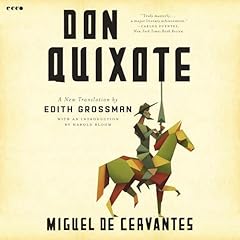
Don Quixote
Translated by Edith Grossman
No se pudo agregar al carrito
Add to Cart failed.
Error al Agregar a Lista de Deseos.
Error al eliminar de la lista de deseos.
Error al añadir a tu biblioteca
Error al seguir el podcast
Error al dejar de seguir el podcast
Prueba gratis de 30 días de Audible Standard

Don Quixote
Compra ahora por $31.58
-
Narrado por:
-
George Guidall
Don Quixote is the classic story. Called the first modern novel, this marvelous book has stood the test of time to become irrevocably intertwined with the fabric of society. Sixteenth-century Spanish gentleman Don Quixote, fed by his own delusional fantasies, takes to the road in search of chivalrous adventures. But his quest leads to more trouble than triumph. At once humorous, romantic, and sad, Don Quixote is a literary landmark. This fresh edition, by award-winning translator Edith Grossman, brings the tale to life as never before.
©2003 Edith Grossman (translation) (P)2003 Recorded BooksLos oyentes también disfrutaron:


![The Brothers Karamazov [Naxos AudioBooks Edition] Audiolibro Por Constance Garnett - translator, Fyodor Dostoevsky arte de portada](https://m.media-amazon.com/images/I/51DpA-g11JL._SL240_.jpg)


Editorial review
By Seth Hartman, Audible Editor
DON QUIXOTE IS AN EPIC QUEST FOR THE SAKE OF IMAGINATION
I was introduced to the epic journey of Don Quixote in my 10th-grade English class. Being no stranger to stories of wandering heroes (stuff like The Odyssey and Gilgamesh), I thought I knew what to expect. The summary evoked images of knights, dragons, and fair maidens, so this book seemed to be a standard dose of medieval-style fantasy. What I got when I cracked open Don Quixote was certainly fantastical, but unlike any fiction I had experienced before it.
This legend begins with Alonso Quixano, a somewhat wealthy but otherwise average man with big dreams. Inspired by the romantic exploits of knights, he assumes the moniker "Don Quixote de la Mancha" and dons an ill-fitting, creaky set of armor. Riding his old work horse Rocinante, he decides that he is going to begin an epic quest for the favor of Dulcinea, a fair maiden he conjured up out of thin air. On his journey, Don Quixote creates fantasy after fantasy, clinging desperately to the image of a knight that he invented for himself.
This story does not only take place from the perspective of a delusional man, however. On his travels, Don Quixote enlists the help of a peasant named Sancho Panza, promising him his own castle and riches beyond his wildest imagination. Sancho quickly sees the truth of the matter, almost pitying the Don for his lofty pipe dreams. Yet eventually, he gets wrapped up in the fantasy too, hoping against his better logic that this quest will work out for them both.
While some people see Don Quixote as a warning to keep both feet in the real world, I see things a bit differently. Despite his obvious delusions of grandeur, I think there is something noble about this quest. Don Quixote is a man who is willing to believe in himself no matter the cost, and he even endures ridicule and beatings for sticking to his beliefs. Yes, it is crazy to think that windmills could be vicious giants, but isn’t there something poetic about his commitment to a heightened reality?
While this work stands as a complete subversion of stories like The Knights of the Round Table, it is important that we continue to look to Don Quixote for inspiration. The audiobook adds yet another element, with veteran narrator George Guidall’s versatile diction creating a new sense of depth. Yes, this story is silly, absurd, and, at times, downright sad, but isn’t life the same way sometimes? Don Quixote reminds us that, no matter our current circumstances, we can always hope for more.
Continue reading Seth's review >
Featured Article: The top 100 classics of all time
Before we whipped out our old high school syllabi and dug deep into our libraries to start selecting contenders for this list, we first had to answer the question, "How do we define a classic?" The answer isn’t as straightforward as you might guess, though there’s a lot to be said for the old adage, "You know it when you see it" (or, in this case, hear it). Of course, most critically, each of our picks had to be fabulous in audio. So dust off your aspirational listening list—we have some amazing additions you don’t want to miss.

Las personas que vieron esto también vieron:



![Don Quijote de la Mancha [Don Quixote] Audiolibro Por Miguel de Cervantes arte de portada](https://m.media-amazon.com/images/I/61rW7GXzlHL._SL240_.jpg)


Funny and sweet masterpiece
Se ha producido un error. Vuelve a intentarlo dentro de unos minutos.
Like Don Quixote, Forrest Gump is episodic in nature, the story progressing through sketches over time, many of them humorous with at least two tragic threads tying them all together: society would always exploit, but was never going to accept, a slow-witted man despite the fact that he was such a significant participant in history and, though Jenny loved Forrest, she would not accept him as her lover and mate until she was nearing death, raising a son of which he had no idea, conceived in their one sexual encounter. Flashback to 1994:
". . .You died on a Saturday mornin.' And I had you placed here under our elm tree. And I had that house of your father's bulldozed to the ground.... I miss you Jenny. If there's anything you need, I won't be far away."
I came late to Don Quixote, only reading it a couple of years ago. As most everyone knows, the novel follows the misadventures of Alonso Quixano, an idealistic hidalgo who has absorbed every known book of chivalry, which he describes as giving him an expertise on knight-errantry including the deeds, holdings, history and general character of each knight ever recorded. He believes himself to be a valorous knight-errant whose name is Don Quixote de la Mancha and sets out to right all wrongs, revitalize chivalry and live out a noble's narrative.
One cannot doubt that today Don Quixote would be committed at least temporarily as a danger to himself and/or others for analysis and treatment of potential mental disorders. He thought windmills were giants, sheep enemy soldiers and fell in love with "Dulcinea del Toboso," whom he describes as a vestal maiden with rosy cheeks, alabaster skin and flowing hair when she was in reality a strapping peasant woman named Aldonza Lorenzo who has barely acknowledged Don Quixote.
Don Quixote's "faithful squire" Sancho Panza calls him the "Knight of the Woeful Countenance." Sancho accompanies Don Quixote for most of the trip suggesting pragmatic, logical options in lieu of Quixote's fantasies unbound by reality. The droll and portly man is full of common sense but has not a grain of spirituality. He provides some comic relief by dropping pithy epigrams, such as "he who's down one day can be up the next, unless he really wants to stay in bed, that is...." He also acts as a "sanity check" on Quixote's world of whimsy. ("Is it possible that your grace is so thickheaded and so short on brains that you cannot see that what I'm telling you is the absolute truth?”).
Don Quixote is filled with hilarity but tinged always with the tragedy borne of sympathy for this man who is ridiculed and played jokes on by people who care not one wit how it might hurt him, for this man who faces long odds and tries and tries and is bound to fall ultimately under the weight of a society, then and now, which did and will not tolerate people who deviate so far from accepted norms; and, the tragic fact that the idealism of nobility and chivalry of centuries ago are no longer nearly as important (and haven't been since at least the early 1600s).
Despite its tragic elements, the novel contains some of the funniest scenes in all of literature. In a way, and what I found most surprising in reading this classic is, the humor is nearly timeless. I've seen dozens and dozens of bits in comedy films and television shows and comic skits that are in some way derivative of the classic comedy and satire of Don Quixote.
Cervantes' paradoxical question seems to be whether it is better to view the world as it is or as it should be? Artist types would say the latter. Kafka said, for example, "Don Quixote's misfortune is not his imagination, but Sancho Panza." Emily Dickinson wrote, "Much madness is the divinest sense."
I sometimes fall into the camp of Kafka, Dickinson and Quixote, when I get to thinking how the world (and life) is sometimes just too damn sad not to block out some reality.
Then I ponder, am I so different than most today? Why do we love reading novels of other worlds and times for which we must temporarily suspend our disbelief (a form of momentary, voluntary madness) hours on end to enjoy the story, why watch movies in which we get to live a different life in the mind for a couple of hours, why root for a sports team playing a game in which we have no *rational* interest in the outcome?
Why, we value escapism and temporary madness so much that many of today's mythical figures in society's eyes are entertainment icons, media stars and sports heroes! But, I digress....
Rarest of Gems: Comedy/Tragedy in Equal Measures
Se ha producido un error. Vuelve a intentarlo dentro de unos minutos.
I didn't realize this had the original and sequel in it and was pleasantly surprised when I found out.
Good strange adventurous listen.
The Infamous Don Quixote
Se ha producido un error. Vuelve a intentarlo dentro de unos minutos.
A true pleasure
Se ha producido un error. Vuelve a intentarlo dentro de unos minutos.
Any additional comments?
At almost a thousand pages of small type, this book is no lightweight undertaking - literally. This book was my end-of-year bridge, spanning three months of fairly consistent and persistent effort.However, despite its heft it is a romp - a tender exploration of sanity, happiness, and all that makes one human - loyalty, respectfulness, truthfulness, compassion. Senor Quixote's exploits are famous, and rightly so. But what the cartoonish depictions fail to capture is the gentlemanly gentle-ness of his character, and his unabashed zeal for life. I thoroughly enjoyed this book and will be re-reading it soon. Hopefully I will be able to rope my three sons into joining me on the next go round with Don Quixote of La Mancha!
This book will make you laugh and cry - READ IT!
Se ha producido un error. Vuelve a intentarlo dentro de unos minutos.