

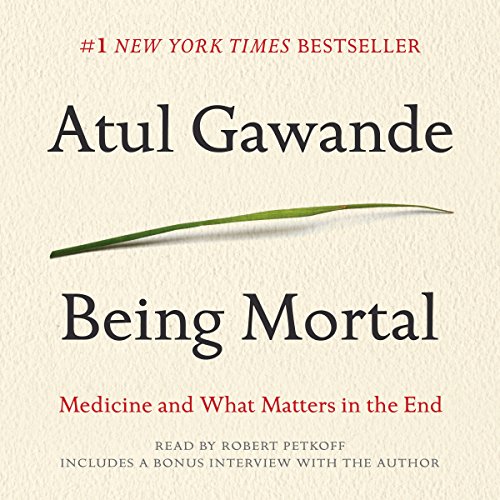
Being Mortal
Medicine and What Matters in the End
No se pudo agregar al carrito
Add to Cart failed.
Error al Agregar a Lista de Deseos.
Error al eliminar de la lista de deseos.
Error al añadir a tu biblioteca
Error al seguir el podcast
Error al dejar de seguir el podcast
Prueba gratis de 30 días de Audible Standard

Being Mortal
Compra ahora por $14.99
-
Narrado por:
-
Robert Petkoff
-
De:
-
Atul Gawande
Number one New York Times best seller
In Being Mortal, best-selling author Atul Gawande tackles the hardest challenge of his profession: how medicine can not only improve life but also the process of its ending Medicine has triumphed in modern times, transforming birth, injury, and infectious disease from harrowing to manageable. But in the inevitable condition of aging and death, the goals of medicine seem too frequently to run counter to the interest of the human spirit.
Nursing homes, preoccupied with safety, pin patients into railed beds and wheelchairs. Hospitals isolate the dying, checking for vital signs long after the goals of cure have become moot. Doctors, committed to extending life, continue to carry out devastating procedures that in the end extend suffering.
Gawande, a practicing surgeon, addresses his profession's ultimate limitation, arguing that quality of life is the desired goal for patients and families. Gawande offers examples of freer, more socially fulfilling models for assisting the infirm and dependent elderly, and he explores the varieties of hospice care to demonstrate that a person's last weeks or months may be rich and dignified.
Full of eye-opening research and riveting storytelling, Being Mortal shows how the ultimate goal is not a good death but a good life - all the way to the very end.
©2014 Atul Gawande (P)2014 Macmillan AudioLos oyentes también disfrutaron:


Featured Article: The Best Science Listens to Channel Your Inner Einstein
While you might listen in order to be entertained, there are also a host of works intended to be purely educational. We chose the best science titles on this list for the fact that they are both. These selections not only bring important perspectives on some of the most pressing scientific issues of our time—they’re also written and performed with a refreshing clarity that makes them easy to swallow and entertaining to the end.

Las personas que vieron esto también vieron:


A Walk through the Valley of the Shadow
Se ha producido un error. Vuelve a intentarlo dentro de unos minutos.
He explains, basically, how medicine needs to focus more on a patient’s wishes at the end of his/her life and not the family’s fears or wishes for the patient. Sometimes families want to go to extraordinary lengths to protect and prolong life, while the patient is really not willing or even physically capable of withstanding the treatments that the family wants to subject them to in the name of love. Sometimes, time has run out, and quality of life is the most important thing at this point. These are certainly tough decisions.
Gawande says that doctors are not really trained to talk to patients about dying. They are trained to try and CURE at any costs. The easy part is talking about all the treatments and drugs that can be used. The hard part is talking about and dealing with a realistic timeline and quality of life. Accepting that life can be shorter than we want can be extremely difficult! Gawande holds out hope that doctors might eventually be better trained to talk to patients about these issues.
Other topics relating to end of life issues are covered as well. There is a fascinating section on assisted living and various newer models which, again, hold out hope for the future in this area.
I was trying to remember the basic questions Gawande asks a person who has a terminal diagnosis. The website NextAvenue had the list for me:
“ It’s really a series of questions that we need to be comfortable asking one another. It needs to be normal to ask these questions, especially when someone is faced with a serious illness, and especially when we know that we’re aging and becoming frail.
We need to know:
1. What is your understanding of where you are and of your illness?
2. What are your fears or worries for the future?
3. What are your goals and priorities?
4. What outcomes are unacceptable to you? What are you willing to sacrifice and what not?
And later,
5. What would a good day look like?
Asking these allows everybody to understand what the goal really is — what are you really fighting for? It’s for a life that contains certain things.”
I also learned that there is a PBS Frontline video of Dr. Gawande and his work. I’m watching it now. It is perhaps even more powerful than just reading about his work. In any case, this book has opened a dialog for doctors, patients, and readers about needed changes in an important area!
An Important Topic!
Se ha producido un error. Vuelve a intentarlo dentro de unos minutos.
Worthwhile book about dying
Se ha producido un error. Vuelve a intentarlo dentro de unos minutos.
What made the experience of listening to Being Mortal the most enjoyable?
powerful stories, great background informationWhat about Robert Petkoff’s performance did you like?
clear and compelling;Was this a book you wanted to listen to all in one sitting?
noAny additional comments?
should hopefully change our whole culture's relationship to aging and illnessmust read for anyone aging
Se ha producido un error. Vuelve a intentarlo dentro de unos minutos.
Any additional comments?
Not always an easy listen, I found Being Mortal nevertheless to be an important one, especially for anyone in the "sandwich" generation or who otherwise might be thinking ahead to their senior years. The book challenges the listener to contemplate what really matters when old age, infirmity, or terminal illness occurs - is it important to add days to life or life to days. Gawande - a physician - asserts that the health care establishment has historically opted for the former when most patients in their care would probably want the latter if we only took the time and effort to ask. This raises poignant, often troublesome or difficult decisions on the part of individuals, their adult children, medical practitioners and the health care system. This is an intelligent and well argued book with only a few key messages. Gawande ably grounds his arguments in the experiences of his family and patients which keeps the narrative moving and makes the messages hit close to home. Being Mortal offers no easy answers but is good at getting the conversation started. In all this is a worthwhile listen though not always a pleasant one. The narration is top shelf.Worthwhile read poses tough questions
Se ha producido un error. Vuelve a intentarlo dentro de unos minutos.