

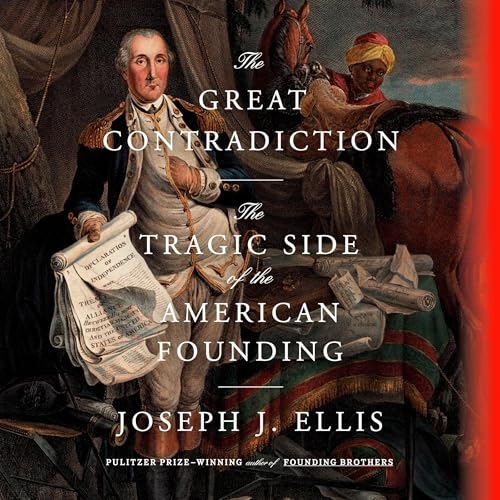
The Great Contradiction
The Tragic Side of the American Founding
Failed to add items
Sorry, we are unable to add the item because your shopping cart is already at capacity.
Add to Cart failed.
Please try again later
Add to Wish List failed.
Please try again later
Remove from wishlist failed.
Please try again later
Adding to library failed
Please try again
Follow podcast failed
Please try again
Unfollow podcast failed
Please try again
Audible Standard 30-day free trial
Select 1 audiobook a month from our entire collection of 1M+ titles.
Yours as long as you’re a member.
Get unlimited access to bingeable podcasts.
Standard auto renews for $8.99 a month after 30 days. Cancel anytime.

The Great Contradiction
Narrated by:
Kimberly Farr
Buy for $19.80
-
Narrated by:
-
Kimberly Farr
-
By:
-
Joseph J. Ellis
An astounding look at how America’s founders—Washington, Jefferson, Franklin, Madison, Adams—regarded the issue of slavery as they drafted the Declaration of Independence and the Constitution. A daring and important work that ultimately reckons with the two great failures of America’s founding: the failure to end slavery and the failure to avoid Indian removal.
On the eve of the American Revolution, half a million enslaved African Americans were embedded in the North American population. The slave trade was flourishing, even as the thirteen colonies armed themselves to defend against the idea of being governed without consent. This paradox gave birth to what one of our most admired historians, Joseph J. Ellis, calls the “great contradiction”: How could a government that had been justified and founded on the principles articulated in the Declaration of Independence institutionalize slavery? How could it permit a tidal wave of western migration by settlers who understood the phrase “pursuit of happiness” to mean the pursuit of Indian lands?
With narrative grace and a flair for irony and paradox, Ellis addresses the questions that lie at America’s twisted roots—questions that turned even the sharpest minds of the Revolutionary generation into mental contortionists. He discusses the first debates around slavery and the treatment of Native Americans, from the Constitutional Convention to the Treaty of New York, revealing the thinking and rationalizations behind Jay, Hamilton, and Madison’s revisions of the Articles of Confederation, and highlights the key role of figures like Quaker abolitionist Anthony Benezet and Creek chief Alexander McGillivray.
Ellis writes with candor and deftness, his clarion voice rising above presentist historians and partisans who are eager to make the founders into trophies in the ongoing culture wars. Instead, Ellis tells a story that is rooted in the coexistence of grandeur and failure, brilliance and blindness, grace and sin.
* This audiobook edition includes a downloadable PDF with maps and charts from the book.
Listeners also enjoyed...






People who viewed this also viewed...




Jefferson was totally wrong about human nature
Something went wrong. Please try again in a few minutes.
“All men created equal “ if white male landowners
Something went wrong. Please try again in a few minutes.
What struck me most was Ellis’s unflinching description of how the Founding Fathers effectively punted on two of the most explosive issues facing the young republic: slavery and Native American sovereignty. The priority was winning independence and holding the union together — with the hope that slavery might somehow “work itself out” over time. Reading this with modern hindsight is sobering. It reframes the Constitution not just as a work of genius, but as a document shaped by avoidance, compromise, and political necessity.
Ellis provides incredible insights into figures like George Washington and Thomas Jefferson. One fascinating takeaway — without spoiling too much — is Ellis’s argument that Washington, had he lived later, would almost certainly have fought on the Union side in the Civil War. That alone speaks volumes about Washington’s evolving views on national unity and slavery.
I also appreciated the attention given to lesser-discussed but crucial figures. Learning more about Alexander McGillivray — the brilliant Creek leader who negotiated directly with Washington — added an essential Native diplomatic dimension that often gets overlooked. And as always, I loved seeing familiar Revolutionary War personalities like Joseph Plumb Martin and the “battling bookseller” Henry Knox make meaningful appearances. Ellis has a gift for weaving these lives together into a living narrative.
My only real critique is structural. The book ends somewhat abruptly. Just as we’re deep into Jefferson’s later life — his financial ruin, his contradictions, his legacy — the narrative simply stops. No epilogue, no extended reflection, no afterword to help land the plane. It felt like the intellectual momentum deserved a more deliberate closing.
Still, this book gave me a deeper understanding of the origins of America’s enduring racial struggles and political fractures. Reading it around Lincoln’s birthday made the connections even more powerful. Lincoln, in many ways, was forced to confront and resolve the moral crises that the founders lacked either the unity or the gumption to face directly.
Ellis doesn’t tear the founders down — but he does humanize them. And in doing so, he reveals how the contradictions present at the creation still echo loudly today.
A compelling, unsettling, and necessary read.
What a powerful and thought provoking listen
Something went wrong. Please try again in a few minutes.