

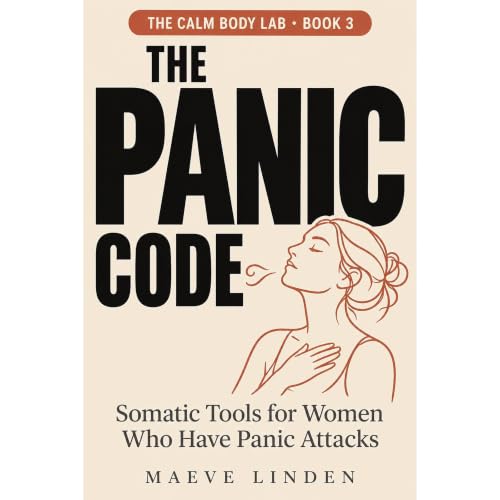
The Panic Code
Somatic Tools for Women Who Have Panic Attacks — When CBT Didn't Hold and the Body Goes First
Failed to add items
Add to Cart failed.
Add to Wish List failed.
Remove from wishlist failed.
Adding to library failed
Follow podcast failed
Unfollow podcast failed
$0.99/mo for 3 months + $20 Audible bonus

The Panic Code
Buy for $14.99
-
Narrated by:
-
Virtual Voice
-
By:
-
Maeve Linden

This title uses virtual voice narration
The first time you had a full-body panic attack, you were holding a flat of strawberries in a grocery store checkout line. Or driving on a highway exit. Or standing in your own kitchen at 6:47 pm. You thought you were having a heart attack. You thought you were losing your mind.
You have done the work. CBT for panic. An SSRI, maybe. Beta-blockers in your bag. The 5-4-3-2-1. The panic books on your nightstand. Some of it helped. None of it has held entirely. The panic still comes, and the shame afterward keeps getting heavier.
The reason is not your effort. In the model this book uses, the body often moves first and the frightening thought follows, which is why a thought-first tool can feel like it arrives late. CBT for panic remains one of the best-supported treatments there is. This book adds the body side.
This is the third book in The Calm Body Lab series by Maeve Linden, a body-first companion to the cognitive work for women whose chronic anxiety has turned into discrete panic attacks. The five-phase panic shape. The body-moves matched to each phase. The 90-minute interrupt for the post-panic shame loop, the hours of replay after an attack that so often feed the next one.
Inside, you will discover:
- The five-phase panic shape (pre-spike, peak, plateau, descent, post-panic shame loop), so panic stops feeling chaotic and becomes an event you can read and navigate
- The polyvagal model in plain language, including where it is debated, so you have a body-based way to understand your panic, not a moral one
- The body-moves at pre-spike and peak: longer exhale, orienting, pendulation, weight-bearing, vocalization, and why a move that fits pre-spike can be wrong at peak
- The body-moves at plateau and descent, the phases most panic books skip, including the shutdown interlude and how the body finishes the cycle on its own
- The post-panic shame loop interrupt: a 90-minute reset many women find shortens the hours after an attack, a five-question attack journal, and a catastrophizing check that works better once the body has settled
- The women-specific panic patterns: cycle-linked, perimenopausal, postpartum, mom-panic and stealth panic
- What CBT for panic does well and where it can plateau, with body-first work as a complement, never a replacement
- How the practices sit alongside medication and ongoing therapy, and why any medication question belongs with your prescriber, not this book
- The 6 to 10 week practice arc, the mid-protocol setback almost everyone hits, and how to tell the work is working
This is not a workbook. It is not a 30-day cure. It is not panic prevention. It is a field guide for a nervous system carrying chronic anxiety, and a body-first way to meet each phase of an attack, including the chapter on the post-panic shame loop, where a small change often matters most.
If panic has ambushed you in the middle of an ordinary, busy day, if CBT helped some but didn't hold, or if you've quietly suspected your body moves before your mind gets a chance, this book was written for you.
You cannot prevent every attack. With practice, the next one often arrives smaller.
This book does not replace medical or mental-health care. New, different or severe chest pain, or fainting, needs urgent care first: call 911 or your local emergency number.
Book 3 of The Calm Body Lab series by Maeve Linden. Scroll up and click Buy Now.