

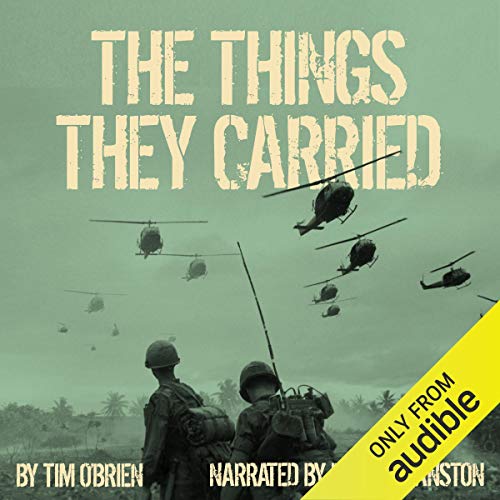
The Things They Carried
No se pudo agregar al carrito
Add to Cart failed.
Error al Agregar a Lista de Deseos.
Error al eliminar de la lista de deseos.
Error al añadir a tu biblioteca
Error al seguir el podcast
Error al dejar de seguir el podcast
Obtén 30 días de Standard gratis

The Things They Carried
Compra ahora por $16.24
-
Narrado por:
-
Bryan Cranston
-
De:
-
Tim O'Brien
This modern classic and New York Times best seller was a finalist for both the 1990 Pulitzer Prize and National Book Critics Circle Award and has become a staple of American classrooms. Hailed by The New York Times as "a marvel of storytelling", The Things They Carried’s portrayal of the boots-on-the-ground experience of soldiers in the Vietnam War is a landmark in war writing. Now, three-time Emmy Award winner Bryan Cranston, star of the hit TV series Breaking Bad, delivers an electrifying performance that walks the book’s hallucinatory line between reality and fiction and highlights the emotional power of the spoken word.
The soldiers in this collection of stories carried M-16 rifles, M-60 machine guns, and M-79 grenade launchers. They carried plastic explosives, hand grenades, flak jackets, and landmines. But they also carried letters from home, illustrated Bibles, and pictures of their loved ones. Some of them carried extra food or comic books or drugs. Every man carried what he needed to survive, and those who did carried their shattering stories away from the jungle and back to a nation that would never understand.
This audiobook also includes an exclusive recording “The Vietnam in Me,” a recount of the author’s trip back to Vietnam in 1994, revisiting his experience there as a soldier 25 years before, read by Tim O’Brien himself.
The Things They Carried was produced by Audible Studios in partnership with Playtone, the celebrated film and television production company founded by Tom Hanks and Gary Goetzman, and producer of the award-winning series Band of Brothers, John Adams, and The Pacific, as well as the HBO movie Game Change.
For more from Audible and Playtone, click here.
©1990 Tim O'Brien (P)2013 Audible, Inc.Reconocimientos y premios
Los oyentes también disfrutaron:







Reseñas editoriales
Reseñas de la Crítica
Featured Article: The Best Vietnam War Audiobooks, Fiction and Nonfiction
Over the past four decades, many people have written about the Vietnam War in an effort to make sense of the raging debates, the staggering death and destruction, and the lingering trauma. History is often complicated, biased, or missing key information, especially when it comes to war. Arm yourself with comprehensive knowledge of the conflict with our selection of titles detailing the Vietnam War, from fiction to nonfiction, personal stories to histories.


Editor's Pick
Bryan Cranston is probably a sorcerer
"You don’t even have to be into war stories to get swept up in the witchy magic of Tim O’Brien’s classic about the Vietnam War. He himself served in the army after being drafted as a young, promising college grad. His Vietnam stories are semi-autobiographical, tender like a bruise, and—in the vein of Kurt Vonnegut—filled with razor-sharp reflections about humanity’s beauties and ills. The best part? It’s brilliantly narrated by Bryan Cranston. It’s probably impossible to listen to this one without getting chills."
—Rachel S., Audible Editor
Las personas que vieron esto también vieron:





Now considered one of the "definitive" Viet Nam war novels, this book did not have the effect on me that it might on someone of O'Brien's generation. I was a child when the Viet Nam war ended, barely old enough to register that a war over there was anything of significance. I lost no family members in Viet Nam; I have no close friends who served there. By the time I came of age, Viet Nam preoccupied the media on which I grew up, but it was a foreign place and a foreign experience.
Tim O'Brien's semi-autobiographical novel is full of anecdotes, small stories, and harrowing episodes, but it's war on a small scale. Some of his buddies die, and others go nuts, but most just try to struggle their way through their tour and survive. They see action but not a lot of epic battles, just the constant threat of being shot at in jungles and drawing lots to see who will crawl into a Viet Cong tunnel with a flashlight in one hand and a combat knife in their teeth.
There is not much humor, but you wouldn't expect a Viet Nam novel to be funny, would you? (M*A*S*H*, famously, was really "about" Viet Nam but since it was still too recent and raw, they had to set it back in the Korean War instead.)
It gives some insight into what Viet Nam was like on the ground, but now, going on five decades later, Viet Nam has been explored and trodden and, if not exorcised from our national psyche, made bearable and confrontable again. And the Vietnamese, desperate to get in on the global market and its bounty of modern technology and foreign currency, no longer hold a grudge against us. They run tours through villages and war memorials. They greet American vets coming back to confront the place they once shed blood in almost like returning alumni.
As a wargamer, I have an academic interest in war. My particular area of interest is World War II, a war so long ago now that there are an ever-dwindling number of men and women who remember it first-hand, and which has faded into the fog of history and national mythology. Viet Nam, I think, is getting there. You can find Viet Nam wargames now, a thing that might upset living Nam vets but which would probably have been unthinkable in the years immediately after the war ended. Listening to Tim O'Brien talk about his ("his") war experiences did not sound very different to me than similar books narrated by World War II vets - equally horrible but equally distant, even though technically Viet Nam is within my living memory.
I appreciated this book, but I'm in that middle generation, too young to have had the real Viet Nam leave a mark on me, too old to find much here I haven't heard before.
The afterword by the author was a bonus in the audiobook, but probably what I found most profound of any of his stories was his meditation on why he went to Viet Nam. When his draft number came up, like many men of that era he contemplated the way he might get out of going, and even set out on that fabled trek to Canada. The story of his abortive flight, and his decision to return home and shoulder his responsibilities - literally - may ring more true for many of his generation than the ones who did end up dodging the draft, or who volunteered, or who were traumatized or killed. He went to Viet Nam because he couldn't stand the thought of letting down his family, his nation, of being seen as a coward. So ironically, as he puts it, he went to Viet Nam because he was a coward.
For all vets and those too young
Se ha producido un error. Vuelve a intentarlo dentro de unos minutos.
Raw, Haunting, Ruthlessly Open Account
Se ha producido un error. Vuelve a intentarlo dentro de unos minutos.
Of its time...
Se ha producido un error. Vuelve a intentarlo dentro de unos minutos.
What made the experience of listening to The Things They Carried the most enjoyable?
Listening to The Things They Carried was not an enjoyable but a gut wrenching experience. The stories that O'Brien told were a mix of truth and fiction that unsettled my well being and made me not want to listen. My stomach was tied in knots. I stopped listening and tried to allow my mind to relax and absorb what I had just listened to. I did listen to the whole book and I am glad that I did. The narration, done by Bryan Cranston, was exquisite. The words were given a life of their own.What was one of the most memorable moments of The Things They Carried?
One of the most memorable moments of The Things They Carried was when Tim was wounded in the buttock and kept calling, then screaming for the medic. The medic didn't come and Tim passed out for a short period of time but when he awoke the medic had still not come. Tim didn't want to die but in order to be kept alive he needed the medic to help him. Finally, the medic arrived and didn't know what in the hell he was doing.This was the medic's first day. He had been in the field fighting with the other men when he heard someone calling for the medic. He was unable to act. He was unable to move and it was as if he was paralyzed. He took ten precious minutes to get his brain working and arrive at the site where Tim lie wounded.
When Tim had been wounded the first time he was treated immediately by a different medic, who was competent. However, that medic had been driven to what I considered could be referred to as psychotic episodes, brought on by the war. He was driven to the point where he shot himself in the foot and had to be medivacted out. His fellow combatants said to those who spoke of him, "he's in Japan."
Tim attempted to tell the medic that he was going into shock. Shock is a life threatening condition resulting from having incurred a wound that causes excess blood loss. The body needs enough blood circulating to keep the heart functioning properly. The ineptness of the treatment Tim was receiving could have led to his death. Tim fought to live to see another day. He survived and was to finish out his tour of duty in the safety of the American compound. There was a hospital, hot showers, a place to sleep without hearing the sounds of war all around him and staying dry because he was now protected from the rain that created the sucking mud where he and his comrades were made to wage the battle where Tim was wounded.
The company that Tim was in, was led by a man who could not lead. He realized this about himself but was unable to tell someone who had the authority to replace him. The night of that battle, he understood, after surveying the area, that his men needed to move to higher ground. However, he chose to remain where they were and another member under his command was sucked into the foul muck after being wounded.
Which scene was your favorite?
My favorite scene was when Tim returned, after a month in the hospital from the second wound he had sustained while in battle and was told he was to finish out his tour of duty at the compound. His days of being a grunt, fearing for his life, carrying an M60 to kill or be killed, were over.If you could rename The Things They Carried, what would you call it?
The Scourges of WarAny additional comments?
I know that the Vietnam war was not supported by the soldier's countrymen. The men who were fighting in the war did not understand why they were fighting in this god-forsaken place called Vietnam. Whatever the politicians reasons were to DRAFT our men to fight in Vietnam, they did need the support of their country, the United States of America and their fellow citizens. Can you imagine, returning from Vietnam, or any war and being spit on. The men who fought in Vietnam were MADE to fight in that war or desert and go to Canada or elsewhere. However, I'm also sure that men wanted to and did desert for their own reasons, from other wars.Tim wanted to run but didn't. However, he was almost in Canada but chose to return home after spending six days with an 81 year old man who, through his power to listen and make no judgments, was the catalyst that Tim feels made him return home and look at the draft notice with his name, one more time.
Why did PTSD become a known and qualified disorder after the Vietnam war? There had been many other prior war's, where men returned home and were said to suffer from, "shell-shock." It is my belief that these men were experiencing what we call, PTSD today.
Those previous wars had definition and reason. The men who returned home were not being spit upon, questioned about their participation in the war at that time. The time that our men spent fighting an unpopular war in Vietnam were as heroic and brave as any other man who had fought in a war before and after Vietnam. Please, give our men the credit that they are due. War isn't defined as popular or unpopular. War is to contend; strive_at war in a state of open armed conflict between nations. These men were soldier's. Soldier's come from every branch of the military and some soldier's fight in a war. These men were soldier's of a war, called the Vietnam war.
Tim O'Brien's book was an eye opener, told by a man who had fought for his country in Vietnam. I have a brother who fought for his country in Vietnam. I listened to Tim tell his stories. The stories may start with the first story being told and reappear in the third story he tells. Put all of the stories together and you come to understand what war was like for Tim O'Brien. The war was many things, terror, courage, death, rain, mud, elephant grass, jungles, villages, comrades, fear and many other things for many different men.
I agree with some of the positive as well as the negative reviews. So, where does that put me? I have the opinion that war, any war, I don't care what the name of the war is, was fought by the men and now women of the USA to uphold democracy, and to keep our country free. Every war has caused and will continue to cause PTSD. I just heard that more money will be spent on treating PTSD than was spent on fighting. Tim O'Brien suffers from PTSD.
His writing skills are brilliant and he has definitely brought the Vietnam war alive. To have his book called a classic and to have it implemented in the school system as necessary reading is an honor. Tim's writing is vivid, breathtaking, no bars held and extremely thought provoking.
I've been listening to many fiction and nonfiction books concerning many different wars. War in and of itself is an atrocity that has been with us since the beginning of time. War will never go away.
Mind Altering War Experience
Se ha producido un error. Vuelve a intentarlo dentro de unos minutos.
I must add that I listened to this as an audio book read by Bryan Cranston, who was devastatingly perfect. Also, the audio book has a bonus track that is well worth listening to, featuring Tim O’Brien reading his essay “The Vietnam in Me.”
I must end this review with transcripts of some of my favorite passages from the book, because I never want to forget them.
All of us, I suppose, like to believe that in a moral emergency we will behave like the heroes of our youth, bravely and forthrightly, without thought of personal loss or discredit. Certainly that was my conviction back in the summer of 1968. Tim O'Brien: a secret hero. The Lone Ranger. If the stakes ever became high enough—if the evil were evil enough, if the good were good enough—I would simply tap a secret reservoir of courage that had been accumulating inside me over the years. Courage, I seemed to think, comes to us in finite quantities, like an inheritance, and by being frugal and stashing it away and letting it earn interest, we steadily increase our moral capital in preparation for that day when the account must be drawn down. It was a comforting theory. It dispensed with all those bothersome little acts of daily courage; it offered hope and grace to the repetitive coward; it justified the past while amortizing the future.
A true war story is never moral. It does not instruct, nor encourage virtue, nor suggest models of proper human behavior, nor restrain men from doing the things men have always done. If a story seems moral, do not believe it. If at the end of a war story you feel uplifted, or if you feel that some small bit of rectitude has been salvaged from the larger waste, then you have been made the victim of a very old and terrible lie. There is no rectitude whatsoever. There is no virtue. As a first rule of thumb, therefore, you can tell a true war story by its absolute and uncompromising allegiance to obscenity and evil.
I'm skimming across the surface of my own history, moving fast, riding the melt beneath the blades, doing loops and spins, and when I take a high leap into the dark and come down thirty years later, I realize it is as Tim trying to save Timmy's life with a story.
And sometimes remembering will lead to a story, which makes it forever. That's what stories are for. Stories are for joining the past to the future. Stories are for those late hours in the night when you can't remember how you got from where you were to where you are. Stories are for eternity, when memory is erased, when there is nothing to remember except the story.
[from “The Vietnam in Me”] … Vietnam was more than terror. For me at least, Vietnam was partly love. With each step, each light year of a second, a foot soldier is always almost dead, or so it feels, In such circumstances, you can’t help but love. You love your mom and dad, the Vikings, hamburgers on the grill, your pulse, your future, everything that might be lost, or never come to be. Intimacy with death carries with it a corresponding new intimacy with life. Jokes are funnier, green is greener, you love the musky morning air. You love the miracle of your own enduring capacity for love.
Powerful
Se ha producido un error. Vuelve a intentarlo dentro de unos minutos.