Episodios

  • When Relationships Hurt: Understanding Gaslighting
    Apr 14 2026

    Have you ever walked away from a conversation questioning yourself… wondering if you were the problem, even when something didn’t feel right?

    In this episode, Larry sits down with therapist Teresa Land to unpack the reality of gaslighting, a subtle but powerful form of emotional harm that can leave you doubting your thoughts, your feelings, and even your sense of reality. They explore how it shows up in everyday relationships, why it’s so hard to recognize, and how it slowly erodes confidence over time.

    You’ll also hear practical, compassionate steps for finding your footing again, setting boundaries, and getting the support you deserve. Whether you’re navigating this personally or simply want to better understand relationship dynamics, this conversation will help you put words to what you may have been feeling for a long time.

    Resources: The Gaslight Effect by Dr. Robin Stern
    Learn more at caretochange.org

    Más Menos
    39 m
  • When Relationships Hurt - What Narcissism Is and Isn’t
    Apr 7 2026

    The word narcissist gets used everywhere right now—but what does it actually mean?

    In this episode, April and Brittany take a grounded, clinical look at narcissism and separate truth from trend. We unpack what narcissism really is, where it comes from, and how it shows up in everyday relationships. You’ll also learn how to distinguish between harmful patterns and normal human behavior, and what to do if you find yourself in a relationship that feels confusing, one-sided, or emotionally draining.

    Whether you’ve wondered if someone in your life is narcissistic or you’re trying to better understand relationship dynamics, this conversation brings clarity, compassion, and practical guidance.

    In This Episode, We Cover:

    • Why the term narcissist is often misunderstood and overused
    • A clear, clinical definition of narcissism
    • The difference between everyday self-centered behavior and true narcissistic traits
    • Common behaviors that get mislabeled as narcissism
    • What narcissism can look like in real-life relationships
    • Healthy ways to set boundaries when dealing with difficult behavior
    • Whether meaningful change is possible
    • What most people get wrong about narcissism

    Key Takeaways:

    • Not all hurtful or self-focused behavior is narcissism
    • Narcissism exists on a spectrum, not as a simple label
    • Understanding the pattern matters more than labeling the person
    • Boundaries are about protecting your wellbeing, not changing someone else
    • Clarity reduces confusion and empowers healthier choices

    A Thought to Sit With:

    Sometimes the most important question isn’t “Are they a narcissist?” but “How is this relationship impacting me and what do I need to be well?”

    Resources & Support:

    If this episode resonated with you, working with a therapist can help you process relationship patterns and build clarity and confidence in your boundaries.

    Connect with Care to Change:

    🧡 Learn more about our services

    🧡 Explore resources for healthier relationships

    🧡 Reach out for support


    Más Menos
    26 m
  • All About Tech - Digital Boundaries for Families
    Mar 24 2026

    In this episode Jared Jones and Teresa Haskins talk about practical digital boundaries for families. Together, they explore how parents can thoughtfully guide their children’s use of technology while maintaining connection and preparing them for adulthood.

    Teresa shares research-informed recommendations for screen use across developmental stages, including limiting screen exposure in early childhood, capping recreational screen time in elementary years, delaying smartphones until high school when possible, and postponing social media until around age sixteen. She emphasizes that these are ideals, not measures of parental success, and encourages families to make thoughtful, intentional decisions based on their unique circumstances.

    A central theme of the episode is the idea of a family reset. Rather than taking an all-or-nothing approach, Teresa encourages parents to begin by examining their own screen habits, having open conversations about the kind of family culture they want, and gradually introducing healthy limits such as screen-free mealtimes. She highlights the importance of collaboration, preparation, and empathy, especially since children’s developing brains are wired for immediate reward and may struggle with emotional regulation during changes.

    Parents are reminded that reducing screen time must be paired with increased connection. Boundaries alone are not enough. Families need shared experiences, conversation, and intentional time together to replace what screens once filled.

    Resources:

    • Becoming a Screen-Savvy Family: How to Navigate a Media-Saturated World--and Why We Should by The Plugged In Staff (link)
    • Plugged In Website (link)
    • The Anxious Generation: How the Great Rewiring of Childhood Is Causing an Epidemic of Mental Illness by Jonathan Haidt (link)

    Thank you for spending this time with us. We invite you to pause and reflect on one small step you can take toward greater health this week. Growth rarely happens all at once. It unfolds in steady, intentional choices.

    If you would like support in your own journey, our team at Care to Change is here to walk alongside you. You can learn more about our services, intensives, and resources at caretochange.org.

    Until next time, take care of your mind, tend to your relationships, and remember that meaningful change is possible.

    Más Menos
    38 m
  • All About Tech - Faith, AI and the Future
    Mar 17 2026

    In this episode Jared Jones and Jean Crane explore the rapidly expanding world of artificial intelligence through the lens of faith and spiritual formation.

    As AI becomes more integrated into schools, workplaces, and everyday life, this conversation helps listeners think critically and spiritually about how to engage this technology with wisdom. Rather than reacting with fear or blind acceptance, Jean invites us into thoughtful awareness, asking how AI is shaping our minds, and relationships.

    This episode is not about rejecting AI. It is about learning how to use it responsibly, intentionally, and in alignment with our values.

    In This Episode We Discuss

    • Why AI has become such an urgent topic for families
    • The difference between using AI as a tool versus relying on it as a crutch
    • Informational oversight and recognizing bias in AI-generated content
    • The potential cognitive cost of outsourcing our thinking
    • Relational atrophy and the rise of emotional attachment to chatbots
    • Spiritual formation and the risk of replacing dependence on the Holy Spirit
    • The importance of preparing kids for long-term character formation, not short-term convenience

    Four Areas of Reflection for Adults

    • Informational Oversight - Am I critically evaluating the information I receive, or accepting it without discernment?
    • Opportunity Cost for the Brain - Am I outsourcing thinking that strengthens my cognitive and critical reasoning skills?
    • Relational Atrophy - Is AI replacing meaningful connection with embodied human relationships?
    • Spiritual Formation - Am I turning to technology before I turn to the Holy Spirit?

    Resources:

    • Against the Machine by Paul Kingsnorth (link)
    • Spiritual Formation and AI video (link)
    • The Tech-Wise Family by Andy Crouch (link)

    Thank you for spending this time with us. We invite you to pause and reflect on one small step you can take toward greater health this week. Growth rarely happens all at once. It unfolds in steady, intentional choices.

    If you would like support in your own journey, our team at Care to Change is here to walk alongside you. You can learn more about our services, intensives, and resources at caretochange.org.

    Until next time, take care of your mind, tend to your relationships, and remember that meaningful change is possible.

    Más Menos
    40 m
  • All About Tech - Raising Kids in a Digital Age
    Mar 9 2026

    In this episode Jared Jones and Mac Zambrano continue the conversation about technology and mental health by focusing specifically on parenting. Together, they explore how to raise kids in a digital world without leading with shame, fear, or control.

    The heart of the episode centers on one key shift: moving from policing behavior to developing character. Instead of raising rule followers, the goal is to raise wise decision makers who can navigate technology well when parents are not present.

    In This Episode We Discuss

    • Ten common tech mishaps families face
    • Why secrecy often grows when parenting becomes overly controlling
    • The balance between structure and connection
    • Character development versus behavior management
    • Why connection creates influence
    • Monitoring technology with relationship instead of fear
    • Talking with curiosity instead of criticism
    • Practical ways to create tech-free connection at home

    Key Takeaways

    • When technology issues arise, connection comes before correction
    • Strict control without relationship can create secrecy
    • Too few boundaries can also lead to shame and hidden behavior
    • The goal is not zero access to technology but supported access
    • Small, consistent moments of connection matter
    • Parents do not have to navigate this alone

    The CARE Framework for Parents

    • C – Calm yourself first - Regulate before you respond.
    • A – Ask with curiosity - Seek to understand before correcting.
    • R – Reflect values, not just rules - Anchor conversations in what your family stands for.
    • E – Engage in repair - Collaborate on what needs to change moving forward.

    Resources discussed:

    • The Digital Parenting Guidebook by David Tucker (link)
    • Screens and Teens (Moody Publishers) (link)
    • Competing Spectacles / Digital discipleship themes (from Desiring God) (link and link)

    Thank you for spending this time with us. We invite you to pause and reflect on one small step you can take toward greater health this week. Growth rarely happens all at once. It unfolds in steady, intentional choices.

    If you would like support in your own journey, our team at Care to Change is here to walk alongside you.

    Más Menos
    31 m
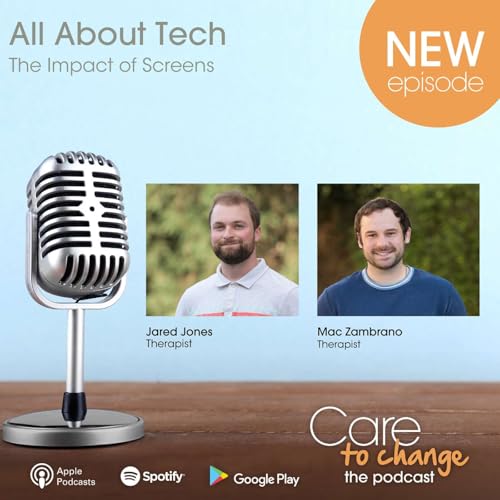
  • All About Tech - The Impact of Screens
    Mar 3 2026

    In this episode Jared Jones and Mac Zambrano explore how screens and technology are shaping our mental and emotional health. From brain development and emotional regulation to family dynamics and social comparison, they unpack what we are seeing clinically and culturally when it comes to screen use.

    This conversation is not about blame or fear. It is about awareness. Screens are part of modern life. The goal is not elimination, but intentional engagement.

    In This Episode We Discuss

    • Why this series matters and what to expect this month
    • The rapid evolution of technology and its impact on families
    • How screens affect the brain, especially attention and novelty-seeking
    • The role of dopamine and fast reward cycles
    • Emotional regulation and using screens to cope with boredom or stress
    • The shift from shared family screens to personalized devices
    • Social development in the digital age
    • Social media, comparison, and rising anxiety and depression in teens
    • The unique pressures facing girls and boys online
    • The relational cost of constant device use
    • Why small, intentional changes matter

    Key Takeaways

    • Awareness comes before change.
    • Screens are not inherently evil, but they are powerful.
    • Emotional regulation, sleep, focus, and relationships can all be affected by excessive or unintentional screen use
    • It is never too late to make small, meaningful shifts.

    Resources discussed:

    • The Anxious Generation: How the Great Rewiring of Childhood Is Causing an Epidemic of Mental Illness by Jonathan Haidt (link)
    • Gen Z Mental Health and Wellbeing e-book (link)

    Thank you for spending this time with us. We invite you to pause and reflect on one small step you can take toward greater health this week. Growth rarely happens all at once. It unfolds in steady, intentional choices.

    If you would like support in your own journey, our team at Care to Change is here to walk alongside you. You can learn more about our services, intensives, and resources at caretochange.org.

    Until next time, take care of your mind, tend to your relationships, and remember that meaningful change is possible.

    Más Menos
    31 m
  • All About Marriage - Let’s Talk About Sex and Intimacy
    Feb 24 2026

    We’re closing out our All About Marriage series with a conversation that many couples avoid but desperately need: sex and intimacy.

    In this episode, Teresa Haskins joins Larry Vincent to talk candidly about one of the most misunderstood areas of marriage. From common myths about sex drive to the emotional, biological, and relational factors that influence intimacy, this discussion brings clarity, compassion, and practical insight.

    If intimacy has felt confusing, disappointing, or difficult in your marriage, you are not alone. This episode will help you reframe expectations, understand the deeper layers of connection, and begin healthier conversations with your spouse.

    In this episode, we discuss:

    • The biggest myths about sex in marriage
    • Why intimacy struggles are rarely just a “low sex drive” issue
    • The biological, psychological, and relational factors that impact desire
    • The difference between using sex to gain connection versus sex flowing from connection
    • What it means to experience body, mind, and spirit alignment in intimacy
    • How unrealistic expectations sabotage fulfillment
    • Why open, vulnerable conversation is the most important first step
    • Encouragement for couples who feel stuck or discouraged

    One powerful takeaway: healthy intimacy is not a performance or a formula. It is an overflow of safety, connection, alignment, and ongoing communication.

    Resources Mentioned:

    • The 40 Forms of Intimacy by Alex Avila
    • Sacred Marriage by Gary Thomas
    • Come As You Are by Emily Nagoski

    If this conversation resonates with you and your spouse, consider taking the next step. The therapists at Care to Change are here to help you move from frustration to connection in a safe and supportive environment.

    Más Menos
    38 m
  • All About Marriage - Life After An Affair
    Feb 16 2026

    In this week’s episode of the All About Marriage series, Larry sits down with therapist Teresa Haskins to have an honest and compassionate conversation about life after an affair. This is a tender and potentially challenging topic, and Teresa encourages listeners to care for themselves as they engage with it.

    They explore the two primary types of affairs, emotional and physical. Emotional affairs often involve secrecy, deep emotional attachment, and misplaced vulnerability, even if there is no physical intimacy. Physical affairs can take many forms, from one-night encounters to workplace dynamics or patterns connected to addiction. In both cases, the betrayal and secrecy are often the most painful parts to heal from.

    The conversation addresses what can lead to an affair, including unmet emotional needs, a desire for validation or excitement, poor communication, or personal struggles within the betrayer. Teresa emphasizes that infidelity is not always the result of something lacking in the marriage; sometimes it reflects unresolved issues within the individual.

    Larry and Teresa also discuss how affairs are discovered. Confession offers the best opportunity for rebuilding trust, while being caught can compound the trauma. From there, healing begins with what Teresa calls the “atonement stage”—a season of humility, transparency, accountability, and patience. Rebuilding trust requires consistent openness and often takes one to two years, sometimes longer.

    They highlight the importance of involving a trained third party early in the process to help both spouses navigate difficult conversations, avoid further harm, and move toward restoration in a healthy way.

    Recommended resources from this episode include Not Just Friends by Shirley Glass and What Makes Love Last? by John Gottman.

    If you or your spouse are navigating betrayal, you do not have to do it alone. Care to Change can provide the structure and support needed to begin healing and rebuilding trust.

    Más Menos
    45 m