

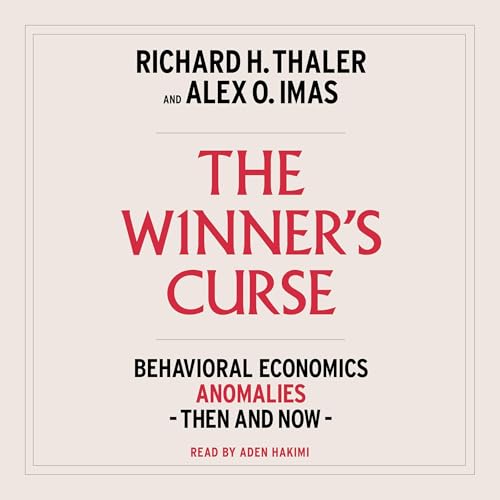
The Winner's Curse
Behavioral Economics Anomalies, Then and Now
No se pudo agregar al carrito
Solo puedes tener X títulos en el carrito para realizar el pago.
Add to Cart failed.
Por favor prueba de nuevo más tarde
Error al Agregar a Lista de Deseos.
Por favor prueba de nuevo más tarde
Error al eliminar de la lista de deseos.
Por favor prueba de nuevo más tarde
Error al añadir a tu biblioteca
Por favor intenta de nuevo
Error al seguir el podcast
Intenta nuevamente
Error al dejar de seguir el podcast
Intenta nuevamente
Prueba gratis de 30 días de Audible Standard
Selecciona 1 audiolibro al mes de nuestra colección completa de más de 1 millón de títulos.
Es tuyo mientras seas miembro.
Obtén acceso ilimitado a los podcasts con mayor demanda.
Plan Standard se renueva automáticamente por $8.99 al mes después de 30 días. Cancela en cualquier momento.

The Winner's Curse
Narrado por:
Aden Hakimi
Compra ahora por $19.49
-
Narrado por:
-
Aden Hakimi
Nobel Prize winner Richard H. Thaler and rising star economist Alex O. Imas explore the past, present, and cutting-edge future in behavioral economics in The Winner’s Curse.
Why do people cooperate with one another when they have no obvious motivation to do so? Why do we hold on to possessions of little value? And why is the winner of an auction so often disappointed?
Over thirty years ago, Richard H. Thaler introduced readers to behavioral economics in his seminal Anomalies column, written with collaborators including Daniel Kahneman and Amos Tversky. These provocative articles challenged the fundamental idea at the heart of economics that people are selfish, rational optimizers, and provided the foundation for what became behavioral economics. That was then.
Now, three decades later, Thaler has teamed up with economist Alex O. Imas to write a new book with an original and creative format. Each chapter starts with an original Anomaly, retaining the spirit of its time stamp. Then, shifting to the present, the authors provide updates to each, asking how the original findings have held up and how the field has evolved since then.
It turns out that the original findings not only hold up well, but they show up almost everywhere. Anomalies pop up in people’s decisions to save for retirement and how they carry outstanding credit card debt. Even experts fail to optimize. The key concept of loss aversion explains missed putts by PGA pros and the selection of which stocks to sell by portfolio managers. In this era of meme stocks and Dogecoin, it is hard to defend the view that financial markets are highly efficient. The good news, however, is that the anomalies have gotten funnier.
With both readability and rigor, The Winner’s Curse is for anyone, from those with a cursory understanding of economics to fellow economists. Each chapter provides a key insight into human behavior so readers learn how to better understand the choices made by their friends, colleagues, and customers, and they might just become better at making decisions themselves. Only recommended for humans.
Los oyentes también disfrutaron:





Las personas que vieron esto también vieron:




Excellent update.
Se ha producido un error. Vuelve a intentarlo dentro de unos minutos.
The premise of this book was very interesting. The authors analyzed the impact of behavioral economic anomalies from the 1980s in order to see if such findings hold up today.
The book covers a lot of common concepts in behavioral economics, which attempts to explore how our emotions influence our decision making. Economic theories are logical and rational, but people are not.
If you read a lot of books about behavioral economics or business psychology, you likely won’t learn much in the way of new information here. Also, the description of the experiments was not interesting at all, so if you’re prone to boredom, you will struggle with this book.
Objectively, it’s still a good book. Some of the better sections were the ones that discussed the endowment effect, status quo bias, and loss aversion. Loss aversion is something that impacts individuals and organizations alike.
Good Information, Boring Delivery
Se ha producido un error. Vuelve a intentarlo dentro de unos minutos.
Ignore individual and group behavior when defining the rational individual at your peril.
Se ha producido un error. Vuelve a intentarlo dentro de unos minutos.
Thaler banger
Se ha producido un error. Vuelve a intentarlo dentro de unos minutos.
Audiobook of a picture book
Se ha producido un error. Vuelve a intentarlo dentro de unos minutos.