

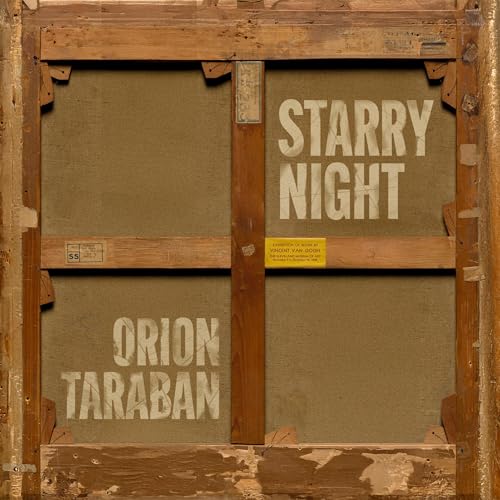
Starry Night
No se pudo agregar al carrito
Add to Cart failed.
Error al Agregar a Lista de Deseos.
Error al eliminar de la lista de deseos.
Error al añadir a tu biblioteca
Error al seguir el podcast
Error al dejar de seguir el podcast
Prueba gratis de 30 días de Audible Standard

Starry Night
Compra ahora por $12.58
-
Narrado por:
-
Orion Taraban
-
De:
-
Orion Taraban
On the evening of July 27th, 1890, Vincent van Gogh, aiming for his heart, shot himself with a revolver. He missed. Today, Vincent van Gogh is considered one of history's most brilliant artists, revered by millions the world over. However, he sold only one painting in his lifetime, spent years in insane asylums, and died penniless in a garret. Haunted by his failures, riddled with addiction, and debilitated by mental illness, van Gogh eventually took his own life.
In this innovative first novel, best-selling author Orion Taraban explores the final days of this tragic figure from the perspective of those most involved: his brother and caretaker, Theo, his friend and physician, Paul Gachet, and Vincent himself.
Take this unique opportunity to see the world through Vincent's eyes. Once you listen to Starry Night, you won't look at life the same way again.
Orion Taraban, Psy.D., is a clinical psychologist in private practice. His YouTube channel (@PsycHacks) has nearly 1 million subscribers and 200 million views, and his many media appearances have established him as a thought leader in popular psychology. He is also the best-selling author of The Value of Others, which examines his model of intersexual relationship dynamics. He currently lives in Napa, California.
©2026 Orion Taraban (P)2026 Orion TarabanLos oyentes también disfrutaron:




Las personas que vieron esto también vieron:


wonderful
Se ha producido un error. Vuelve a intentarlo dentro de unos minutos.
Godspeed, Doc. Well done.
spec-freaking-tacular, my dudes
Se ha producido un error. Vuelve a intentarlo dentro de unos minutos.
Chapter 1- setting the scene for a brooding male emotional exposé and even in minuta a critique of female dispositions. A justification of an artist’s tortured states, leading to the inevitability of his nihilistic demise. The writer’s own critique/analysis of the titles painting namesake. A worthy attempt of trying to imagine the main characters mindset was to inspire the piece.
Chapter 2- Vincent’s brothers perspective a beautifully written chapter full of wonderful metaphors and bro-mance.
Chapter 3- perspective of a female child minimizing a young female to banal naïveté.
Chapter 4- Vincent’s friend/collegue/doctor perspective apparently… alludes to an intellectual friendship where competing egos are inevitable but the doc is seemingly aloof to.
Chapter 5- the shortest chapter, only 1min,,of Vincent’s assumed lover/crush. Displaying somewhat of a chip on the shoulder of the author. Showing an inability to elaborate from a female perspective. Admittedly the author cannot escape his maleness this chapter subtly vilifies the feminine influence through a sort of blame. Although the brother and friend must also take some sort of blame for not valuing the main character enough through tangible means to motivate him to stay alive.
Chapter 6- Vincent’s own omniscient perspective. The deepest in content this chapter is almost erotic in tone and palpability. Bc sex sells, right?!… the writing is a string of adjective and nouns descriptive and somewhat limited bc the main character was a visual artist not a writer however sprinkled here and there are beautiful moments of written art trying to convey the indescribable “pure perspective” <->… “raindrops like phoenix fire”. The author does well to attempt describing man’s relationship to the divine through the process of slow death by self inflicted wounds. It’s as if the self inflicted pain is the only way to feel the beauty of the divinity of life. A feeble attempt is made to describe the paradox of reality. Though the theme of genius in insanity is made well. Author makes many comparisons of prescribed religion vs divinity in the natural world. Over all the premise seems to be free will is only confirmed when one makes the choice to die without caring whom else it harms. Also man’s’ justification of addiction to reaffirm free will through self prescribed choices of happiness even in death. Recognition that in the end the character choose his own suffering or torture in order to feel alive.
Book report
Se ha producido un error. Vuelve a intentarlo dentro de unos minutos.
Poetically Written
Se ha producido un error. Vuelve a intentarlo dentro de unos minutos.
For who among us know the subtle diet of the soul
Se ha producido un error. Vuelve a intentarlo dentro de unos minutos.