Episodios

  • 14: Becoming Smarter News Consumers, with the founder of Ad Fontes Media, Home of the Media Bias Chart
    Dec 2 2025

    In an age where AI can fake a video, social platforms reward outrage, and even the word 'misinformation' means different things to different people, one question rises above the noise: how do we know what to trust?

    Today, we're joined by Vanessa Otero, the lawyer-turned-media-analyst behind Ad Fontes Media and its well-known Media Bias Chart, to explore exactly that. Vanessa takes us inside the mechanics of bias, the structures driving extreme content, and the habits that actually make us smarter news consumers.

    This episode is your practical guide to staying informed without getting manipulated.

    What to listen for:

    • What the Ad Fontes media bias chart looks like, and how to use it: their mission is to rate all the news to positively transform society.

    • Knowing that there's a high correlation between high bias and low reliability

    • Advice for media consumers who are trying to recognize bias without all the tools – including considering disbelieving everything until you can verify it through multiple sources

    • New ways to discuss the media landscape. Example: Instead of saying "fake news" or "misinformation," which are politically charged and open to interpretation, consider using more accurate language like "misleading information" or "inaccurate information."

    About our guest:

    Vanessa Otero is the Founder and CEO of Ad Fontes Media, the company that rates news for bias and reliability.

    Ms. Otero founded Ad Fontes in 2018 with a mission to rate all the news to positively transform society. She created the original Media Bias Chart in 2016, which was the seed idea for creating the company. She is passionate about bringing people together and overcoming the challenges of political polarization in our present environment. Prior to starting Ad Fontes, she practiced as a patent attorney specializing in software. Vanessa holds a B.A. in English from UCLA and a J.D. from the University of Denver.

    Más Menos
    40 m
  • 13: How to Have Difficult Conversations, featuring Dr. Bill Doherty, Co-founder of Braver Angels
    Nov 18 2025

    Are you a little worried about holiday conversations with your relatives and family members in this increasingly polarized political climate? You're not alone.

    Welcome to something new – a live discussion with our guest, Dr. Bill Doherty, co-founder of Braver Angels and a deeply experienced relationship therapist, coaching one of us (Sara) through how to have difficult conversations, not in theory, but with an actual extended family member who has differing political viewpoints from me.

    Nowadays, politics is personal. So, as much as it's tempting to bury our heads in the sand, these conversations are skills of democratic living - we can't abandon them at a family level and expect our political leaders to do it for us.

    You won't want to miss the discomfort, the realizations, the tips and perspectives that can help us ALL have better, more meaningful connections and conversations with the people we love in our lives – even and especially if we don't always agree with them.


    What to listen for:

    • What are the two types of conversation levels, and what you should do when one or both are challenged by something like a provocative question

    • Why it's important to have difficult conversations like these 1-1, versus in a group

    • How we approach these conversations with a "grownup" mindset, despite what we're seeing these days on a more global scale

    About our guest:

    Bill Doherty is a Professor Emeritus in the Department of Family Social Science at the University of Minnesota. As a therapist, he focuses on couples on the brink of divorce and on political stress in relationships. He has authored 14 books for professionals and the public. Following the 2016 U.S. Presidential election, he co-founded Braver Angels, a citizen initiative bringing conservatives and liberals together to counteract political polarization and restore the fraying social fabric in American society. Bill is the chief designer of the Braver Angels workshops and has conducted workshops all over the country, including for state legislatures and Members of Congress. Braver Angels now has volunteers working in all 50 states. Among his awards is the Lifetime Achievement Award from the American Family Therapy Academy.


    Related episodes:

    How to have uncomfortable conversations, our primer for holiday seasons

    How to have compassionate dialogue, with Dr Nancy Dome

    Más Menos
    46 m
  • 12: Uncompete: The Case for Redefining Success, Together - with Ruchika Malhotra
    Nov 4 2025

    When we have repeat guests back on the pod, it's because we love them, their work, and the message that they're not only sending out into the world but embodying themselves. And we think all of this can be said a million times over for today's guest and her brand new book (out today!).

    As we think about this conversation, which we can't wait for you to listen to, there were those mic drop moments, but there were also those contemplative moments where we were not only deep in conversation, but we really felt the power of this notion of uncompeting. We can't wait for you to feel this too, as you listen to our conversation with Ruchika Malholtra about her new book Uncompete and why we should all be redefining success together.

    What to listen for:

    • What led Ruchika to coin this new term – uncompete – and what it really means, including various nuances that are important to understand

    • Which parts of uncompeting were the hardest for each of us to integrate – liberating our bodies, redefining success, accepting joy, among them

    • The power of community and radical generosity, as we shift our understanding of power from "power over" to emphasize "power to"

    • What's been bringing each of us joy lately!

    About our guest:

    Ruchika T. Malhotra is the founder of Candour, a global inclusion strategy firm that has worked with some of the world's biggest organizations, and author of Uncompete: Rejecting Competition to Unlock Success. A former business journalist, she is now a regular contributor to Harvard Business Review. Her writing has appeared in The New York Times, Forbes, Bloomberg, The Seattle Times, and more.

    She has held adjunct faculty positions in communications at the University of Washington and Seattle University and is the author of Inclusion on Purpose: An Intersectional Approach to Creating a Culture of Belonging at Work, MIT Press's top-selling book of 2022. Ruchika was born in Singapore and has lived in six cities across four countries. She is the Thinkers50 Radar class of 2019; Shortlisted for the 2023 Thinkers50 Talent Award; and co-wrote one of HBR.org's top 100 most-read articles in history: Stop Telling Women They Have Imposter Syndrome. Ruchika invests in and advises various ventures as a Venture Capital limited partner and angel investor.

    Related episodes:

    Inclusion on Purpose, with Ruchika on Dear White Women: https://www.whatdoyoumeanbythat.com/dwwepisodes/159-inclusion-on-purpose-with-ruchika-tulshyan-mwdah

    On being kinder, not nicer, with Dr. Kelli Harding: https://www.whatdoyoumeanbythat.com/episodes/03-how-to-be-kinder-not-nicer-with-dr-kelli-harding

    Más Menos
    58 m
  • 11: What We Meant By That - The Debrief on Elie Mystal's Brilliance
    Oct 21 2025

    Welcome to our first Debrief episode, where we reflect and digest what our brilliant guests shared in a prior conversation.

    We were blown away by the sheer brilliance and clarity in our last episode with former litigator and political commentator Elie Mystal, author of Bad Laws and Allow Me to Retort. We've read and recommend both books, and especially want Bad Laws to get in the hands of our Democratic lawmakers for whenever (fingers crossed) they get back in power.

    But say you don't have time or desire to go back and listen to a full hour of incredible insights. We pulled out some of the key quotes that hit us hard, and we're gonna get into our thoughts on them.

    What to listen for?

    • The behind-the-scenes on why and how we ended up talking with a phenomenal legal mind, thanks to books, college reunions, and a bold podcast title
    • What we think about the idea that we need to still teach our kids, outside of what they learn at school
    • That we all deeply believe that what you're doing right now is what you would have been doing during any major crisis in history – the Holocaust, the Underground Railroad. So what are you doing?

    Más Menos
    22 m
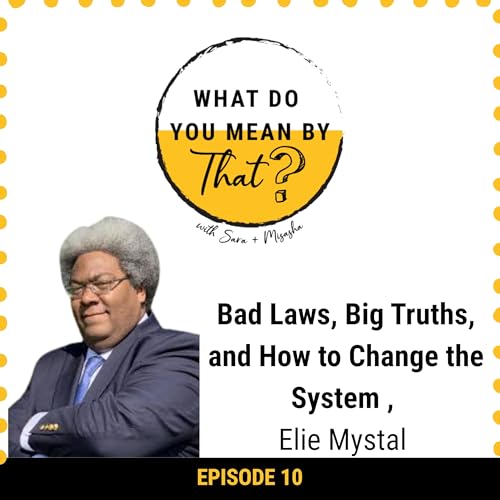
  • 10: Elie Mystal on Bad Laws, Big Truths, and How to Change the System
    Oct 7 2025

    This episode is a must-listen for anyone who's ever felt like legal talk is impossible to understand (👋 Sara included!). We're joined by Elie Mystal, brilliant legal mind, powerful truth-teller, and New York Times bestselling author of Allow Me to Retort: A Black Guy's Guide to the Constitution, to break down the complex world of American law and what Democrats are doing all wrong (and can do better) in a way that's sharp, accessible, and even funny.

    💥 He's back with a bold new book: Bad Law: Ten Popular Laws That Are Ruining America. If you're fired up about the state of our country, about policy that is working frighteningly as intended, or simply want to understand how certain laws are quietly shaping (and harming) everyday life, this conversation is for you.

    What to listen for:

    • The least-legal legal chat we've ever had, including loads of straight-talking humor that makes the truth go down a little easier – on how SCOTUS operates and how we can change it, on the laws we might easily repeal to make tremendous change in our country, and more

    • Why we might be seeing more whitewashing of history, and the truth that we are back to us all needing to educate our own children on this country's true history.

    • That what we are (or aren't) doing now is exactly what we would have been doing during any great catastrophe in history

    • Practical ideas for how YOU can help dismantle harmful laws and make a difference in our country's trajectory.

    This episode is perfect for fans of legal analysis without the jargon, book lovers, including our former Dear White Women book club, and anyone looking to better understand (and change) our current system.

    🎧 Press play, and get ready to rethink what you thought you knew about the law.

    About our guest:

    Elie Mystal is the Justice Correspondent for The Nation, where he writes about politics and social and racial justice. Elie's first book, Allow Me To Retort – A Black Guy's Guide to the Constitution, was on the NYT's bestsellers list in April 2022. His second book, Bad Law: Ten Popular Laws That Are Ruining America, was released in March 2025. Mystal was the executive editor of Above the Law, a website with approximately 2 million unique visitors that focuses on law, courts, and justice. He's known for writing about the law and politics, breaking down Supreme Court decisions, and up-to-the-minute coverage of Supreme Court confirmation battles.

    Off the page, Mystal is a legal contributor to the More Perfect podcast, a Radiolab spinoff, on WNYC. He's appeared regularly on MSNBC since 2018, appearing on All In With Chris Hayes, The Beat With Ari Melber, A.M. Joy with Joy Reid, and Up with David Gura. On the Radio, Mystal has been a frequent guest on the Brian Lehrer Show, the Dean Obedallah Show, and Signal Boost with Zerlina Maxwell. He's also appeared on The Mike Huckabee Show, the Megyn Kelly Show, Red Eye with Greg Gutfeld, and done various appearances on CNBC and Fox Business about legal industry news.

    Mystal received his undergraduate degree in Government from Harvard University, his J.D. from Harvard Law School, and worked as an associate at Debevoise and Plimpton from 2003-2005.

    Más Menos
    54 m
  • 09: The Devil Emails At Midnight, With Mita Mallick
    Sep 23 2025

    Whether you've ever been a boss or have ever had a boss, you know how much those singular individuals can shape the workplace. According to studies, a good manager can increase employee engagement by as much as 70%. And, according to a survey by the American Psychological Association, a whopping 75% of employees report their boss as the worst and most stressful part of their jobs.

    So, how do we know if we're being a good boss or a bad boss? Do we just know, or should we be looking out for specific things?

    Enter the incredible stories that focus on what good leaders can learn from bad bosses, featuring the author of the brand-new book, The Devil Emails at Midnight, Mita Mallick.

    What to listen for:

    • The importance of time in creating a healthier workplace culture

    • Accountability - and how to hold others accountable, as well as check in with yourself

    • What boss archetypes Mita has found most personally challenging

    • The keys to being a good boss

    About our guest

    Mita Mallick is a Wall Street Journal and USA Today best-selling author. She's on a mission to fix what's broken in our workplaces. She's a corporate change-maker with a track record of transforming businesses and has had an extensive career as a marketing and human resources executive. Mallick has brought her talent and expertise to companies like Unilever, Pfizer, AVON, Johnson & Johnson, Carta, and more. She's a highly sought-after speaker and business coach to start-up founders, executives, and CEOs of public companies. Her highly anticipated second book, "The Devil Emails at Midnight: What Good Leaders Can Learn from Bad Bosses," comes out September 30, 2025.

    For more about the book or to purchase The Devil Emails at Midnight: What Good Leaders Can Learn From Bad Bosses, click here: https://www.amazon.com/dp/1394316488

    Más Menos
    24 m
  • 08: How to Be a Better Human: What WE Really Think
    Sep 9 2025

    We had a very insightful superfan make a brilliant suggestion that we're acting on, starting with this episode. David Gaines, author of Radical Business, CEO of La Terza Coffee, and kind human being, sent in a message cheering us on for the podcast rebrand, and then pushed us to do just a bit more. Specifically, he said, "The guests you have on clearly have their brilliance to add to the world, but for me personally, the main reason I listen to your work is that I find a lot of brilliance in your perspectives as you process in real time what your guests are saying."

    Considering that while we are deeply curious human beings who are pretty darn good at interviewing people, we are ALSO speakers who very much have our own brilliant perspectives - his words, not ours - too. So, David, thank you. We're going to weave in more episodes with our thoughts, reflections, and actions based on what we learn from our guests going forward!

    In addition, this fall, we're working on something new for our newsletter subscribers, so make sure you're subscribed to be the first to hear about it!

    And if you're more of an audiophile, based on the fact that you're listening to this podcast, take a moment to check the link

    below to leave an audio recording of your feedback on how we can make this podcast the best it can be for YOU!

    What to listen for:

    • Insight into how we came up with this idea for our 2025 summer series, and how we source our guests.

    • Our favorite takeaways from each one of our summer episodes, including practical tips, general themes, and questions that we're still mulling over.

    • How you can make the podcast better - we're looking for your input!

    CLICK HERE to record yourself giving us feedback on how to make this podcast and newsletter better for you!!!!! https://platform.amoofy.com/record/podcast-feedback/start

    Más Menos
    31 m
  • 07: How to Rest without Feeling Guilty
    Aug 26 2025

    In our last episode of our series on how to be a better human, we're talking about rest. Specifically, what do we mean by rest, and why is it so important? How do we grapple with its significance in our individual and collective lives, and for real, how do we DO LESS? This conversation has become increasingly frequent in our lives, and we wanted to share our thoughts with you. If this resonates, please share with your friends, and tell us how you incorporate rest, in whatever form, into your lives as well.

    What to listen for:

    • How we reframe the idea of rest - from something used as a break from your life to something that is part of your life

    • Ways that we incorporate rest in our everyday lives, for real, with the caveat to make sure we're not judging others for their ability/inability to rest the way we think is best

    • Having no guilt about resting, by drawing on the concepts of Rest as Resistance - pulling ourselves out of the system of exploitative capitalism as per Tricia Hersey's book by the same name

    Resources we mention in this episode:

    The Reclaimed (Whitney Alese) post with ideas of things to do that matter:

    https://www.instagram.com/p/DI_kN69Nb-0/?img_index=1&igsh=aDB2Z2pocXgwNDFr

    The book Rest is Resistance (Tricia Hersey):

    https://bookshop.org/p/books/rest-is-resistance-a-manifesto-tricia-hersey/18255493?ean=9780316365215&next=t

    The Dear White Women episode featuring Kibi Anderson:

    https://www.whatdoyoumeanbythat.com/dwwepisodes/248-for-all-womxn-the-rested-rebel-with-kibi-anderson-hyagx

    A neurologist website about the foods to avoid to quell migraines:

    https://www.gottaheadache.com/

    Más Menos
    24 m