Episodios

  • You React Before You Realize It: The Science of Split-Second Survival
    Apr 12 2026

    Ep 144. Nature is one of the most powerful teachers of human behavior. From the earliest stages of life, we learn one of the most important survival skills: recognizing boundaries. What is safe to approach? What signals danger? What requires distance, caution, or immediate action?

    These lessons form the foundation of how we navigate the world.

    At its highest level, self-regulation is a conscious process. It involves deliberate decision-making—choosing how to respond, how to act, and how to maintain control in a given situation. This is the domain of awareness, intention, and higher-order cognitive processing.

    But there is another level of self-regulation that operates far below conscious awareness.

    This deeper system is rooted in ancient neurological wiring, processing information in milliseconds—often before we are even aware that something has happened. Through fast visual and sensory pathways, the brain rapidly detects potential threats and initiates protective responses. This is the body’s built-in survival intelligence, designed to preserve life without waiting for conscious thought.

    In these moments, behavior is not chosen—it is triggered.

    And when survival is perceived to be at stake, these responses may not always appear socially appropriate. They are efficient, automatic, and focused on one objective: safety and self-preservation.

    This creates a critical challenge in modern life.

    We must learn to operate effectively in a world that requires both rapid instinctive response and refined social interaction.

    This is where deliberate self-regulation becomes essential.

    True mastery lies in bridging the gap between subconscious survival responses and conscious awareness. When we develop the ability to recognize early signals of stress, threat, or activation, we gain the opportunity to influence our response—rather than being controlled by it.

    This is the space where real skill is developed.

    The Running Man Self-Regulation Skills Model operates within this intersection—where milliseconds matter, where awareness meets reaction, and where individuals can train themselves to maintain control across a wide range of environments:

    • High-threat, high-stress situations
    • Dynamic interpersonal and social interactions
    • Everyday decision-making and performance settings

    By training both the conscious and subconscious layers of response, we build not only awareness—but adaptability, composure, and control.

    Self-regulation is not just about staying calm.
    It is about staying effective—no matter the environment.

    Train the body. Train the mind. Recognize the signal early.

    Take care. Walk well.

    Hey folks, let me know what you think about the Running Man Podcast. Let me know where you're from and how you are doing in your little part of the world!

    Support the show

    intro outro music for episodes 1 through 111 done by Jonathan Dominguez Rogue musician. He can be found on youtube at Lazyman2303.

    New musical intro and outro music created by Ed Fernandez guitarist extraordinaire. To get in contact with Ed please send me an email at runningmangetskillsproject@gmail.com and I will forward him the contact.

    Donations are not expected but most certainly appreciated. Any funds will go toward further development of the podcast for equipment as we we grow the podcast. Many thanks in advance.

    https://www.buzzsprout.com/2216464/support

    Más Menos
    30 m
  • The Illusion of Certainty: Why You’re More Wrong Under Stress
    Apr 5 2026

    Ep 143. Certainty is one of the most appealing ideas in human psychology. It promises clarity, predictability, control, and confidence in outcomes. We are drawn to certainty because it feels safe—it reduces ambiguity and gives us the illusion that we can fully understand and control what comes next.

    But certainty, especially under stress, can become a dangerous illusion.

    When we are under pressure, fear, or sudden stress, the brain rapidly interprets incoming information to determine safety or threat. In these moments, emotions can amplify perception. What we feel can quickly become what we believe—and what we believe can feel absolutely certain, even when it is not accurate.

    This is where the myth of certainty emerges.

    Under stress, we are more likely to over-trust our interpretations, assume we are correct, and act on incomplete or distorted information. The nervous system prioritizes speed over accuracy, which means our conclusions may be fast—but not always reliable.

    In reality, life operates on a spectrum of probability, uncertainty, and possibility, not absolute certainty.

    Yet many people respond to uncertainty in one of two ways:

    Overconfidence — believing they are certain when they are not
    Over-preparation — attempting to eliminate all uncertainty before taking action

    This second pattern can lead to what might be called “preparation paralysis”—a state where fear of the unknown prevents forward movement. The mind exaggerates risk, amplifies worst-case scenarios, and creates a hyperbolic sense of danger that keeps us from acting.

    The result: hesitation, avoidance, and missed opportunity.

    This is where self-regulation skills become essential.

    Self-regulation allows us to remain centered, grounded, and rational—even in uncertain or high-pressure situations. By regulating the body through breath, awareness, and physiological control, we create space between stimulus and response. This space allows for clearer thinking, better decision-making, and more accurate interpretation of reality.

    Instead of reacting to fear, we begin to respond with clarity.

    Instead of seeking certainty, we learn to operate effectively within uncertainty.

    And that is where true confidence is built.

    Not in knowing everything—but in trusting our ability to navigate what we do not know.

    Certainty may feel powerful.
    But adaptability is what makes us effective.

    Train your awareness. Regulate your state. Act with clarity.

    Take care. Walk well.

    Hey folks, let me know what you think about the Running Man Podcast. Let me know where you're from and how you are doing in your little part of the world!

    Support the show

    intro outro music for episodes 1 through 111 done by Jonathan Dominguez Rogue musician. He can be found on youtube at Lazyman2303.

    New musical intro and outro music created by Ed Fernandez guitarist extraordinaire. To get in contact with Ed please send me an email at runningmangetskillsproject@gmail.com and I will forward him the contact.

    Donations are not expected but most certainly appreciated. Any funds will go toward further development of the podcast for equipment as we we grow the podcast. Many thanks in advance.

    https://www.buzzsprout.com/2216464/support

    Más Menos
    29 m
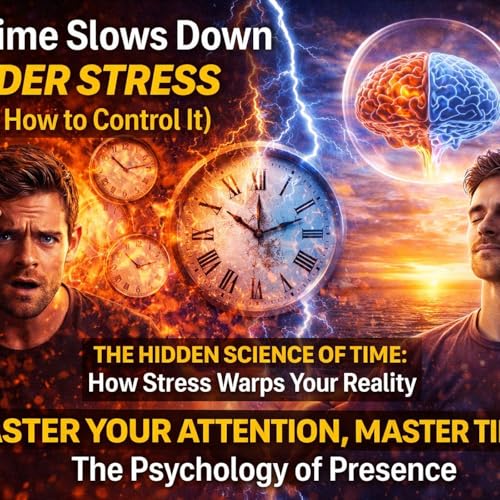
  • Why Time Slows Down Under Stress And How to Control It
    Mar 30 2026

    Ep 142. Under stress, the perception of time can shift dramatically. In moments of excitement or positive stress, time can feel fast, fluid, and fleeting. But in moments of fear, uncertainty, or shock, time can appear to slow down—or even feel like it stops entirely. This is not imagination. It is the nervous system adjusting perception in real time to help us survive and respond.

    The human brain is built for efficiency and prediction. Through pattern recognition, it constantly anticipates what will happen next in order to conserve energy and respond quickly to potential threats. This predictive nature allows us to move through life efficiently—but it also creates a hidden cost.

    We begin to live outside of the present moment.

    Our attention shifts toward the past—what has already happened—or toward the future—what we expect might happen. In doing so, we unintentionally sacrifice the richness and clarity of what is happening right now. The present moment becomes compressed, overlooked, or filtered through expectation and fear.

    Attention itself requires energy. And when that attention is constantly directed toward anticipated stress, danger, or uncertainty, it creates cognitive fatigue, emotional strain, and unnecessary tension in the nervous system.

    This is why self-regulation skills are essential.

    When we learn to regulate our physiological response to stress—through breath control, awareness, and intentional focus—we begin to reclaim our attention. We become more accurate in reading our environment. We respond earlier, more efficiently, and with less emotional cost.

    Instead of reacting to imagined threats, we begin to respond to reality.

    This shift allows us to move through life with greater clarity, reduced distress, and improved performance. It enhances our ability to stay present, conserve energy, and create higher-quality experiences in real time.

    And something important happens:

    When we improve the quality of our present moment, we naturally begin to build a more stable, more grounded, and more fulfilling future.

    Mastering time is not about controlling the clock—it is about mastering attention, perception, and response.

    Train your awareness. Regulate your state. Experience time fully.

    Walk well.

    Hey folks, let me know what you think about the Running Man Podcast. Let me know where you're from and how you are doing in your little part of the world!

    Support the show

    intro outro music for episodes 1 through 111 done by Jonathan Dominguez Rogue musician. He can be found on youtube at Lazyman2303.

    New musical intro and outro music created by Ed Fernandez guitarist extraordinaire. To get in contact with Ed please send me an email at runningmangetskillsproject@gmail.com and I will forward him the contact.

    Donations are not expected but most certainly appreciated. Any funds will go toward further development of the podcast for equipment as we we grow the podcast. Many thanks in advance.

    https://www.buzzsprout.com/2216464/support

    Más Menos
    27 m
  • Is It Your Personality… or Just Stress? The Truth About Who You Are
    Mar 22 2026

    Ep 141. Personality is often treated as something fixed—an identity we carry and a label others use to define us in social life. In psychology, personality is commonly understood as the product of environment, upbringing, conditioning, and repeated exposure to life experiences.

    But what if much of what we call “personality” is not who we truly are?

    What if it is simply how we have learned to respond under stress?

    When stress—especially chronic stress—becomes a constant in our lives, it begins to shape our thoughts, emotions, and behaviors. Over time, repeated stress responses can become so familiar that we begin to identify with them:

    “I am anxious.”
    “I am angry.”
    “I am always tense.”
    “I am a worrier.”

    But neuroscience and biology tell a deeper story.

    Research shows that the brain is highly adaptable (neuroplasticity). Stress doesn’t just affect how we feel—it physically shapes neural pathways and reinforces patterns of reactivity. The more often we respond to stress in the same way, the more automatic that response becomes.

    This is where confusion happens.

    We begin to mistake stress reactivity for personality.

    In reality, many of these traits are not fixed identity—they are conditioned responses developed through repeated exposure to stress over time.

    The good news is that this process can be reversed.

    By practicing physiological self-regulation techniques—such as controlled breathing, body awareness, and nervous system regulation—we can begin to change how the body responds in real time. This is not just cognitive reframing or positive thinking. It is training the body itself to respond differently under pressure.

    With consistent practice, the nervous system becomes more familiar with calm, control, and stability—even in high-stress situations.

    And something powerful begins to happen:

    We shift from reaction to response.

    We begin to experience ourselves not as the stress patterns we’ve learned—but as the person beneath them.

    This is the difference between:
    “This is who I am”
    and
    “This is how I’ve been responding.”

    Through self-regulation, we reclaim authorship over our internal state. We rediscover clarity, presence, and a more authentic sense of self—one that is not defined by fear, anxiety, or chronic tension.

    Personality is not always permanent.
    Much of it is practice.

    And with new practice, new patterns—and a new experience of self—can emerge.

    Take care. Walk well.

    Hey folks, let me know what you think about the Running Man Podcast. Let me know where you're from and how you are doing in your little part of the world!

    Support the show

    intro outro music for episodes 1 through 111 done by Jonathan Dominguez Rogue musician. He can be found on youtube at Lazyman2303.

    New musical intro and outro music created by Ed Fernandez guitarist extraordinaire. To get in contact with Ed please send me an email at runningmangetskillsproject@gmail.com and I will forward him the contact.

    Donations are not expected but most certainly appreciated. Any funds will go toward further development of the podcast for equipment as we we grow the podcast. Many thanks in advance.

    https://www.buzzsprout.com/2216464/support

    Más Menos
    30 m
  • Confidence Under Pressure: The Skill Most People Never Train
    Mar 14 2026

    Ep 140. In a stressful life, confidence can feel like a fragile commodity. When stress, fear, and anxiety become frequent visitors in our personal world, our sense of certainty and control can disappear quickly. The human nervous system is constantly scanning the environment for signals of safety or threat. Every moment, our internal state responds to cues from the outside world, telling us whether we are secure or at risk.

    Because of this, confidence is not simply a personality trait—it is often the result of nervous system regulation and emotional resilience.

    This is where self-regulation skills become essential. Self-regulation allows us to navigate both high-stress situations and everyday experiences with greater clarity, composure, and control. When we learn how to manage our breathing, focus our attention, and regulate emotional responses, we create the internal conditions necessary for better decision-making, stronger relationships, and higher-quality experiences in life.

    But developing self-regulation is not as simple as telling ourselves, “Next time I feel anxious, I’ll just breathe and everything will be fine.” Real skill development does not happen through wishful thinking.

    It happens through practice.

    Just like riding a bicycle, learning a new language, swimming, or mastering a piece of software, emotional regulation requires repetition and training. Over time, deliberate practice builds familiarity within the nervous system. What once felt overwhelming begins to feel manageable. What once caused hesitation or avoidance begins to feel like a challenge we can face with composure.

    This process is known as building conscious competence. Through repeated exposure and intentional practice, the mind and body begin to understand how to respond effectively under pressure.

    Eventually, something powerful happens: confidence begins to emerge naturally.

    When we have practiced self-regulation during low-stakes moments—through breathing techniques, awareness training, and emotional control—our nervous system becomes prepared for higher-stakes situations. Stressful environments that once caused fear, anxiety, or avoidance begin to feel more navigable.

    Over time, the skills become second nature.

    We begin to walk into situations that once triggered stress with greater ease and clarity. Confidence is no longer something we hope for—it becomes something we carry with us, built through experience and practice.

    The path is simple, though not always easy:
    Practice the skill until the skill becomes who you are.

    Take care. Walk well.


    Hey folks, let me know what you think about the Running Man Podcast. Let me know where you're from and how you are doing in your little part of the world!

    Support the show

    intro outro music for episodes 1 through 111 done by Jonathan Dominguez Rogue musician. He can be found on youtube at Lazyman2303.

    New musical intro and outro music created by Ed Fernandez guitarist extraordinaire. To get in contact with Ed please send me an email at runningmangetskillsproject@gmail.com and I will forward him the contact.

    Donations are not expected but most certainly appreciated. Any funds will go toward further development of the podcast for equipment as we we grow the podcast. Many thanks in advance.

    https://www.buzzsprout.com/2216464/support

    Más Menos
    31 m
  • Time Poverty vs Flow State: Mastering Your Experience of Time
    Mar 7 2026

    Ep 139. Time is one of the most powerful forces shaping human experience. Yet most people feel as though they never have enough of it. Deadlines, responsibilities, emergencies, and perceived threats create a psychological compression of time. In moments of urgency or danger, the nervous system shifts into survival mode, and our sense of time becomes intensified. Seconds feel precious, decisions feel heavier, and pressure increases.

    But the human experience of time is not fixed—it is deeply influenced by our state of awareness, emotional regulation, and perception.

    When we are in harmony with time, life feels different. Instead of urgency and pressure, we experience flow—a state where attention becomes fully engaged in the present moment. In this state, time can feel expansive. Minutes pass gently. Creativity increases. Gratitude and curiosity arise naturally. Rather than feeling rushed, we feel grounded, focused, and connected to what we are doing.

    Psychologists sometimes describe the opposite experience as “time poverty.” When we feel time-poor, our awareness is dominated by the sense that time is slipping away too quickly. We become trapped in what could be called uptime awareness—constantly watching the clock, anticipating the next obligation, and feeling that there is never enough space to breathe.

    Fortunately, our relationship with time can be trained.

    Practices such as mindfulness, gratitude, present-moment awareness, and intentional focus can expand our subjective experience of time. When we cultivate appreciation and presence, the mind slows down enough to perceive more detail, more opportunity, and more possibility within each moment.

    Over time, this becomes a skill.

    Learning to regulate our perception of time allows us to perform better under pressure and experience greater enjoyment in daily life. This ability becomes a powerful resource for self-regulation, emotional control, and performance across many domains—including work, athletics, martial arts training, self-defense, learning environments, and academic performance.

    Mastering time is not about controlling the clock. It is about mastering the state of mind that experiences it.

    With awareness, intention, and practice, time can move from being a source of pressure to becoming a resource for clarity, resilience, and grace under pressure.

    Take care. Walk well.

    Hey folks, let me know what you think about the Running Man Podcast. Let me know where you're from and how you are doing in your little part of the world!

    Support the show

    intro outro music for episodes 1 through 111 done by Jonathan Dominguez Rogue musician. He can be found on youtube at Lazyman2303.

    New musical intro and outro music created by Ed Fernandez guitarist extraordinaire. To get in contact with Ed please send me an email at runningmangetskillsproject@gmail.com and I will forward him the contact.

    Donations are not expected but most certainly appreciated. Any funds will go toward further development of the podcast for equipment as we we grow the podcast. Many thanks in advance.

    https://www.buzzsprout.com/2216464/support

    Más Menos
    25 m
  • The Truth About Reinventing Yourself: How Dreams Transform Identity
    Feb 21 2026

    Ep 138. Achieving a dream is never a single moment—it is the culmination of sustained effort, sacrifice, discipline, and unwavering direction. It represents the gradual construction of a new level of skill, capability, confidence, and identity. What appears externally as success is internally the result of thousands of unseen decisions, moments of resilience, and acts of courage.

    Every transformation begins with a single step. The process is not instantaneous—it is a journey of personal growth, skill acquisition, and psychological evolution. Many people describe this process as “reinventing themselves,” but in truth, we do not become someone else. We become a deeper, more capable, more refined version of who we have always been.

    Through challenge, adversity, and persistence, knowledge accumulates. Experience sharpens perception. Courage strengthens identity. Transformation is not replacement—it is expansion.

    Like the caterpillar that becomes the butterfly, the human being evolves by degree and magnitude. The same core individual remains, but elevated by discipline, awareness, and earned competence. The person who began the journey and the person who completes it are connected by effort—but separated by growth.

    When we reach what once appeared to be the pinnacle, we discover it is not an endpoint. It is a platform. A foundation from which to build further excellence, deeper mastery, and meaningful contribution. True achievement is not arrival—it is readiness for the next ascent.

    This is where purpose expands beyond the self. Those who have walked the path of growth gain the ability to mentor, guide, and inspire others. They become living proof that transformation is possible. They bring value, encouragement, and clarity to those who feel confined by limitation or mediocrity.

    Personal mastery creates leaders. Leaders create possibility. Possibility creates generational change.

    Growth is earned through courage. Identity is shaped through action. Destiny is revealed through persistence.

    Become who your effort has prepared you to be.

    Take care. Become. Walk well.

    Hey folks, let me know what you think about the Running Man Podcast. Let me know where you're from and how you are doing in your little part of the world!

    Support the show

    intro outro music for episodes 1 through 111 done by Jonathan Dominguez Rogue musician. He can be found on youtube at Lazyman2303.

    New musical intro and outro music created by Ed Fernandez guitarist extraordinaire. To get in contact with Ed please send me an email at runningmangetskillsproject@gmail.com and I will forward him the contact.

    Donations are not expected but most certainly appreciated. Any funds will go toward further development of the podcast for equipment as we we grow the podcast. Many thanks in advance.

    https://www.buzzsprout.com/2216464/support

    Más Menos
    30 m
  • Fix Your Sleep, Fix Your Life: The Science of Rest, Recovery, and Resilience
    Feb 8 2026

    Ep 137. Sleep, hydration, and nutrition are the three foundations of human survival and performance. No matter where we live or what challenges we face, every person depends on quality rest, clean water, and healthy food to function, adapt, and thrive.

    Among these essentials, sleep is the most powerful and often the most neglected. Sleep directly affects physical health, emotional balance, cognitive performance, and nervous system regulation. When sleep is disrupted by insomnia, stress, or irregular schedules, cortisol levels rise, inflammation increases, and the body enters a state of chronic survival mode.

    Over time, poor sleep creates a cascade of downstream health problems—fatigue, anxiety, weakened immunity, impaired focus, mood instability, and reduced emotional resilience. As sleep quality declines, so does our ability to self-regulate, manage stress, and maintain psychological well-being.

    Substances such as alcohol, THC, and excessive use of sleep supplements like melatonin can interfere with natural sleep architecture. While they may seem helpful in the short term, they often disrupt REM cycles, increase vivid dreams or nightmares, and reduce deep restorative sleep.

    For individuals with sleep-disordered breathing, CPAP therapy has been associated with improved sleep quality, reduced nightmares, lower cortisol levels, and better long-term health outcomes. Restoring healthy breathing during sleep allows the nervous system to exit chronic alert mode and return to baseline regulation.

    More than any supplement, stimulant, or productivity hack, sleep remains the most effective performance enhancer available. It accelerates physical recovery, strengthens emotional resilience, sharpens decision-making, and supports long-term mental clarity.

    When you protect your sleep, you protect your health, your focus, and your capacity to live with intention.

    Take care, and walk well.

    Hey folks, let me know what you think about the Running Man Podcast. Let me know where you're from and how you are doing in your little part of the world!

    Support the show

    intro outro music for episodes 1 through 111 done by Jonathan Dominguez Rogue musician. He can be found on youtube at Lazyman2303.

    New musical intro and outro music created by Ed Fernandez guitarist extraordinaire. To get in contact with Ed please send me an email at runningmangetskillsproject@gmail.com and I will forward him the contact.

    Donations are not expected but most certainly appreciated. Any funds will go toward further development of the podcast for equipment as we we grow the podcast. Many thanks in advance.

    https://www.buzzsprout.com/2216464/support

    Más Menos
    28 m