

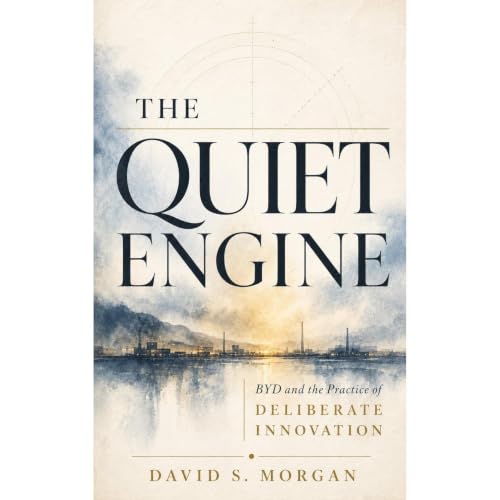
The Quiet Engine
BYD and the Practice of Deliberate Innovation
Failed to add items
Add to Cart failed.
Add to Wish List failed.
Remove from wishlist failed.
Adding to library failed
Follow podcast failed
Unfollow podcast failed
Get 30 days of Standard free

The Quiet Engine
Buy for $10.99
-
Narrated by:
-
Virtual Voice
-
By:
-
David S Morgan

This title uses virtual voice narration
In 2011, Elon Musk was asked whether BYD was a threat to Tesla. He laughed.
By 2025, the company he waved away had become the world's largest maker of electric and plug-in hybrid vehicles. The laugh wasn't ignorance — it was the entirely rational verdict of the best available tools, applied to the available evidence. The tools were simply wrong about what to look for.
Some of the most formidable companies in the world spend years, even decades, building decisive advantage in a register our evaluation systems are not built to detect. Their metrics look unremarkable. Their founders make no headlines. By the time the advantage becomes visible, it has already compounded for so long that competitors cannot close the gap. David S. Morgan calls this the Quiet Engine — and argues that the very instruments we trust to read competition are systematically blind to the thing that matters most.
Drawing on the formation histories of BYD, TSMC, Novo Nordisk, Corning, and Toyota, The Quiet Engine traces how durable advantage actually forms: slowly, under constraint, in the routines and accumulated knowledge no quarterly report can capture. From these cases Morgan builds a working framework — six laws of Deliberate Innovation, six signals that mark a Quiet Engine before it becomes obvious, and a typology that locates any organization's competitive activity in the landscape the book describes.
This is a book for the people in the room where the decision gets made: executives, board members, investors, strategists, and operators who evaluate companies, allocate capital, or build capability under pressure to show results that deep formation does not yet produce.
The Quiet Engine is running somewhere right now. It is being misread by systems working exactly as designed. The question is whether you will recognize it — or encounter it, as others have, at the moment it becomes impossible to ignore.