

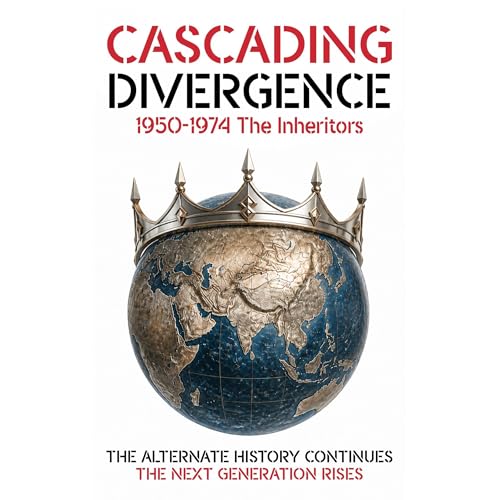
CASCADING DIVERGENCE
1950-1974 The Inheritors (12th Story in a Saga of a World Transformed by the Untimely Loss of Winston Churchill)
Failed to add items
Sorry, we are unable to add the item because your shopping cart is already at capacity.
Add to Cart failed.
Please try again later
Add to Wish List failed.
Please try again later
Remove from wishlist failed.
Please try again later
Adding to library failed
Please try again
Follow podcast failed
Please try again
Unfollow podcast failed
Please try again
Get 30 days of Standard free
 Prime members? New to Audible? You receive a 2 month trial instead.
Auto-renews at $8.99/mo after 30-day trial. Cancel anytime

CASCADING DIVERGENCE
Narrated by:
Virtual Voice
Buy for $9.99
-
Narrated by:
-
Virtual Voice
-
By:
-
Ron Wood

This title uses virtual voice narration
Virtual voice is computer-generated narration for audiobooks.
Here’s What Unfolds in This Gripping Sequel to CASCADING DIVERGENCE 1949 Fault Lines:
• A World Made Permanent
Otto Hitler, Alessandra Mussolini, and Crown Prince Akihito grow up inside systems designed to make empire feel natural. Otto is shaped by German science, discipline, rockets, and orbital command. Alessandra is raised as the graceful face of Rome’s imperial future, a child taught to make conquest look like family. Akihito, heir to Japan’s sacred line, becomes the Storm Prince after a desperate typhoon rescue proves that courage can serve even a brutal empire.
• Technology Becomes Memory
Rockets, satellites, television, computers, registries, highways, aircraft, and space stations transform the struggle for power. Germany races into orbit and toward the Moon. Japan follows with determination, naval discipline, and fear of German dominance above the Earth. Italy uses screens, settlement films, and Alessandra’s image to make African empire appear warm, Catholic, fertile, and inevitable. Across all three Axis worlds, machines do more than move people and information. They teach societies what to remember—and what to forget.
• The Bounded Free World
The United States and the Freedom Federation remain armed, wealthy, constitutional, and alive behind the Pan-American Security Zone and Project Aegis. But survival has narrowed their imagination. As Richard Vale comes of age in the reduced free world, he sees Federation debate, caution, and legal restraint set against Axis order, certainty, technology, and dynastic continuity. He does not reject freedom. But he begins to wonder whether freedom can endure if it looks weaker than command.
Why Readers Are Drawn to This Series
• A Realistic Generational Alternate History – This installment moves beyond battlefield victory into the deeper question of what happens when empires survive long enough to educate children, build institutions, control memory, and make conquest look ordinary..
• Power Without Constant War – The Inheritors explores how domination can be maintained through schools, families, screens, registries, ceremonies, technology, diplomacy, settlement, and the quiet conversion of violence into normal life.
• Technology with Moral Consequence – This book stands on its own as a new generational entry point while deepening the long, cascading consequences of earlier choices across Germany, Italy, Japan, Britain, America, South America, and the Freedom Federation.
• Independent Yet Interconnected – This book stands on its own while deepening the long, cascading consequences of earlier decisions across Germany, Italy, Japan, Britain, America, and the Freedom Federation.
A Closer Look…
1950–1974 The Inheritors is a novel about the world after victory has hardened into permanence. The Axis powers no longer rely only on conquest. They build schools, families, ceremonies, technologies, and myths powerful enough for the next generation to inherit without questioning the crimes beneath them.
At the center of this new age stand four young figures: Otto Hitler, Alessandra Mussolini, Crown Prince Akihito, and Richard Vale. Three are heirs of victorious empires. One is a son of the surviving free world. Each grows up watching order, technology, fear, courage, family, and propaganda compete to define the future.
Perfect for readers of realistic alternate history, 1950–1974 The Inheritors explores enduring questions about empire, memory, technology, freedom, inheritance, moral compromise, and the danger of a world where tyranny no longer looks temporary—but civilized, modern, and permanent.
adbl_web_anon_alc_button_suppression_t1
People who viewed this also viewed...
No reviews yet