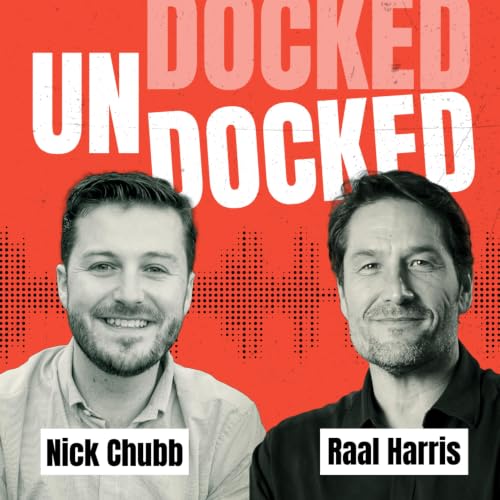
UnDocked: The Maritime Transformation Show Podcast By Raal Harris and Nick Chubb cover art

UnDocked: The Maritime Transformation Show

UnDocked: The Maritime Transformation Show

By: Raal Harris and Nick Chubb
Listen for free

This Season's Biggest Deal | $0.99/mo for 3 months + $20 Audible bonus

$8.99/mo thereafter—terms apply.
Summary
Undocked is a weekly podcast where Nick Chubb and Raal Harris explore what’s changing in maritime and technology. Through candid conversations and guest interviews, the show unpacks emerging trends, overlooked stories, and strategic insights, offering a fresh, unfiltered perspective on the evolving future of one of the world’s oldest industries.2026 Raal Harris and Nick Chubb
Episodes
  • The Microsoft Outage and FAA Ground Stop: Lessons for Maritime's IT Resilience Debate
    Nov 19 2026

    The global Microsoft 365 outage raises uncomfortable questions about how businesses prepare for technology failures. If your email, communications and critical software suddenly become unavailable, how much of your organisation can continue operating?

    This week, Nick Chubb and Raal Harris examine the hidden dependencies behind shipping's digital infrastructure, the fragility of global supply chains and what Alfa Laval's $700 million acquisition of NAVTOR could mean for maritime software.

    CHAPTERS

    05:02 How businesses coped without critical cloud services
    09:49 The hidden dependencies behind cloud infrastructure
    12:28 AI investment, reliability and cascading failures
    16:38 Nvidia's leadership shock and AI infrastructure risk
    20:02 Preparing for the failure of a major technology provider
    22:00 Supply-chain resilience beyond IT infrastructure
    27:40 National risk planning and just-in-time supply chains
    32:50 Crisis communications and mapping vendor dependencies
    38:09 Alfa Laval's $700 million NAVTOR acquisition
    41:55 Bringing NAVTOR, StormGeo and Portchain together
    47:14 NAVTOR's acquisition history and overlapping products
    52:05 Can industrial companies successfully integrate software businesses?
    54:43 Splash Crew, seafarer fatigue and hours-of-rest concerns

    Nick and Raal open with the widespread disruption to Microsoft 365 services and the practical implications for businesses that rely on a handful of major technology providers. With companies reverting to telephone calls and alternative communication methods, they question whether modern organisations adequately understand their technological dependencies.

    The discussion considers the trade-off between efficiency and resilience, including whether the pressure to invest in AI and innovation risks diverting attention from infrastructure reliability. Even maintaining multiple technology suppliers may provide limited protection if those suppliers depend on the same underlying systems.

    Raal broadens the discussion to global supply chains, examining how concentrated production, limited inventories and shared infrastructure can turn relatively isolated disruptions into much larger problems. The hosts consider what meaningful resilience looks like when multiple systems fail simultaneously.

    Attention then turns to Alfa Laval's $700 million acquisition of NAVTOR. Nick explains the industrial group's growing maritime software portfolio, while Raal examines the challenges of integrating acquired businesses. With StormGeo and Portchain already in the portfolio, the acquisition raises questions about overlapping products, customer requirements and whether consolidation can deliver the expected benefits without compromising innovation.

    EPISODE PARTNER

    Most organisations think about carbon reporting in terms of deadlines and regulations.

    The leading ones are already using real-time carbon data to sharpen decisions, not just file returns.

    With EU ETS now covering the full voyage and IMO's GHG Fuel Intensity standard arriving from January 2028, the fleets ahead of the curve are the ones measuring performance continuously.

    Insight and SmartSea make that possible by combining CarbonLnk IoT sensors, Insight's data orchestration and HPE GreenLake infrastructure into one connected approach to carbon management.

    Because when you can measure performance in real time, compliance becomes another opportunity to improve the business.

    Turn compliance into commercial advantage with Insight.

    Show more Show less
    1 hr and 1 min
  • Looking Back at Crew Connect 2026 with Seatrade Maritime’s Marcus Hand
    Nov 12 2026

    Seatrade Maritime’s Marcus Hand joins Nick Chubb and Raal Harris to unpack Crew Connect 2026 in Manila: a crewing agenda reshaped by geopolitical risk, emerging technology and persistent workforce pressures. They explore what the industry’s more candid debates reveal about seafarer safety, training, fatigue and the future of maritime careers.

    CHAPTERS

    • 03:49 What has changed in crewing?
    • 08:31 Geopolitics and seafarer safety
    • 16:09 Alternative fuels and training costs
    • 21:37 AI, digital skills and technostress
    • 28:13 Welfare, fatigue and career progression
    • 35:58 Rethinking the seafarer shortage
    • 40:25 Inclusion and changing career expectations
    • 44:35 Connectivity and ship-shore communication
    • 52:14 Uncertainty and the industry's priorities

    Reflecting on Crew Connect in Manila, Raal Harris and Seatrade Maritime's Marcus Hand bring Nick Chubb up to speed on a conference where geopolitics displaced much of the traditional technical agenda. For the Philippines, conflict-zone risks are not abstract: seafarer safety is both a national priority and a family concern.

    The conversation examines who pays for alternative-fuel training, the growing influence of AI and the uneven digital skills of incoming seafarers. Welfare debates are becoming more practical, with fatigue, career progression and employment models exposing weaknesses in how shipping recruits and retains talent. Even the familiar seafarer shortage narrative faces scrutiny, particularly the distinction between available applicants and experienced officers.

    Finally, the trio consider lessons from cruise-sector employment practices and whether improved connectivity is genuinely helping crews or introducing new workloads and dependencies. The overriding theme is uncertainty, and the importance of more candid industry conversations.

    EPISODE PARTNER

    This episode is sponsored by OneOcean

    On Tuesday 17 November, Nick Chubb will host the next webinar in OneOcean's See Further series, asking: what does effective loss prevention actually look like in practice?

    When something goes wrong on one ship, how do you make sure another crew doesn't face the same problem?

    He will be joined by Christopher Saunders, Chief Maritime Officer at RightShip, and John Hissey from OneOcean, who spent four years working in loss prevention at Britannia P&I.

    The event will use real case studies to explore how operators can recognise risks earlier, learn from incidents and prevent them happening again.

    It's live at 11 am GMT, and you can register using this link: https://zoom.us/webinar/register/5617944785391/WN_d7RP_oc6Rqy2ezufNzjiZg

    Show more Show less
    57 mins
  • Transitioning to Digital Seafarer Certificates, Baltic Sea Surveillance, and GPS Spoofing
    Nov 5 2026

    Digitalising seafarer credentials sounds straightforward, but replacing paper certificates with PDFs only solves part of the problem. In this episode of UnDocked, Nick Chubb and Raal Harris discuss new Thetius research into making crew qualifications more secure, interoperable and seafarer-friendly. They also cover Baltic maritime surveillance, GPS spoofing, a potential solution to shipping's 'sail fast and wait' problem and robotic hull cleaning.

    CHAPTERS

    05:20 Crew Connect Manila
    06:14 Thetius research into digital seafarer certification
    10:30 Why PDF certificates aren't digital transformation
    15:55 The risks of losing seafarer certificates
    19:27 Nick creates a fake certificate using Claude in 11 minutes
    20:54 How secure digital credentials could work
    24:43 Offline verification and connectivity challenges
    27:41 The interoperability challenge across flag states
    29:56 Industry recommendations and who should pay
    35:06 Why seafarer trust and adoption matter
    37:59 Bornholm's maritime surveillance mystery
    43:17 AIS vulnerabilities and tracking dark vessels
    45:01 GPS spoofing, jamming and maritime navigation risks
    46:38 What happens when a ship loses GPS?
    50:45 Could computer vision revive celestial navigation?
    51:46 StormGeo acquires Portchain: just-in-time arrivals
    56:12 Robotics, shipyard jobs and automation

    Nick and Raal begin with Securing Trust: The Transition to Digital Seafarer Credentials, new research from Thetius commissioned by Maritime Passport.

    The report examines how shipping can move beyond fragmented paper-based certification towards a system that allows qualifications to be securely issued, held and independently verified.

    Nick recounts the experience of a master mariner carrying 4kg of certificates and demonstrates how he created a convincing fake training certificate using AI in just 11 minutes.

    They discuss the importance of common standards, protecting personal information, offline verification and ensuring seafarers retain control over their credentials without having to pay for access to their right to work.

    The conversation then moves to an unusual story from the Danish island of Bornholm, where a mysterious request to install coastal surveillance cameras eventually leads to Windward's acquisition of Azimut AI. Nick explains how computer vision could help track vessels operating without AIS.

    Raal raises concerns about GPS interference, prompting a discussion about the vulnerability of interconnected bridge systems and whether traditional navigation skills, including celestial navigation, deserve renewed attention.

    Next, StormGeo's acquisition of Portchain offers a potential route towards better coordination between vessel arrivals and terminal availability, tackling the persistent inefficiency of ships sailing at speed only to wait outside port.

    Finally, Cargill's partnership with Neptune Robotics brings robotic hull cleaning into focus, with Nick and Raal considering the opportunities for safer maintenance and improved vessel efficiency.

    Read the Thetius report:
    https://thetius.com/securing-trust-the-transition-to-digital-seafarer-credentials/

    EPISODE PARTNER

    This episode is sponsored by Insight.

    What if compliance simply happened as your business operated, instead of being chased after the fact?

    That's the advantage of building NIS2 cyber requirements, IMO safety compliance and EU ETS reporting directly into operational workflows from the outset — not bolted on afterwards. Insight and SmartSea make that possible with an integrated digital approach that keeps these requirements running in the background of daily operations, not as a separate compliance project.

    Because when compliance is built into how the fleet runs, it becomes another driver of performance, not a drag on it.

    Protect your maritime estate with Insight.

    Show more Show less
    1 hr and 1 min
adbl_web_anon_alc_button_suppression_t1
No reviews yet
adbl_web_global_use_to_activate_webcro_2487_promo_pdp_banner_buybox_T2_holiday_sweetener