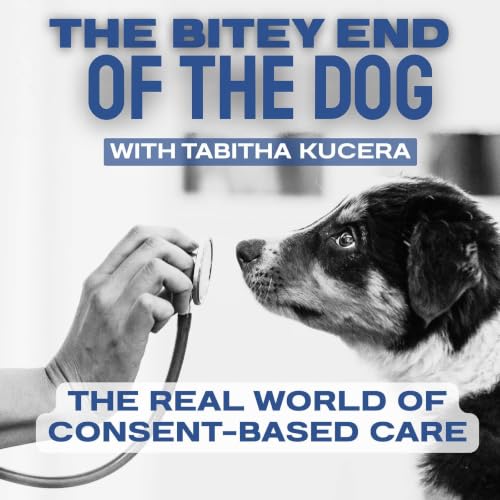
The Bitey End of the Dog Podcast By Michael Shikashio CDBC cover art

The Bitey End of the Dog

The Bitey End of the Dog

By: Michael Shikashio CDBC
Listen for free

Prime Member Exclusive | $0.99/mo for 4 months + $20 Audible credit

$8.99/mo thereafter—terms apply.

A podcast dedicated to helping dogs with aggression issues. Michael Shikashio CDBC chats with experts from around the world on the topic of aggression in dogs!

© 2026 The Bitey End of the Dog
Episodes
  • Dog Welfare: Are We Giving Dogs the Lives They Actually Want?
    Sep 21 2026

    Your dog can be loved, well-fed, and perfectly “trained” and still be living a life that doesn’t feel good to them. That’s the uncomfortable heart of animal welfare, and it’s why I sat down with Kim Brophey and veterinary behaviorist Dr. Carlo Siracusa for a wide-ranging, nuanced conversation about what quality of life really means for dogs.

    For the season finale of The Bitey End of the Dog, we dig into a definition of animal welfare that’s easy to say but hard to live by: the dog’s quality of life as perceived by the dog. From there, we explore positive welfare, the Five Domains, and why measuring welfare can’t rely on one snapshot moment. We talk about behavioral diversity as a concrete way to notice when a dog is thriving versus when their world is getting smaller, and we discuss agency and choice as the missing ingredient in many “perfect on paper” dog lives.

    Then we take on aggression through a welfare lens. When is aggressive behavior normal communication that deserves to be heard, and when is it a sign of deeper dysregulation or compromised welfare? We also get specific about the relationship of physical health and behavior, including pain, resilience, and the role of behavior medication. Dr. Siracusa explains why meds can support welfare when used thoughtfully, and why the bigger risk is often unregulated, low-quality behavior modification.

    If you care about dog behavior, dog training ethics, enrichment, and humane aggression work, this one will challenge your assumptions in the best way.

    Learn more about Kim:
    https://www.familydogmediation.com/

    Learn more about Dr. Siracusa:
    https://www.vet.upenn.edu/directory/carlosiracusa/

    Learn more about options for help for dogs with aggression here:
    AggressiveDog.com

    Learn more about the CANIS Conference here:
    CANIS Conference

    Subscribe to the bonus episodes available here:
    The Bitey End of the Dog Bonus Episodes

    Check out all of our webinars, courses, and educational content here:
    Webinars, courses, and more!

    Show more Show less
    1 hr and 7 mins
  • What Really Predicts Dog Bites? With Dr. Helen Howell
    Sep 7 2026

    You can’t “test” your way to certainty about whether a dog will bite—and provoking a dog during an assessment may tell us very little about the risk that dog presents in the real world.

    In this episode, I’m joined by Dr. Helen Howell, a forensic behaviorist and expert witness who works on serious injury and fatality cases. We talk about what a modern dog bite risk assessment should look like when the goal is not only to assess risk, but also to identify practical ways to reduce it.

    Helen brings a unique combination of experience to this work, including 16 years as a police officer and detective, along with her background in clinical animal behavior. Her approach asks us to look beyond the dog and consider the entire picture: the environment, daily management, human behavior, training history, predictability and routine, as well as the caregiver’s ability and willingness to manage risk.

    We also discuss why provocative assessments can be both ethically concerning and scientifically unreliable. Helen explains how structured professional judgment—a model used in forensic psychology—can provide a more consistent, evidence-based way to assess whether a dog presents a low, moderate, or high risk while still accounting for the individual circumstances of each case.

    Helen walks us through the DBR24, which considers 24 risk factors along with the potential impact of a bite, and the DBR Triage tool, designed to help nonspecialists recognize possible risks in homes with children or vulnerable people. We also explore factors such as pain, aversive methods, inconsistent training, human behavior, and the limitations created by poorly recorded dog bite data.

    If you work with aggression, human-directed aggression, legal cases, or dog bite prevention, this conversation offers a thoughtful and practical framework for assessing risk while improving safety and welfare for both dogs and people.


    About Helen:
    https://www.dogbehaviourexpert.co.uk/

    Learn more about options for help for dogs with aggression here:
    AggressiveDog.com

    Learn more about the CANIS Conference here:
    CANIS Conference

    Subscribe to the bonus episodes available here:
    The Bitey End of the Dog Bonus Episodes

    Check out all of our webinars, courses, and educational content here:
    Webinars, courses, and more!

    Show more Show less
    58 mins
  • The Real World of Consent-Based Care With Tabitha Kucera
    Sep 1 2026

    Touching animals sounds simple enough. But what happens when you need to trim a nail, clean an ear, draw blood, remove a painful mat, or help a frightened animal through urgent medical care?

    In this episode, I’m joined by Tabitha Kucera, an Elite Fear Free and Low Stress Handling Certified Registered Veterinary Technician and Veterinary Technician Specialist in Behavior. We take a practical and honest look at what humane handling means when an animal needs care but may not want to be touched.

    We talk about consent, cooperative care, low-stress handling, and Fear Free veterinary care—and why none of these should be treated as a one-size-fits-all approach. Tabitha explains how body language, baseline stress, pain, illness, relationship history, and context can change how an animal experiences touch. We also discuss the important difference between an animal who is comfortable and one who is frozen, shut down, or simply enduring the interaction.

    There is an important human side to this conversation as well. Caregivers may be frightened, frustrated, or ashamed when routine husbandry becomes difficult. Veterinary teams may be working under significant time pressure with an animal who urgently needs help. Better outcomes require communication, empathy, realistic expectations, and collaboration among trainers, veterinary professionals, groomers, shelter teams, and caregivers.

    If you’ve ever wondered when touch is welcome, when it’s necessary, and how we can make difficult handling safer and more humane, this episode is for you.

    If you find the conversation helpful, please share it with a colleague, subscribe to the podcast, and leave a review so more professionals and caregivers can find it.

    About Tabitha:
    https://chirrupsandchatter.com/about/

    Learn more about options for help for dogs with aggression here:
    AggressiveDog.com

    Learn more about the CANIS Conference here:
    CANIS Conference

    Subscribe to the bonus episodes available here:
    The Bitey End of the Dog Bonus Episodes

    Check out all of our webinars, courses, and educational content here:
    Webinars, courses, and more!

    Show more Show less
    1 hr and 11 mins
adbl_web_anon_alc_button_suppression_t1
All stars
Most relevant
Michael's podcasts are so informative. His podcasts have such a depth of content I have not found elsewhere.

Michael Shikasio is amazing.

Something went wrong. Please try again in a few minutes.

I love this podcast. Michael and his guests are always informative, current on science, and entertaining.

many things

Something went wrong. Please try again in a few minutes.

this "expert" cheerfully glosses over the fact that breed plays a major role in aggression when asked about an example. dog with a history of biting. A breed selectively bred to fight is an unsuitable pet. This is not a hard concept. One breed is responsible for the majority of fatalities and severe injuries. Pitbulls/Staffordshire terriers ARE THE PROBLEM.

more pitbull apologism

Something went wrong. Please try again in a few minutes.