

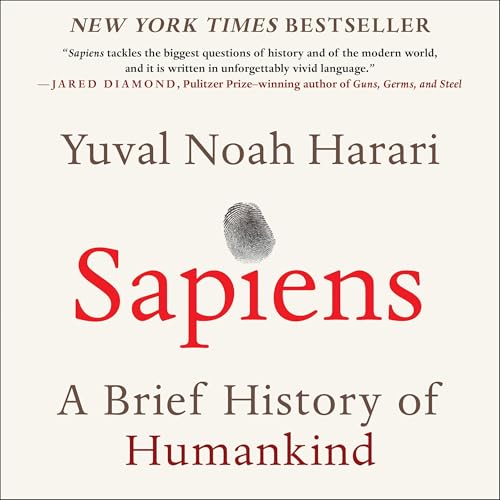
Sapiens
A Brief History of Humankind
No se pudo agregar al carrito
Add to Cart failed.
Error al Agregar a Lista de Deseos.
Error al eliminar de la lista de deseos.
Error al añadir a tu biblioteca
Error al seguir el podcast
Error al dejar de seguir el podcast
Obtén 30 días de Standard gratis

Sapiens
Compra ahora por $29.69
-
Narrado por:
-
Derek Perkins
#1 New York Times Bestseller • New York Times Readers’ Pick: Top 100 Books of the 21st Century • The Summer Reading Pick for President Barack Obama and Bill Gates
Official U.S. edition
From renowned historian Yuval Noah Harari comes a groundbreaking narrative of humanity’s creation and evolution—a #1 international bestseller—that explores the ways in which biology and history have defined us and enhanced our understanding of what it means to be “human.”
One hundred thousand years ago, at least six different species of humans inhabited Earth. Yet today there is only one—homo sapiens. What happened to the others? And what may happen to us?
Most books about the history of humanity pursue either a historical or a biological approach, but Dr. Yuval Noah Harari breaks the mold with this highly original book that begins about 70,000 years ago with the appearance of modern cognition. From examining the role evolving humans have played in the global ecosystem to charting the rise of empires, Sapiens integrates history and science to reconsider accepted narratives, connect past developments with contemporary concerns, and examine specific events within the context of larger ideas.
Dr. Harari also compels us to look ahead, because over the last few decades humans have begun to bend laws of natural selection that have governed life for the past four billion years. We are acquiring the ability to design not only the world around us, but also ourselves. Where is this leading us, and what do we want to become?
Featuring 27 photographs, 6 maps, and 25 illustrations/diagrams, this provocative and insightful work is sure to spark debate and is essential reading for aficionados of Jared Diamond, James Gleick, Matt Ridley, Robert Wright, and Sharon Moalem.
Reconocimientos y premios
Los oyentes también disfrutaron:





Featured Article: The Best Nonfiction Audiobooks to Jump into Right Now
The best nonfiction audiobooks take involved, often intimidating subjects and reinvigorate them with sharp narration so you can stay focused and on track. In this list, we’ll share our picks for some of the best nonfiction audio out there, encompassing a wide array of topics—from the entire history of humanity to astrophysics to the American prison system. Engage with some of the most fascinating, deeply human real-life stories our catalog has to offer.

Continuar la serie

Las personas que vieron esto también vieron:







There is a very long chapter on how our consumerism has been absolutely devastating to the animals we share the planet with. It was difficult to read, and not because it isn't true, but because it made me feel like shit. I don't know that I'll go full on vegan, but I recognize my impact and I am committed to cutting my meat consumption significantly.
The ending is pretty bleak, but we have also innovated our way into a pretty scary crossroads. Which road will we take? Moving on to Homo Deus. This is one of the those books that should be required reading for everyone. I'm going to recommend it to all of my friends. All two of them.
Should be required reading
Se ha producido un error. Vuelve a intentarlo dentro de unos minutos.
The economic subjects around money and statistics and commerce were fascinating. This gave a great background of today's commerce in historical terms easily understood.
The last few chapters were enlightening in where we are heading and a subject I find myself in conversations with others.
Expands upon the book Guns, Germs, and Steel
Se ha producido un error. Vuelve a intentarlo dentro de unos minutos.
Everyone Should Read This.
Se ha producido un error. Vuelve a intentarlo dentro de unos minutos.
Great inforn mation
Se ha producido un error. Vuelve a intentarlo dentro de unos minutos.
Must Read
Se ha producido un error. Vuelve a intentarlo dentro de unos minutos.