

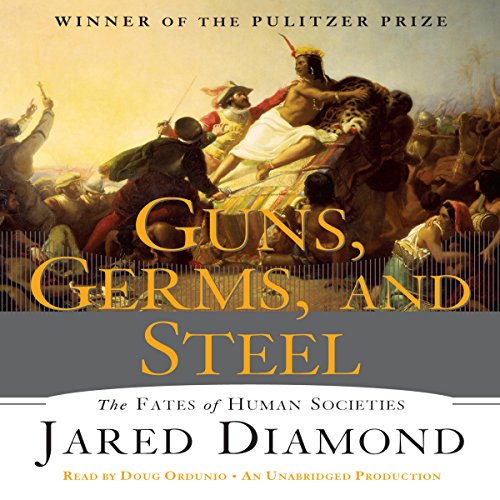
Guns, Germs and Steel
The Fate of Human Societies
No se pudo agregar al carrito
Add to Cart failed.
Error al Agregar a Lista de Deseos.
Error al eliminar de la lista de deseos.
Error al añadir a tu biblioteca
Error al seguir el podcast
Error al dejar de seguir el podcast
Obtén 30 días de Standard gratis
 ¿Miembros Prime? ¿Nuevo en Audible? Recibes una prueba de 2 meses en su lugar.
Guns, Germs and Steel
Compra ahora por $22.50
-
Narrado por:
-
Doug Ordunio
-
De:
-
Jared Diamond
Having done field work in New Guinea for more than 30 years, Jared Diamond presents the geographical and ecological factors that have shaped the modern world. From the viewpoint of an evolutionary biologist, he highlights the broadest movements both literal and conceptual on every continent since the Ice Age, and examines societal advances such as writing, religion, government, and technology. Diamond also dissects racial theories of global history, and the resulting work—Guns, Germs and Steel—is a major contribution to our understanding the evolution of human societies.
Reconocimientos y premios
Los oyentes también disfrutaron:








Reseñas de la Crítica
An ambitious, highly important book.—James Shreeve, New York Times Book Review
A book of remarkable scope, a history of the world in less than 500 pages which succeeds admirably, where so many others have failed, in analyzing some of the basic workings of culture process.... One of the most important and readable works on the human past published in recent years.—Colin Renfrew, Nature
The scope and the explanatory power of this book are astounding.—The New Yorker
No scientist brings more experience from the laboratory and field, none thinks more deeply about social issues or addresses them with greater clarity, than Jared Diamond as illustrated by Guns, Germs, and Steel. In this remarkably readable book he shows how history and biology can enrich one another to produce a deeper understanding of the human condition. —Edward O. Wilson, Pellegrino University Professor, Harvard University
Serious, groundbreaking biological studies of human history only seem to come along once every generation or so. . . . Now [Guns, Germs, and Steel] must be added to their select number. . . . Diamond meshes technological mastery with historical sweep, anecdotal delight with broad conceptual vision, and command of sources with creative leaps. No finer work of its kind has been published this year, or for many past. —Martin Sieff, Washington Times
[Diamond] is broadly erudite, writes in a style that pleasantly expresses scientific concepts in vernacular American English, and deals almost exclusively in questions that should interest everyone concerned about how humanity has developed. . . . [He] has done us all a great favor by supplying a rock-solid alternative to the racist answer. . . . A wonderfully interesting book.—Alfred W. Crosby, Los Angeles Times
An epochal work. Diamond has written a summary of human history that can be accounted, for the time being, as Darwinian in its authority.—Thomas M. Disch, The New Leader
Featured Article: The 20 Best History Audiobooks You Never Heard in School
While history is by definition the study of the past, no subject tells us more about the present, or is as exciting to follow in contemporary times. The range of subgenres within history writing is huge. Some authors cover a massive scope, while others zoom in to examine tiny, overlooked elements in a new way. Unlike your history class of old, these selections don’t demand memorization of names and dates. Read on for the best in our catalog.

Las personas que vieron esto también vieron:


Would you try another book from Jared Diamond and/or Doug Ordunio?
An awful lot of research went in to the writing of this book and equally the amount of focus to narrate. I don't think the audible version is the best for me. I've been comparing notes w/my husband who is away in Central America currently. I'm joining him in a couple weeks. He has both the hard copy & Kindle version. I'm looking forward to reviewing both to have a better grasp on the story,What other book might you compare Guns, Germs and Steel to and why?
I feel unqualified to answer this question. I've stepped outside my comfort zone w/this book. I'm very attracted to Historical Fictions that bring history alive & put flesh, blood & emotions to characters instead of stating & correlating facts.Have you listened to any of Doug Ordunio’s other performances before? How does this one compare?
I'm a newbie to Audible. I currently live on a small Caribbean island w/few resources. This is a wonderful tool for research & reading entertainment for me. Formerly, when I lived & worked in the US, I was highly addicted to audio tapes. My stepchildren in England are continuing that lifestyle, listening at home, work, driving. I feel Mr. Ordunio's performance was admirable for the continued drive & focus it must have taken to produce this narration, however, this could probably be due to the fact he enjoys relaying such books to his audience. We all strive to excel at something. I would have been miserable to ever undertake such a task, so hats off to Mr. Ordunio's talent!Do you think Guns, Germs and Steel needs a follow-up book? Why or why not?
It's hard to imagine anything was left out, but considering 1,000s of yrs, yes there could be a follow up. If so, I'd break the different aspects into smaller versions..Any additional comments?
Considering the massive amount of research compiled to write this book, it was extremely well outlined.Thousands of years to digest in 8 hours
Se ha producido un error. Vuelve a intentarlo dentro de unos minutos.
What did you love best about Guns, Germs and Steel?
Jared Diamond is amazing. He takes highly complex issues and describes them with prose that imply simplicity and dignity. He makes complex and difficult social issues understandable to people like me.What other book might you compare Guns, Germs and Steel to and why?
I purchased this audio book based on an Audible recommendation. I subsequently purchased all other works he has authored on Amazon.Which character – as performed by Doug Ordunio – was your favorite?
The narration is neutral. That is how it should be.If you were to make a film of this book, what would be the tag line be?
NAT GEO already did. The tag line from that should be: READ THE BOOK!Any additional comments?
He simplifies complex scientific thinking without diluting the important facts.Bloody wonderful!
Se ha producido un error. Vuelve a intentarlo dentro de unos minutos.
Compelling information everyone needs to read
Se ha producido un error. Vuelve a intentarlo dentro de unos minutos.
Snoozefest lecture format
Se ha producido un error. Vuelve a intentarlo dentro de unos minutos.
Loved it
Se ha producido un error. Vuelve a intentarlo dentro de unos minutos.