

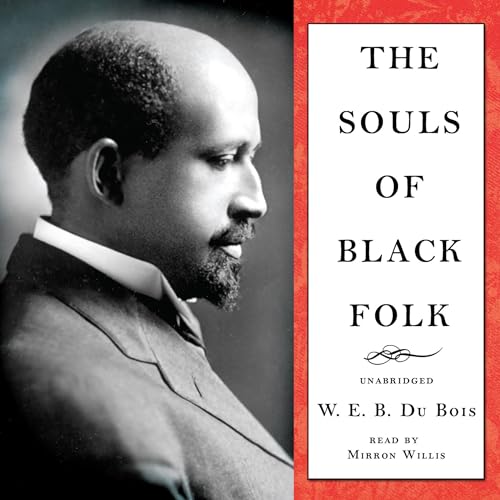
The Souls of Black Folk
Failed to add items
Add to Cart failed.
Add to Wish List failed.
Remove from wishlist failed.
Adding to library failed
Follow podcast failed
Unfollow podcast failed
Get 30 days of Standard free

The Souls of Black Folk
Buy for $17.17
-
Narrated by:
-
Mirron Willis
-
By:
-
W. E. B. Du Bois
“The problem of the twentieth century is the problem of the color line,” writes Du Bois, in one of the most prophetic works in all of American literature. First published in 1903, this collection of 15 essays dared to describe the racism that prevailed at that time in America—and to demand an end to it. Du Bois’ writing draws on his early experiences, from teaching in the hills of Tennessee, to the death of his infant son, to his historic break with the conciliatory position of Booker T. Washington.
Du Bois received a doctorate from Harvard in 1895 and became a professor of economics and history at Atlanta University. His dynamic leadership in the cause of social reform on behalf of his fellow blacks anticipated and inspired much of the black activism of the 1960s.
The Souls of Black Folk is a classic in the literature of civil rights.
William Edward Burghardt Du Bois (1868–1963) was one of the greatest African American intellectuals - a sociologist, historian, novelist, and activist whose astounding career spanned the nation’s history from Reconstruction to the civil rights movement. Born in Massachusetts and educated at Fisk, Harvard, and the University of Berlin, his masterpiece remains his most studied and popular work. Its insights into black life at still ring true today.
Public Domain (P)2010 Blackstone Audio, Inc.Listeners also enjoyed...





Critic reviews
“Thanks to W. E. B. Du Bois’ commitment and foresight—and the intellectual excellence expressed in this timeless literary gem—black Americans can today look in the mirror and rejoice in their beautiful black, brown, and beige reflections.” (Amazon.com review)
Featured Article: The top 100 classics of all time
Before we whipped out our old high school syllabi and dug deep into our libraries to start selecting contenders for this list, we first had to answer the question, "How do we define a classic?" The answer isn’t as straightforward as you might guess, though there’s a lot to be said for the old adage, "You know it when you see it" (or, in this case, hear it). Of course, most critically, each of our picks had to be fabulous in audio. So dust off your aspirational listening list—we have some amazing additions you don’t want to miss.

People who viewed this also viewed...





deep
Something went wrong. Please try again in a few minutes.
W. E. B. Du Bois is a great American who finally abandoned his country late in life because he could no longer tolerate the capitalist consequence of social, political, and economic discrimination. He describes discrimination in “The Souls of Black Folk” as a veil, a fine gauzy material that hides the details of black Americans who have the same potential as their white counterparts. The details are in the political, social, and economic discrimination imposed by a majority on a minority. Du Bois identifies that minority as people of color; i.e. specifically black Americans.
Du Bois is a great American because he understood how American capitalism undermines core political beliefs like equality of opportunity and the equality of all human beings. The inherent nature of man “to be greedy” makes fools of us all. Du Bois understood the importance of education, economic opportunity, and political power. He misunderstood that the drive for money, power, and prestige distorts pursuit of the “good” in all forms of government. Communism, socialism, and capitalism require a Hobson’s choice; i.e. “a choice of taking what is available or nothing at all”. Even for minorities, it seems capitalism offers the best hope because it attempts to regulate the worst parts of human nature.
A CAPITALIST VEIL
Something went wrong. Please try again in a few minutes.
every American should read
Something went wrong. Please try again in a few minutes.
Relevant! Heat breaking! Lovely!
Something went wrong. Please try again in a few minutes.
invaluable history with full context.
Something went wrong. Please try again in a few minutes.