Episodios

  • The Real Madness of March: Gambling Disorder, Recovery & Public Health
    Mar 24 2026
    “There’s no such thing as responsible gambling. Remember when we were told to smoke responsibly, and that opiate pain pills aren’t addictive? -Kavita Fischer, MDSeveral years ago, when Dr. Kavita Fischer downloaded an online betting app, she was just looking for something fun to do with her free time. However, within months she found herself so consumed by online gambling that she was taking out loans, chasing losses, and unable to stop, even after a big win that could have cleared her debt.Now, she has become a leading advocate for the change in what she describes as a “predatory” industry, sharing her story of gambling disorder and relapse. As she points out, gambling disorder is among the most stigmatized of all addictions, and silence protects the industry, not the patients. In this essential episode, she and Dr. Reid discuss the conflicted interests of those who are supposed to provide regulations to the industry, the broken treatment landscape, and what real public health reform would look like.*Please note that this episode mentions suicide and non-suicidal self-injury.“Responsible Gambling” Is a MythThis phrase places all blame on the individual, mirroring the tobacco and opioid playbooks. Consumer protection messaging, not personal responsibility tropes, is what’s needed. After all, responsible gambling campaigns are estimated to be up to 90% funded by the gambling industry itself, creating an obvious conflict of interest.“It smells like, looks like something uncomfortably familiar: normalizing a product, denying the harm, blaming the user. That’s exactly what we saw with tobacco and opioids.” -Kavita Fischer, MDThe Product Is Engineered for AddictionOnline gambling moved the casino from a destination to your pocket. Research shows proximity to a casino increases gambling disorder risk, and now everyone is living with a casino in their pocket. These apps are designed to keep you clicking and loop you back in when you try to leave. Unlike alcohol, the industry actively sends promotions and re-engagement offers to people who are trying to quit.“No one’s leaving alcohol at your doorstep. No industry is sending coupons for alcohol to prevent you from getting treatment. That’s exactly what this industry does.”-Kavita Fischer, MDThe Business Model Requires Addicted Gamblers70–90% of industry profits come from problem gamblers. States that have partnered with gambling operators are essentially acting as the bookie, collecting tax revenue with little meaningful regulation protecting citizens. Additionally, this tax revenue may not be going toward the programs we expect it to.The Highest Suicide Rate of Any Addiction• 1 in 2 people with gambling disorder have thought about suicide• 1 in 5 have attempted itPer Dr. Fischer, a recent study found financial debt (not concurrent mental illness or substance use) is the single most powerful independent risk factor for suicide in this population.The LIE/BET Screener: Two Questions That Open DoorsOnly 8–10% of people with gambling disorder seek treatment on their own. Dr. Fischer advocates for universal screening using this validated two-question tool:1. Have you ever had to lie to people important to you about how much you gambled?2. Have you ever felt the need to bet more and more money?Treatment Options Are Limited but ExistThere is no FDA-approved medication for gambling disorder. The gold standard is CBT + Motivational Interviewing, delivered by ICGC-certified counselors. Support groups (Gamblers Anonymous, Gam-Anon for families) and state gambling board referral lists are the most accessible entry points.Children Are Especially VulnerableAbout 50% of adolescents have gambled in some form, mostly online. In-game mechanics like loot boxes, lucky wheels, and virtual currencies introduce gambling behavior through gaming. Dr. Fischer recommends parental controls, open conversations, and legislative pressure to enforce age restrictions.Resources & LinksCrisis & Helplines• National Problem Gambling Helpline: 1-800-MY-RESET (new number — crisis screening and local referrals)• Gamblers Anonymous Hotline: 855-222-5542Support Groups• Gamblers Anonymous — in-person, virtual, and telephone meetings• Gam-Anon — for family members and loved onesAdvocacy• Stop Predatory Gambling — nonprofit exposing industry harms and pushing for policy reformTreatment & Screening• International Problem Gambling and Gaming Certification Organization (IPGGC) find certified CBT/MI counselors.• LIE/BET Screener — two-question tool, appropriate for any clinical intakeGambling-Blocking Apps• Gamban — blocks tens of thousands of gambling sites across all devices• BetBlocker — free, available on iOS, Android, Windows, Mac, and LinuxDr. Fischer’s Writing• “The Real Madness of March” — psychiatric journal article on why all clinicians should screen for gambling disorder• The House Always Wins: Learning to Overcome ...
    Más Menos
    36 m
  • Women Burdened by Invisible Work
    Mar 12 2026
    “Most of the couples that I spoke with wanted to distance themselves from old-school gender norms, and yet very few were able to achieve balance when it came to the division of this mental work.”— Dr. Allison DamingerIf you’ve ever lain awake mentally running through tomorrow’s logistics while your partner sleeps soundly beside you, this episode is for you. Dr. Allison Daminger, sociologist and author of What’s on Her Mind?, has spent nearly a decade studying something most families feel but few can name: the invisible cognitive labor that keeps a household running. It’s not the cooking or the carpooling, it’s the anticipating, the researching, the deciding, and the endless following up. In this conversation, Dr. Daminger unpacks why this mental work falls so disproportionately on women—even in couples who are genuinely trying for something more equal, what makes it so stubbornly hard to redistribute, and what it would actually take, in our homes and in our culture, to change it.Website: allisondaminger.com · Substack: The Daminger DispatchWhat Is Mental Workload?Dr. Daminger describes mental workload as “project management for the household” — a set of cognitive processes geared toward figuring out what a family needs and ensuring those needs get fulfilled. It breaks down into four key steps:* Anticipation — scanning ahead for upcoming needs, problems, or opportunities* Identifying options — brainstorming or researching possible solutions* Decision-making — choosing the best course of action for the family* Monitoring — following up to make sure the solution actually workedUnlike physical housework, this labor is largely invisible, often not recognized as “work” even by the person doing it.“This is a set of mental processes that are geared toward figuring out what your family needs, what you owe to other people, and then how to ensure that those needs and obligations get fulfilled.”— Dr. Allison DamingerKey Research FindingsThe Gender Gap Is StarkIn Dr. Daminger’s study of different-gender couples, 4 out of 5 were “woman-led,” meaning she was effectively the “cognitive laborer in chief.” While couples were closer to 50-50 on physical housework (cooking, cleaning, driving), the mental work remained deeply unequal.Earning More Doesn’t Level the Playing Field, Not for WomenWhen men earned more or worked more hours, they almost always did less cognitive labor. But the same did not hold true in reverse: women who were the primary earners still shouldered a disproportionate share of mental work. The breadwinner pass applied to men, not women.“In cases where she was doing more hours or earning more money, a lot of the time she was still doing more of the cognitive labor.”— Dr. Allison DamingerWhy Does This Persist?Accountability StructuresOne of Dr. Daminger’s core explanations is “accountability structures,” which is the fact that men and women are held responsible for different outcomes. Men feel guilt around financial failure; women feel guilt when household or parenting management slips. This asymmetry shapes who pays attention and who steps in.“If the kid comes to school missing their clarinet on band day, or guests come over and there’s dog hair on the floor, these are outcomes that usually are going to be blamed on women.”— Dr. Allison DamingerThe Stickiness ProblemCognitive labor is deeply embedded in knowledge, relationships, and practice, making it hard to hand off. A partner who has attended every pediatrician appointment holds context the other doesn’t have. Many women conclude it’s simply easier to keep doing it than to train someone else. This keeps the division of labor frozen even when both partners want change.“You can teach someone to change a diaper pretty quickly. But a lot of cognitive work is embedded in knowledge and relationships that are hard to just hand over.”— Dr. Allison DamingerWhat Balanced Couples Do Differently“If you can lead from the place of: I’m suffering, this is not working for me, that will activate a form of compassion that is harder to access when it’s framed as criticism.”— Dr. Allison DamingerTransfer Ownership, Not Just TasksThe “just tell me what to do” dynamic is a common trap. If she’s still the one generating the list, she still owns the domain. Dr. Daminger’s advice: transfer full vertical ownership of a category, not just execution of individual tasks.“All things laundry, that’s now you. Not just one piece, but making sure there’s detergent, making sure the kids have clean clothes on time, making sure the washer and dryer are functioning. If you can give someone up-and-down vertical ownership of the whole project, that’s often more effective than one-off task delegations.”— Dr. Allison DamingerStart Small and Give It Time• Pick lower-stakes domains first — tasks you won’t catastrophize if done differently• Set a grace period (e.g., two ...
    Más Menos
    45 m
  • "First, Seek to Understand": A CBT Expert's Guide to Everyday Communication
    Mar 5 2026
    “Honesty doesn’t have to be brutal. Honesty can be compassionate. Honesty can be respectful.” -Dr. Cory NewmanEpisode OverviewIn this episode, host Dr. Jennifer Reid sits down with Dr. Cory Newman, PhD to explore how the core principles of cognitive behavioral therapy can be woven into our everyday communication with partners, friends, family, coworkers, and even ourselves. What begins as a conversation about therapy technique quickly becomes a practical guide to navigating disagreements, setting boundaries, and showing up more compassionately in all our relationships.Throughout the conversation, Dr. Reid draws connections to her book Guilt Free: Reclaiming Your Life from Unreasonable Expectations (Penguin Life, 2026), which examines how guilt—particularly for women—shapes our communication patterns, our willingness to set boundaries, and our capacity for self-compassion.15 Key Takeaways (Dr. Newman had so many life-changing recommendations, we wanted to make sure you could read about them even if you didn’t have time to listen!)1. The Three Pillars of CBTDr. Newman describes CBT as resting on three foundational principles: * A supportive therapeutic alliance* A deep understanding of the patient’s lived experience (including cultural and sociological factors)* The development of practical coping skills. These skills promote agency and problem-solving rather than hopelessness and helplessness.CBT Connection: The cognitive behavioral model emphasizes that thoughts, behaviors, and emotions are interconnected. By shifting how we think and what we do, we can change how we feel (Beck, 1979).2. Communication Is Both Internal and ExternalWe tend to think of communication as what we say to others, but Dr. Newman emphasizes that internal dialogue matters just as much. CBT helps people talk to themselves more compassionately, constructively, and hopefully. That same skill then translates outward into better interpersonal communication.He also distinguishes between expressive communication (how we speak) and receptive communication (how we listen), both of which are essential to healthy relationships.Guilt Free Connection: In Guilt Free, Dr. Reid explores how harsh internal dialogue, especially the relentless voice of “I should be doing more,” fuels excessive guilt. Learning to communicate with yourself compassionately is the first step toward breaking free from unreasonable expectations.3. Start with IntentEvery meaningful conversation benefits from a clear, positive intent: to boost morale, to connect, to offer something useful, to communicate understanding. Dr. Newman suggests that even outside of therapy, we can adopt the mindset that our goal in any interaction is to leave the other person, and the relationship, in a better state than when we started.CBT Connection: Intentional communication is a behavioral intervention. By deliberately choosing our communicative goals before speaking, we interrupt automatic patterns that often lead to conflict (Beck, 1995).4. Validity + Utility: The Two-Part Test for What We SayDr. Newman introduces a powerful filter: before speaking, ask whether your comment has both validity (is it truthful?) and utility (is it useful?). Truth alone can be harsh. He pushes back on the idea of “brutal honesty.”Guilt Free Connection: The validity-utility framework directly parallels the guilt equation in Guilt Free, where guilt = our expectations (whether fair or not) minus our perceived reality. Often, guilt-driven communication passes the validity test but fails the utility test. For example, we may say things out of obligation that don’t help ourselves or others.5. Intent vs. Impact: Naming the MismatchSometimes people don’t mean to cause harm, but their words land that way. Dr. Newman recommends naming the gap directly: “I don’t think you’re trying to put me down, but the message you’re sending sounds like a put-down.” This approach acknowledges the other person’s good faith while still making room for your experience.CBT Connection: Distinguishing between intent and impact is central to cognitive restructuring. Cognitive distortions like mind-reading and personalization often cause us to assume malicious intent where there is none (Burns, 1980).6. Seek to Understand Before Problem-SolvingWhen someone is in distress, the instinct is often to jump straight to fixing. Dr. Newman advises leading with empathy instead: “If I were thinking the way you’re describing, I’d be a nervous wreck too.” Validate first, then gently offer alternative perspectives. Problem-solving is more effective once the person feels heard.Guilt Free Connection: Dr. Reid describes a pattern she sees frequently, which is people, especially women, catastrophizing about situations and layering guilt on top. The compassionate validation Dr. Newman describes is exactly the antidote: honor the feeling, question the expectation.7. Turn Complaints into RequestsAlmost any complaint ...
    Más Menos
    54 m
  • Support During Fertility Treatments: “The Hardest Thing Is Reaching Out."
    Feb 3 2026
    Join us for an intimate conversation with Dr. Keri Smotrich, Licensed Clinical Psychologist and Certified Perinatal Mental Health Counselor, about the emotional challenges of fertility struggles, pregnancy loss, and the journey to parenthood. We dive into the identity crisis that often comes with infertility, what to expect from those first medical appointments, and how to be kind to yourself through the process. Dr. Smotrich shares practical advice on setting boundaries with friends and family, managing the emotional roller coaster of hope and disappointment, and finding safe people to talk to. Throughout it all, Dr. Smotrich reminds us that seeking help is actually a sign of strength.*Please note: we briefly discuss pregnancy loss and miscarriage.Resources Mentioned:* Postpartum Support International (PSI) - Offers support groups, virtual meetings, and peer mentor programs for fertility challenges, pregnancy loss, and perinatal mental health* Penn Fertility Care in Philadelphia and surrounding areasConnect with Dr. Smotrich:Licensed in New Jersey, Pennsylvania, and 45+ states via SciPact for telehealth services. Visit her website for more information. https://keri-smotrichpsyd.clientsecure.me/Remember: Seeking support is a sign of strength, not weakness. You don’t have to white knuckle through this journey alone.Thanks for reading A Mind of Her Own! Subscribe for free to receive new posts and support my work.Find Dr. Reid on Instagram: @jenreidmd, LinkedIn, and YouTubeYou can also order Dr. Reid’s book, Guilt Free! (If you are in the UK, you can order here and here.)Also check out Dr. Reid’s regular contributions to Psychology Today: Think Like a ShrinkSeeking a mental health provider? Try Psychology TodayNational Suicide Prevention Lifeline: 1-800-273-8255Dial 988 for mental health crisis supportSAMHSA’s National Helpline - 1-800-662-HELP (4357)-a free, confidential, 24/7, 365-day-a-year treatment referral and information service (in English and Spanish) for individuals and families facing mental and/or substance use disorders.Disclaimer:The views expressed on this podcast reflect those of the host and guests, and are not associated with any organization or academic site. Also, AI may have been used to create the transcript and notes, based only on the specific discussion of the host and guest and reviewed for accuracy.The information and other content provided on this podcast or in any linked materials, are not intended and should not be construed as medical advice, nor is the information a substitute for professional medical expertise or treatment. All content, including text, graphics, images and information, contained on or available through this website is for general information purposes only.If you or any other person has a medical concern, you should consult with your health care provider or seek other professional medical treatment. Never disregard professional medical advice or delay in seeking it because of something that have read on this website, blog or in any linked materials. If you think you may have a medical emergency, call your doctor or emergency services (911) immediately. You can also access the National Suicide Help Line at 1-800-273-8255 or call 988 for mental health emergencies. This is a public episode. If you would like to discuss this with other subscribers or get access to bonus episodes, visit amindofherown.substack.com
    Más Menos
    39 m
  • Doctor, Writer, Woman: Navigating Guilt and Identity at Midlife
    Jan 21 2026
    Join Dr. Reid, psychiatrist, creator and host of “A Mind of Her Own,” and author of Guilt Free, for this conversation with Nancy Reddy, author of The Good Mother Myth and creator of Be Less Careful and Mara Gordon, family doctor and creator of the Your Doctor Friend by Mara Gordon newsletter. We discuss: * External validation (fellowships, book deals) helps but isn’t the whole story—self-actualization with age matters moreOn Midlife Transformation* The conversation centered on women making big changes in midlife when life seems “set”* Mara just turned 40 and sees a shift toward self-actualization that comes with age* There’s power in coming to realize what doesn’t work for you (as Jennifer noted from Parker Palmer) as much as what doesOn Healthcare and Creativity* Both physicians emphasized the need for creative outlets alongside science—whether theater, writing, or podcasting* The medical system rewards quantitative efficiency over storytelling, yet healthcare contains rich narratives that deserve to be told* Writing in healthcare comes with unique fears: professionalism concerns, employer reactions, HIPAA violations, plus universal impostor syndromeAdvice for Healthcare Writers* Write beyond fear: Identify specific sources of fear (HIPAA, professional image, employer concerns) and name them* Find your values: What matters to you? Build work that lets you grow and shine in alignment with those values* Build community: Connect with other writers, mentors, and trusted friends who can help you navigate fears* Try different formats: Podcasts, newsletters, books—find what feels authentic to your communication styleNotable Quote: “I think anyone in healthcare has really the potential to create some beautiful work. There’s so many stories there that really deserve to be told.”The Takeaway: Writing is an act of courage, especially in fields like medicine where vulnerability feels risky. But midlife offers a gift—enough experience to know what matters, enough confidence to claim your voice, and enough wisdom to write beyond fear.Find Dr. Reid on Instagram: @jenreidmd, LinkedIn, and YouTubeYou can also preorder Dr. Reid’s book, Guilt Free! (If you are in the UK, you can order here and here.)Also check out Dr. Reid’s regular contributions to Psychology Today: Think Like a ShrinkThanks for reading A Mind of Her Own! Subscribe for free to receive new posts and support my work.Seeking a mental health provider? Try Psychology TodayNational Suicide Prevention Lifeline: 1-800-273-8255Dial 988 for mental health crisis supportSAMHSA’s National Helpline - 1-800-662-HELP (4357)-a free, confidential, 24/7, 365-day-a-year treatment referral and information service (in English and Spanish) for individuals and families facing mental and/or substance use disorders.Disclaimer:The views expressed on this podcast reflect those of the host and guests, and are not associated with any organization or academic site. Also, AI may have been used to create the transcript and notes, based only on the specific discussion of the host and guest and reviewed for accuracy.The information and other content provided on this podcast or in any linked materials, are not intended and should not be construed as medical advice, nor is the information a substitute for professional medical expertise or treatment. All content, including text, graphics, images and information, contained on or available through this website is for general information purposes only.If you or any other person has a medical concern, you should consult with your health care provider or seek other professional medical treatment. Never disregard professional medical advice or delay in seeking it because of something that have read on this website, blog or in any linked materials. If you think you may have a medical emergency, call your doctor or emergency services (911) immediately. You can also access the National Suicide Help Line at 1-800-273-8255 or call 988 for mental health emergencies. This is a public episode. If you would like to discuss this with other subscribers or get access to bonus episodes, visit amindofherown.substack.com
    Más Menos
    31 m
  • Slowly Building "Small Communities of Care."
    Jan 13 2026
    “We’re not alone...that’s kind of our mission and why we do the work that we do.”Anu Gorakanti (MD) and Laura Holford (RN) co-founded Introspective Spaces, a collective creating contemplative community spaces for healthcare workers to reconnect with themselves and reimagine a new way forward in healthcare. Now approaching their five-year anniversary, they share how they’re building “small communities of care” across the country—one relationship at a time.Introspective Spaces on SubstackListen to a prior podcast with Anu and Laura here!Key Themes:* The Power of Slow Work: “Change moves at the speed of trust” (Stephen Covey, via adrienne maree brown’s Emergent Strategy). Building authentic community takes time, and that’s exactly what healthcare needs.* From Isolation to Connection: Both founders started Introspective Spaces after feeling alone in their moral distress, believing they were the only ones struggling. Their mission: help healthcare workers realize they’re not alone.* The Imagination Battle: As adrienne maree brown writes, we’re living in someone else’s imagination. Healthcare’s current design is intentional—but healthcare workers can activate their own imagination to create something different.* Humanizing One Another: “What if humanizing healthcare starts with humanizing one another?” Breaking down silos between physicians, nurses, and other healthcare workers can shift the entire culture of care.Introspective Spaces Programs:* Artist’s Way cohorts (including a new healthcare parents group) Next cohort begins March 9th!! Sign up here.* Grief spaces and retreats* Book clubs using foundational texts like Emergent Strategy* Building interdisciplinary communities in 5-6 cities nationwide* Find them in Instagram @IntrospectiveSpacesOther Resources Mentioned:* Emergent Strategy by adrienne maree brown* The Artist’s Way program, based on the book by Julia Cameron* Let Your Life Speak by Parker Palmer (Listen to Dr. Reid’s interview with Dr. Palmer here!)* The Pitt (Max series depicting healthcare moments rarely seen in real life)Thanks for reading A Mind of Her Own! Subscribe for free to receive new posts and support my work.Find Dr. Reid on Instagram: @jenreidmd, LinkedIn, and YouTubeYou can also preorder Dr. Reid’s book, Guilt Free! (If you are in the UK, you can order here and here.)Also check out Dr. Reid’s regular contributions to Psychology Today: Think Like a ShrinkThanks for reading A Mind of Her Own! This post is public so feel free to share it.Seeking a mental health provider? Try Psychology TodayNational Suicide Prevention Lifeline: 1-800-273-8255Dial 988 for mental health crisis supportSAMHSA’s National Helpline - 1-800-662-HELP (4357)-a free, confidential, 24/7, 365-day-a-year treatment referral and information service (in English and Spanish) for individuals and families facing mental and/or substance use disorders.Disclaimer:The views expressed on this podcast reflect those of the host and guests, and are not associated with any organization or academic site. Also, AI may have been used to create the transcript and notes, based only on the specific discussion of the host and guest and reviewed for accuracy.The information and other content provided on this podcast or in any linked materials, are not intended and should not be construed as medical advice, nor is the information a substitute for professional medical expertise or treatment. All content, including text, graphics, images and information, contained on or available through this website is for general information purposes only.If you or any other person has a medical concern, you should consult with your health care provider or seek other professional medical treatment. Never disregard professional medical advice or delay in seeking it because of something that have read on this website, blog or in any linked materials. If you think you may have a medical emergency, call your doctor or emergency services (911) immediately. You can also access the National Suicide Help Line at 1-800-273-8255 or call 988 for mental health emergencies. This is a public episode. If you would like to discuss this with other subscribers or get access to bonus episodes, visit amindofherown.substack.com
    Más Menos
    46 m
  • The Guilt Free Series: A Conversation with the Author, Jennifer Reid, MD
    Dec 18 2025
    Family physician and writer Dr. Mara Gordon interviews psychiatrist Dr. Jennifer Reid about her new book Guilt Free (releasing January, 27, 2026). The conversation explores why women experience disproportionate guilt, how to distinguish toxic from adaptive guilt, and practical strategies for managing guilt—especially during the holidays.The Guilt EquationDr. Reid breaks down guilt into a simple formula: Guilt = Expectations - Perceived Reality“Guilt is the difference between our expectations of ourselves, which are created by many things, the difference between that and how well we feel like we’re meeting them.”The problem? Women often set impossibly high expectations while minimizing what they’re actually accomplishing.Holiday GuiltDecember amplifies guilt because of:* Cultural expectations about creating “perfect” experiences* Pressure to control others’ emotions* Comparison (social media, consumer-driven ideals)* Ambivalence about events we “should” enjoy“There’s a lot of guilt around the sense of I should be feeling a certain way. I should be making sure others are feeling a certain way around this situation... And these expectations, which as we’ll talk about are such a huge part of guilt, can really explode then.” Thanks for reading A Mind of Her Own! Subscribe for free to receive new posts and support my work.Find Dr. Reid on Instagram: @jenreidmd, LinkedIn, and YouTubeFind Dr. Gordon on Instagram: Mara Gordon, MD Dr. Gordon on Substack at My Doctor Friend here: Mara Gordon, MD You can also preorder Dr. Reid’s book, Guilt Free! (If you are in the UK, you can order here and here.)Also check out Dr. Reid’s regular contributions to Psychology Today: Think Like a ShrinkThanks for reading A Mind of Her Own! This post is public so feel free to share it.Seeking a mental health provider? Try Psychology TodayNational Suicide Prevention Lifeline: 1-800-273-8255Dial 988 for mental health crisis supportSAMHSA’s National Helpline - 1-800-662-HELP (4357)-a free, confidential, 24/7, 365-day-a-year treatment referral and information service (in English and Spanish) for individuals and families facing mental and/or substance use disorders.Disclaimer:The views expressed on this podcast reflect those of the host and guests, and are not associated with any organization or academic site. Also, AI may have been used to create the transcript and notes, based only on the specific discussion of the host and guest and reviewed for accuracy.The information and other content provided on this podcast or in any linked materials, are not intended and should not be construed as medical advice, nor is the information a substitute for professional medical expertise or treatment. All content, including text, graphics, images and information, contained on or available through this website is for general information purposes only.If you or any other person has a medical concern, you should consult with your health care provider or seek other professional medical treatment. Never disregard professional medical advice or delay in seeking it because of something that have read on this website, blog or in any linked materials. If you think you may have a medical emergency, call your doctor or emergency services (911) immediately. You can also access the National Suicide Help Line at 1-800-273-8255 or call 988 for mental health emergencies. This is a public episode. If you would like to discuss this with other subscribers or get access to bonus episodes, visit amindofherown.substack.com
    Más Menos
    44 m
  • The Guilt Free Series: Running from Perfection with Dr. Caitlin Massone
    Nov 20 2025
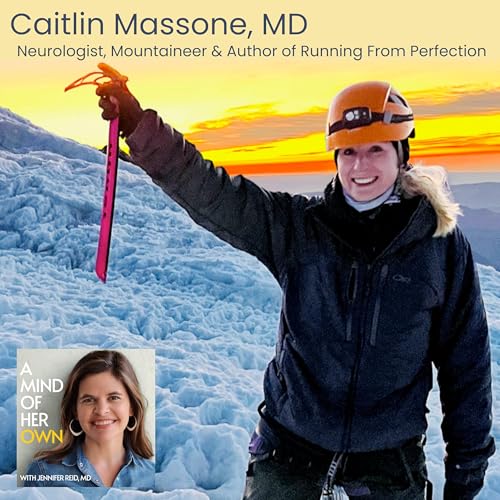
    In this episode of A Mind of Her Own, host Dr. Jennifer Reid explores guilt, perfectionism, and recovery with Dr. Caitlin Massone, author of Running from Perfection. This conversation is part of the Guilt-Free series, leading up to the release of Dr. Reid’s book Guilt Free on January 27, 2026.Dr. Massone is a neurologist, ultramarathon runner, and mountaineer who battled eating disorders for 14 years. She shares how family trauma triggered her anorexia at 16, the guilt she carried through medical school while struggling with bulimia, and how nature and endurance sports became her path to healing.Key QuotesOn losing control:“I was really just trying to regain control amidst all of that chaos and turmoil. When my dad left, we went from having a fully stocked fridge and pantry to all of a sudden having this kind of feast and famine cycle.”On teenage guilt:“At the time, I was feeling guilty as if I wasn’t a good enough daughter. Every kid has these questions that go through their head that they never voice. Like, is this in some way my fault?”On being a doctor with an eating disorder:“I felt like I was in some way being hypocritical or not being an example for my patients. That was probably some of the worst guilt that I felt.”On finding empowerment through running:“When I run, I feel powerful and I feel like my body’s so capable and it doesn’t matter what it looks like in the mirror. It really has been just a remarkable transformation.”On nature as medicine:“Exercise and nature have been so integral in helping me heal and just keeping me happy.”More Resources:National Alliance for Eating DisordersNational Eating Disorder AssociationFind Dr. Massone: @drcait23 on Instagram | CaitlinMassone.comFind Dr. Reid on Instagram: @jenreidmd, LinkedIn, and YouTubeYou can also preorder Dr. Reid’s book, Guilt Free! (If you are in the UK, you can order here and here.)Also check out Dr. Reid’s regular contributions to Psychology Today: Think Like a ShrinkThanks for checking out A Mind of Her Own! This post is public so feel free to share it.Seeking a mental health provider? Try Psychology TodayNational Suicide Prevention Lifeline: 1-800-273-8255Dial 988 for mental health crisis supportSAMHSA’s National Helpline - 1-800-662-HELP (4357)-a free, confidential, 24/7, 365-day-a-year treatment referral and information service (in English and Spanish) for individuals and families facing mental and/or substance use disorders.Disclaimer:The views expressed on this podcast reflect those of the host and guests, and are not associated with any organization or academic site. Also, AI may have been used to create the transcript and notes, based only on the specific discussion of the host and guest and reviewed for accuracy.The information and other content provided on this podcast or in any linked materials, are not intended and should not be construed as medical advice, nor is the information a substitute for professional medical expertise or treatment. All content, including text, graphics, images and information, contained on or available through this website is for general information purposes only.If you or any other person has a medical concern, you should consult with your health care provider or seek other professional medical treatment. Never disregard professional medical advice or delay in seeking it because of something that have read on this website, blog or in any linked materials. If you think you may have a medical emergency, call your doctor or emergency services (911) immediately. You can also access the National Suicide Help Line at 1-800-273-8255 or call 988 for mental health emergencies. This is a public episode. If you would like to discuss this with other subscribers or get access to bonus episodes, visit amindofherown.substack.com
    Más Menos
    33 m