Episodios

  • Anthony Abbagnano – From Reactive to Creative: Moving One Letter (and One Breath) to Transform Leadership
    Jan 13 2026
    What if the most powerful shift you could make as a leader wasn't another productivity hack—but simply learning to breathe? In this episode of Legendary Leaders, host Cathleen O'Sullivan sits down with Anthony Abbagnano—founder of the Alchemy of Breath and one of the world's leading voices in modern breathwork—whose calm presence and practical wisdom will make you rethink everything you thought you knew about resilience. Anthony shares why most of us have unlearned how to breathe properly, and why that disconnection costs us more than we realize. He opens up about his midlife crisis in Ibiza, the moment he realized he'd abandoned his inner child for sixty years, and how inner child work isn't just playfulness—it's reconciling with the wounded parts we left behind. With disarming warmth, he explains why trauma can be our teacher, how the difference between "reactive" and "creative" is just moving one letter, and why ten breaths before a meeting might be the most productive thing you do all day. Together, Cathleen and Anthony explore why we lose choice under stress, the neuroscience behind overwhelm, and how the Coherence breath—a simple five-second inhale, five-second exhale—can regulate your nervous system in five minutes. This conversation is for anyone racing through life, leading from chaos instead of calm, or wondering where they've been holding their breath—and what might happen if they finally let go. Episode Timeline: 00:00:46 Why most people have unlearned to breathe properly 00:06:08 Inner child work: beyond playfulness to reconciliation 00:07:35 Anthony's midlife crisis in Ibiza and creating "the bridge" process 00:13:17 How trauma takes our breath away and embeds in the body 00:17:06 Restoring choice to a choiceless moment 00:22:15 Outer Chaos, Inner Calm: navigating today's messy world 00:28:11 Reactive vs. creative: moving one letter to transform leadership 00:31:19 Building community: the five-year Italy experiment 00:42:28 Why Western society lives in shallow breathing 00:47:02 The gradient of choice: how stress shrinks our options 00:48:07 Ten breaths that transformed a hostile boardroom meeting 00:53:06 Meet, prevail, acknowledge, celebrate: the four stages of growth 00:57:41 How breath creates space for creativity in business 01:08:26 The Coherence breath: a live demonstration 01:19:53 Take a breath before you react (and do a random act of kindness) Key Takeaway: Trauma Takes Your Breath Away—Healing Means Taking It Back: When we're wounded, we literally lose our breath in that moment of impact. The body absorbs the shock and stores it as chronic tension or disease. But trauma isn't something to erase—it's something to learn from. Mo Gowdat surveyed 12,000 trauma survivors and 99% said they'd keep their trauma for the growth it brought. The work isn't forgetting the wounded parts; it's restoring choice to the moments where breath—and power—were taken away. One Breath Creates Space—And Space Creates Choice: Write out "reactive." Move the "C" to the front and you get "creative." That's what one breath does. Under stress, we self-lobotomize—exporting processing power to our amygdala, leaving us with only fight, flight, or freeze. But one conscious breath creates space between stimulus and response. Ten breaths before a meeting can transform hostility into harmony. It's not about fixing the problem—it's about polishing your lens so you can see solutions that were there all along. The Coherence Breath: Five In, Five Out, Five Minutes, Three Times a Day: Breathe in through your nose for five seconds, out for five seconds. This practice—used by military and SWAT teams worldwide—regulates your nervous system and becomes your automatic response to tension. After two weeks, it stops being something you "do" and becomes how you breathe. When panic hits? Extend your exhale to counter rising stress. Practice it when you're calm so you can reach for it when you're not. Inspire Literally Means to Bring In Spirit—That's What Leadership Looks Like: Four-fifths of neural messages go from body to brain, not the other way around. Your body knows things your mind hasn't figured out yet. Conscious breathing slows your frontal lobe and creates space for insight beyond thinking. You're not just calming down—you're accessing what Anthony calls "spiritual resources." That's when quantum shifts happen: when you stop trying to think your way through and start breathing your way into clarity. About Anthony Abbagnano: Anthony Abbagnano is a visionary healer, breathwork pioneer, and the founder of Alchemy of Breath, where a global community of over 100,000 seekers turns a biological reflex into a tool for radical transformation. A former international entrepreneur—only to walk away from the corporate world to study under masters in India and the Amazon. He's trained facilitators in 40+ countries and shared stages with everyone from Deepak...
    Más Menos
    1 h y 26 m
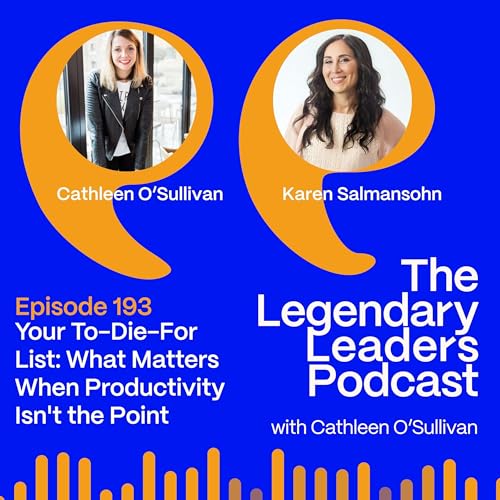
  • Karen Salmansohn – Your To-Die For List: What Matters When Productivity Isn't the Point
    Dec 30 2025
    What makes someone quit a six-figure advertising career to write books that help people think differently? In this episode of Legendary Leaders, host Cathleen O'Sullivan sits down with Karen Salmansohn—bestselling author, behavioral change expert, and the creative force behind NotSalmon.com—whose sharp wit and mortality-driven wisdom will make you rethink everything on your to-do list. Karen shares why fun isn't frivolous—it's fuel. She breaks down the science of why laughter literally shakes ideas loose, explains why her "e-pee-phanies" in the bathroom cracked more creative codes than caffeine ever did, and reveals the mortality marble jar that transformed how she spends every single month. With disarming honesty, she opens up about hiding her intelligence to be liked and finally "coming out" as a smart person in her sixties. Together, Cathleen and Karen explore the fatal flaw of to-do lists, why your identity is the puppet master of your habits, and how writing your own eulogy can wake you up from a "near-life experience." This conversation is for anyone who's tired of sleepwalking through their days and ready to design a life their future self will actually thank them for. Episode Timeline: 00:05:36 How funny are you? Karen's son vs. Jon Stewart's verdict 00:06:34 Fun as a high-performance fuel (and meditation on steroids) 00:09:23 Manifestation, energy, and why confidence attracts results 00:14:48 From advertising to authorship: quitting the senior VP job her parents hated 00:19:38 The Häagen-Dazs theory on productivity: only pick what excites you 00:22:35 Procrastination strategies: turn your pain into purpose 00:27:03 Writing your eulogy: the wake-up call that changes everything 00:29:41 The fatal flaw of to-do lists (and why you need a to-die list) 00:33:31 The seven core values that minimize regret: A to G 00:38:31 Identity-based statements: "I am loving, so I find a way to Connecticut" 00:44:34 Feisty then, feisty now: how Karen sold the book her agent didn't want 00:46:33 Hiding her intelligence to be liked, then embracing it fully in her sixties 00:57:14 Hedonia vs. eudaimonia: why happiness isn't the goal 01:00:16 Life as a den of pleasure AND a laboratory for growth 01:12:51 Near-life experiences: when you're scrolling instead of living 01:16:07 The mortality marble jar: 437 marbles and a monthly reckoning Key Takeaway: Your Identity Is the Puppet Master of Your Habits: Who you think you are determines what you actually do. If you walk around thinking "I'm sloppy," you'll do sloppy things. If you think "I'm a loving person," you'll find a way to get to Connecticut for your friend's birthday—even without a car. Studies show people who identified as "voters" were three times more likely to show up at the polls than those who just heard clever slogans. Change your identity statement, change your behavior. To-Do Lists Prioritize Productivity, Not Meaning—That's Their Fatal Flaw: You can check off every box on your to-do list and still waste your life. Karen created a "to-die list" alongside her to-do list—a place for meaningful habits tied to core values, not just tasks. The top regrets of the dying? Working too hard, not spending time with friends, not allowing themselves to be happier, not living true to themselves. Your to-die list is the bridge between current you and the person your eulogy will describe. Life Is a Den of Pleasure AND a Laboratory for Growth—You Need Both: We're addicted to instant gratification—scrolling, avoiding discomfort, waiting for "someday." But here's the truth: you can't seize every day. Aristotle said the goal isn't living pain-free; it's learning lessons that grow you into your best self. Emotional diversity is what makes you flourish. Instead of "seize the day," try "seize every other day." The moments in the laboratory of growth—where you get curious about your patterns and repair what keeps repeating—are what make the pleasure meaningful. The Mortality Marble Jar: Math That Shakes You Awake: Karen calculated how many months she has left if she lives to 100 (she promised her son). She bought that many marbles, put them in a jar, and every month she moves one marble to her "past" jar. The first time she did it, she couldn't remember what she'd done that month. Depressing. Now she intentionally plans meaningful experiences—dancing with friends, theater nights, time with her son—so when she holds that marble, she has something to report. The question that changes everything: "Is this really worth a marble of my life?" About Karen Salmansohn: Karen Salmansohn is a bestselling author, behavioral change expert, and the founder of NotSalmon.com, where 1.5 million followers get their daily dose of psychology wrapped in wit. A former senior VP creative director who walked away from advertising in her twenties—despite her parents' protests—she's sold over 2 million books including How to Be Happy,...
    Más Menos
    1 h y 25 m
  • Stop Being So Damn Helpful: The Curse of the Over-Responsible Leader
    Dec 24 2025

    Are you the person everyone turns to because you'll "just handle it"? The one replying to emails at 11pm, rewriting your team's work, or silently resenting the people you keep rescuing? In this solo episode, Cathleen O'Sullivan tackles a behavior that's as exhausting as it is common: over-functioning in the name of being helpful.

    Cathleen reveals why constant helpfulness isn't kindness—it's a control strategy that stifles growth, creates dependency, and keeps you small. She shares the story of a leader who was praised for being dependable but passed over for promotion because she wasn't seen as visionary, and unpacks why always being the fixer means you're losing time, energy, and strategic thinking space.

    This punchy episode delivers four practical steps to shift from over-functioning to actual leadership: building awareness around guilt-driven yeses, replacing rescuing with coaching questions, using scripts that empower without abandoning, and practicing the useful discomfort of not jumping in. Your team doesn't need a hero. They need a leader. And you need your energy back.

    Episode Timeline:

    00:01:01 Why being helpful is actually a curse

    00:01:44 "It's just quicker if I do it"—the trap of over-functioning

    00:03:43 The exhausted leader who felt like a parent to her team

    00:04:35 How helpfulness backfires: creating dependency, not ownership

    00:05:59 The people pleaser passed over for promotion

    00:06:45 Step 1: Build awareness—am I doing work that's not mine?

    00:08:19 Step 2: Replace rescuing with coaching questions

    00:10:09 Step 3: The script for letting go without guilt

    00:12:00 Step 4: Practice useful discomfort—let them struggle and grow

    00:14:08 The truth: over-helpfulness is a control strategy in disguise

    00:14:42 Your challenge: find one moment this week and don't jump in

    Key Takeaway:

    • Step 1: Build Awareness—Notice When You're Over-Functioning Am I doing work that's not mine? Saying yes out of guilt? Secretly resentful? One leader kept rewriting her team's decks—not for quality, but out of fear of being judged. Keep asking "why" until you hit the root cause.

    • Step 2: Replace Rescuing with Coaching Questions Don't jump into fix-it mode. Ask: "What have you tried? Where did you get stuck? What do you think could work?" Put ownership back in their hands. Let them think first—then see where they really get stuck.

    • Step 3: Use a Script for Letting Go Without Guilt Try this: "I trust you to run with this. If you hit a wall, I'm here, but I know you've got this." Leadership isn't about perfection—it's about empowerment and growing together.

    • Step 4: Practice Useful Discomfort—Let Them Struggle Wait 24 hours before replying. Let someone struggle without stepping in—they'll figure it out. Ask yourself: Am I fixing this to help, or to feel needed? Growth is messy. If you never let them wobble, they'll never walk on their own.

    Connect with Cathleen O'Sullivan:

    Business: https://cathleenosullivan.com/

    LinkedIn: https://www.linkedin.com/in/cathleen-osullivan/

    Instagram: https://www.instagram.com/legendary_leaders_cathleenos/

    FOLLOW LEGENDARY LEADERS ON APPLE, SPOTIFY OR WHEREVER YOU LISTEN TO YOUR PODCASTS

    Más Menos
    16 m
  • Darryl Stickel – Share, Don't Scare: The Science of Building Trust When the World Feels Broken
    Dec 16 2025
    What makes a complete stranger walk up to you on a bus and say, "I'm really having a hard time today"? In this episode of Legendary Leaders, host Cathleen O'Sullivan sits down with Darryl Stickel—trust researcher, founder of Trust Unlimited, and author of Building Trust—whose life's work reveals that connection isn't magic. It's a skill you can learn, practice, and pull off even when everything feels like it's falling apart. Darryl shares why trust isn't just about certainty—it's about being willing to get hurt. He breaks down the formula, explains why leaders who admit they're not perfect inspire fierce loyalty, and walks through the exact steps he used to help warring union reps and board executives shake hands after five years in court. With disarming honesty, he opens up about surviving multiple concussions, navigating life as a legally blind leader, and discovering that accepting help isn't weakness—it's a gift you give other people. Together, Cathleen and Darryl explore what it means to lead without pretending, why "share, don't scare" transforms relationships, and how pulling three specific levers can rebuild trust faster than you think. This conversation is for anyone who's tired of surface-level connections and ready to do the uncomfortable work that actually brings people closer. Episode Timeline: 00:02:38 Why vulnerability is the part of trust everyone ignores 00:05:02 The trust equation: uncertainty × vulnerability = perceived risk 00:09:51 When not to be vulnerable: protecting yourself while staying open 00:15:54 Three levers every leader needs: benevolence, integrity, ability 00:26:35 Men, mental health, and the Aspirational Men's Program 00:30:53 Internal vs. external locus of control: what you actually control 00:39:43 The benevolence conversation: "What does success look like for you?" 00:50:41 Five years in court: how he got unions and executives talking again 00:57:48 "I feel uncertainty" vs. "I don't trust you": the language that neutralizes conflict 01:08:56 The one small step: start with a dose of vulnerability 01:14:09 The father who went from "they're scared of me" to "they fight over who sits next to me" 01:18:12 Hockey, concussions, and finding purpose in the wreckage Key Takeaway: Trust = Uncertainty × Vulnerability, and Both Are at All-Time Highs: Trust isn't just about predicting someone's behavior—it's about being willing to be hurt when you can't know for sure what they'll do. In deep relationships, uncertainty shrinks and vulnerability expands. But right now, with uncertainty spiking everywhere, even small asks for vulnerability feel like jumping off a cliff. Refusing Help Is Selfish—You're Robbing People of Joy: Darryl told a room of executives: "You just shared how powerful it is to help someone. Now explain why you're so effing selfish—you never let anyone have that experience with you." When you never admit you need help or show vulnerability, you steal the gift of contribution from others. Even the struggling woman panhandling on the street felt meaning when she could help the blind guy cross. Change the Story, Change Everything: Darryl's son wanted a baseball scholarship, so Darryl "nagged" him about eating well, practicing, studying, being a good teammate. But because they'd defined success together first, his son heard every nudge as "Dad has my back" instead of criticism. We interpret the world through stories—if you don't actively shape the narrative, 20 different versions will spread, and most won't work in your favor. Start With One Small Dose of Vulnerability: Don't open the kimono. Don't pretend you're clueless. Just admit you made a mistake in the past, probably will in the future, or need someone's expertise on something. Leaders reach positions because of technical skill—that skill atrophies the moment you sit behind a desk. Tell people: "You're the expert now. I'm going to need your help." That small crack opens everything. About Darryl Stickel: Darryl Stickel is founder of Trust Unlimited and author of Building Trust: Exceptional Leadership in an Uncertain World. He holds a PhD from Duke University, where his doctoral thesis on building trust in hostile environments was so groundbreaking his advisors admitted he'd solved what they thought was impossible. After consulting at McKinsey & Company, Darryl founded Trust Unlimited in 2001 and has since worked with unions, military units, Fortune 500 companies, and nonprofits worldwide—from helping the Canadian military build trust with locals in Afghanistan to reuniting fathers with sons who'd given up hope. Legally blind and navigating the world with his guide dog Drake, Darryl teaches that vulnerability isn't weakness—it's the foundation of everything that matters. Connect with Darryl Stickel: LinkedIn: ca.linkedin.com/in/darryl-stickel-phd Website: https://www.trustunlimited.com/ Book: https://...
    Más Menos
    1 h y 30 m
  • Kate Grant – Listen to Your Inner Voice: Leading a Life of Impact Without Apology
    Dec 2 2025
    What does it take to lead with both purpose and perseverance? In this episode of Legendary Leaders, host Cathleen O'Sullivan sits down with Kate Grant—CEO of the Fistula Foundation and author of No Woman Left Behind—whose remarkable journey from Madison Avenue to global health leadership reveals what can happen when compassion meets conviction. Kate shares how walking away from a thriving advertising career became the first step toward transforming the lives of more than 100,000 women suffering from obstetric fistula—a preventable childbirth injury that still affects over a million women in the world's most underserved regions. With honesty and humility, she opens up about redefining success, the courage it takes to stay focused on one mission, and how saying "no" to good ideas is often the price of real impact. Cathleen O'Sullivan (Merkel) Together, Cathleen and Kate explore the intersection of leadership, purpose, and humanity—what it means to build something that lasts, lead with heart, and never look away from the people and problems that need us most. This conversation is for anyone who believes leadership is less about power and more about the lives we choose to touch. Episode Timeline: 00:03:34 What is obstetric fistula and why it still exists 00:07:39 The devastating social cost: ostracism, shame, and isolation 00:16:21 A survivor's story: 30 years of suffering and the gift of a chicken 00:28:30 Building a global network: from one hospital to 35 countries 00:33:12 The fundraising approach: efficiency, focus, and saying no 00:38:25 Ensuring quality: working with expert surgeons and measuring outcomes 00:47:15 Leaving Madison Avenue: when success isn't enough 00:53:05 The earthquake and breakup that cracked everything open 01:03:11 Redefining success: career, motherhood, and the myth of having it all 01:10:00 What's next: stepping down and training as a therapist 01:19:16 Final wisdom: listen to your inner voice and own your choices Key Takeaway: A Hidden Crisis with a Solution: Obstetric fistula—a childbirth injury from obstructed labor—affects at least one million women in Africa and Asia, leaving them incontinent and ostracized. Yet 90% of cases are fixable with surgery, making this needless suffering Kate refuses to accept. Relentless Focus Drives Impact: The Fistula Foundation does one thing exceptionally well—funding surgeries—and has helped over 100,000 women by resisting mission creep, measuring outcomes rigorously, and treating the nonprofit like a results-driven business. Listen to Your Inner Voice: Kate left a successful advertising career after travel exposed her to global poverty and an earthquake cracked her life open—proving that transformation requires quieting external voices and giving your own inner compass a microphone. Empowerment Through Accountability: When problems arise, assume you created them—not to blame yourself, but to empower yourself to learn and fix what's broken rather than playing victim to circumstances or other people. You Can't Have It All at Once: Success means making intentional choices about where to invest finite energy—Kate chose her son and the foundation over remarriage, showing that owning your trade-offs without apology is more honest than pretending you can do everything equally well. About Kate Grant: Kate Grant is a global health and social-impact leader with over 25 years of experience advancing maternal health and women's rights worldwide. As President & CEO of Fistula Foundation, she has expanded access to life-changing surgeries for thousands of women across Africa and Asia while building high-performing teams and partnerships with governments and NGOs. She is also the author of No Woman Left Behind – A Journey of Hope to Heal Every Woman Injured in Childbirth, a memoir highlighting her journey from a corporate career to leading a global health movement. Known for her equity-focused, collaborative leadership, Kate's mission is to ensure every woman has the opportunity to live a healthy, dignified life. Connect with Kate Grant: LinkedIn: https://www.linkedin.com/in/kate-grant-92110561/ Website: https://fistulafoundation.org/ No Woman Left Behind (Book): https://fistulafoundation.org/no-woman-left-behind/ Connect with Cathleen O'Sullivan: Business: https://cathleenosullivan.com/ LinkedIn: https://www.linkedin.com/in/cathleen-osullivan/ Instagram: https://www.instagram.com/legendary_leaders_cathleenos/ FOLLOW LEGENDARY LEADERS ON APPLE, SPOTIFY OR WHEREVER YOU LISTEN TO YOUR PODCASTS
    Más Menos
    1 h y 24 m
  • Donzel Leggett – Transform, Don't Just Change: The Mindset for a Destiny-Driven Life
    Nov 18 2025
    What does it really mean to design your own destiny? In this episode of Legendary Leaders Podcast, host Cathleen O'Sullivan sits down with Donzel Leggett—former Fortune 200 executive, author of Make Your Destiny Happen, and founder of Destiny Development Delta whose career has spanned three decades of transformational global leadership. From his Key West roots to the pivotal moment he walked away from professional football, Donzel shares how he turned missed opportunities and painful kicks in the butt into clarity about his calling. With warmth and honesty, he opens up about the weight of expectations, the courage to challenge them, and how a life plan created at 24 has guided everything since—including losing 90 pounds in four months and bouncing back from a million-dollar business failure that shaped his next chapter. Together, Cathleen and Donzel explore the difference between change and transformation, why spending time with yourself is the most radical act of leadership, and how his Destiny Development Delta model helps people stop leaving life to chance. This conversation is for anyone ready to lead themselves with intention, passion, and purpose. Episode Timeline: 04:49 Growing up in Key West: lessons in diversity and strong women leaders 07:41 College football and missed opportunities to lead teammates 10:12 Creating a life plan at 24—and what destiny really means 15:11 Challenging expectations: when others' dreams don't match your own 23:34 Walking away from professional football and the emotional fallout 30:36 Three pivotal moments: football, fatherhood, and finding his calling 36:14 Recognizing your calling: the feeling you can't ignore 40:45 Why 90% of people can't answer where they want to be in 10 years 47:06 First steps to self-leadership—even when life feels overwhelming 52:19 Getting back on track: losing 90 pounds and finding balance 55:44 The restaurant that failed—and the million-dollar MBA 01:01:20 The Destiny Development Delta model: A-Attitudes and iLead Change 01:04:23 Change vs. transformation: chameleon or butterfly? 01:09:05 Transformation as an iterative journey through life's shifts 01:13:32 What's next: spreading hope around the world Key Takeaway: Creating Your Own Destiny: Donzel challenges the idea that destiny is predetermined—it's something you design by getting clear on what you want, building a life plan, and taking sustained action. Leading Yourself First: Leadership isn't about titles or hierarchy—it's about taking charge of your own life, whether you're an executive, a barber, or a stay-at-home parent. Transformation vs. Change: Real transformation means becoming something different (like a caterpillar to butterfly), not just making adjustments—and it starts with spending time with yourself to uncover what you truly want. The Power of a Life Plan: Donzel created his life plan at 24 and has followed it for over 30 years, showing how vision plus intentional action creates both success and fulfillment. Learning from Failure: From walking away from football to losing a million dollars on a restaurant, Donzel shows how reframing failure as learning and taking accountability fuels growth and resilience. About Donzel Leggett: Donzel Leggett is a global operations and leadership executive with over 30 years of experience leading large-scale teams and operations in consumer products companies, including a 28-year tenure at General Mills. He is the Principal and Founder of Destiny Development Delta, LLC, where he coaches executives and teams to unlock their full potential and build inclusive, high-performing cultures. He is the author of Make Your Destiny Happen, a transformational framework for designing and living a purposeful life. Known for driving exceptional results while uplifting people, his leadership approach centers on authenticity, accountability, and helping others take charge of their destinies. Donzel's mission is to inspire people globally to transform their leadership, envision their future, and take sustained action to make it reality. Connect with Donzel Leggett: LinkedIn: https://www.linkedin.com/in/donzelleggett/ Facebook (Donzel Leggett): https://www.facebook.com/donzel.leggett.9/ Facebook (Destiny Dev Delta): https://www.facebook.com/destinydevdelta Instagram (Donzel Leggett) https://www.instagram.com/donzel_leggett/ Linktree: https://li nktr.ee/destinydevdelta YouTube: https://www.youtube.com/@DonzelLeggett Make Your Destiny Happen Petite Podcast: https://feeds.captivate.fm/make-your-destiny-happen/ Website: https://destinydevdelta.com/ Make Your Destiny Happen Book: https://www.makeyourdestinyhappen.com Connect with Cathleen O'Sullivan: Business: https://cathleenosullivan.com/ LinkedIn: https://www.linkedin.com/in/cathleen-osullivan/ Instagram: https://www.instagram.com/legendary_leaders_cathleenos/ FOLLOW LEGENDARY LEADERS ON APPLE, SPOTIFY OR WHEREVER YOU ...
    Más Menos
    1 h y 21 m
  • Lenya McGrath – The Compass Within: Leading with Purpose and Positivity
    Nov 4 2025
    What does it really mean to bring your authentic self to leadership? In this episode of Legendary Leaders Podcast, host Cathleen O'Sullivan sits down with Lenya McGrath—global brand strategist, creative leader, and award-winning marketer whose career has shaped some of the world's most iconic brands. From her early days in Sydney's ad world to leading high-performing teams across continents, Lenya shares how she turned "too happy" feedback into her leadership superpower. With warmth and humility, she opens up about authenticity in the workplace, building psychological safety in creative teams, and how her personal compass guides her through change—from navigating anxiety during the pandemic to saying bold yeses (and firmer no's) in life and career. Together, Cathleen and Lenya explore what it means to lead with heart, why self-awareness is the ultimate growth tool, and how small acts of courage can make people, brands, and businesses truly fly. Episode Timeline: 01:03 Meet Lenya McGrath: a creative leader who makes people feel seen 03:20 Early lessons in creative partnership and leading with kindness 11:14 Why optimism is a superpower and how it builds psychological safety 21:13 Motherhood and mentoring: raising confident, self-aware daughters 24:33 Authenticity vs. oversharing—bringing your real self to work 26:44 How masking drains energy and connection 31:59 Reconnecting with your internal compass and values 33:13 Navigating anxiety during the pandemic and finding purpose 36:52 Lenya's five-step approach to move from problem to solution 40:46 Boundaries and values—knowing when to say no 45:12 Falling in love with creativity: from visual merchandising to ad agencies 48:57 How to tell if a company aligns with your purpose 50:29 Reflection and release: check-ins, "letters to self," and letting go 56:28 Saying yes to new adventures—and being firm with your no's 58:40 Why saying no can feel harder for women 01:02:34 Lenya's top two pieces of advice for aspiring creatives Key Takeaway: Authenticity as Leadership: Lenya shares how embracing her true, optimistic self—once labeled "too happy"—became her greatest leadership strength. Psychological Safety Through Positivity: She shows how lightness and empathy foster trust, creativity, and deeper collaboration. Purpose as a Compass: Whether leading teams or raising daughters, Lenya's guiding goal is to help people, brands, and businesses fly. Reflection and Renewal: Her weekly check-ins and "letters to self" reveal how intentional reflection fuels growth and resilience. Boundaries and Bravery: From saying yes to new adventures to confidently saying no, Lenya explores how alignment sustains authenticity. About Lenya McGrath: Lenya McGrath is a global brand and marketing leader with 15+ years of experience helping consumer brands stand out and scale. Her career spans agency and in-house roles, working with notable brands such as Amazon, PlayStation, Canon, Wilson Sporting Co., Herman Miller, and P&G (Olay). Known for her "market-shaper" mindset, Lenya blends brand strategy, integrated marketing, and leadership to help organizations embed authentic differentiation into their culture, behaviour, and business strategy. With a reputation for positivity, collaboration, and driving commercial results, her work has been recognised across creative and brand awards. Passionate about growth, creativity, and human-centred leadership, Lenya continues to inspire leaders to bring their whole selves to work, build purpose-driven brands, and drive meaningful impact. Connect with Lenya McGrath: Website: https://www.lenyamcgrath.com/ LinkedIn: https://www.linkedin.com/in/lenyamcgrath/ Connect with Cathleen O'Sullivan: Business: https://cathleenosullivan.com/ LinkedIn: https://www.linkedin.com/in/cathleen-osullivan/ Instagram: https://www.instagram.com/legendary_leaders_cathleenos/ FOLLOW LEGENDARY LEADERS ON APPLE, SPOTIFY OR WHEREVER YOU LISTEN TO YOUR PODCASTS
    Más Menos
    1 h y 7 m
  • The Productivity Lie: Why Doing Less Makes You a Better Leader
    Oct 28 2025

    What if productivity isn't about doing more—but doing less, with purpose? In this solo episode of The Legendary Leaders Podcast, host Cathleen O'Sullivan challenges one of leadership's biggest myths: that constant hustle equals success.

    Drawing from her own journey and stories from the leaders she's coached, Cathleen exposes the "productivity lie" that glorifies busyness and burnout. She reveals why intentionality—not intensity—is what truly sets great leaders apart, and how creating space to think, rest, and reflect can actually amplify your impact.

    From practical tools like the "stop doing list" and the one-minute pause, to mindset shifts that turn overwhelm into clarity, this episode is a masterclass in reclaiming your energy and leading with purpose. It's your permission slip to slow down, focus, and lead on your terms.

    Episode Timeline:

    00:00 Introduction and welcome back to The Legendary Leaders Podcast

    00:45 The productivity myth: being busy means you're a better leader

    01:59 The cultural addiction to busyness and confusing motion with progress

    03:24 Why great leaders are intentional—not overworked

    06:57 Client stories: breaking the busy habit and rediscovering focus

    08:22 Practical tools to break the busy cycle

    13:19 Delegating with purpose and empowering your team to grow

    14:47 Escaping the busy trap and retraining others' expectations

    15:33 Redefining productivity: protecting your energy like gold

    16:01 Weekly challenge: cancel one non-essential meeting and make space to think

    16:35 Closing reflections and invitation to lead on your terms

    Key Takeaway:

    • The Productivity Lie: Cathleen challenges the belief that great leadership means doing more, showing how intentional focus creates greater impact than endless activity.

    • Redefining Worth: Your value isn't measured by hours worked or meetings attended—true leadership is about clarity, direction, and energy.

    • Breaking the Busy Cycle: Tools like the "stop doing" list, one-minute pause, and weekly calendar audit help leaders reclaim time for what truly matters.

    • Delegation with Purpose: Letting go isn't about dumping tasks—it's about growing others, building trust, and creating space to lead strategically.

    • Modeling Healthy Leadership: By slowing down, setting boundaries, and protecting your energy, you model balance and focus for your team.

    • Lead with Intention: Doing less isn't laziness—it's leadership with purpose, giving you and your team room to think, create, and thrive.

    Connect with Cathleen O'Sullivan:

    Business: https://cathleenosullivan.com/

    LinkedIn: https://www.linkedin.com/in/cathleen-osullivan/

    Instagram: https://www.instagram.com/legendary_leaders_cathleenos/

    FOLLOW LEGENDARY LEADERS ON APPLE, SPOTIFY OR WHEREVER YOU LISTEN TO YOUR PODCASTS

    Más Menos
    17 m
adbl_web_global_use_to_activate_DT_webcro_1694_expandible_banner_T1