Episodios

  • Episode 129: AI Pearls for Dermatologists: What Every Derm Needs to Know in 2026 | The Future of Dermatology Podcast
    Mar 31 2026

    Summary:

    Dr. Faranak Kamangar, Inc. 2026 Female Founders 500, is podcasting from from AAD 2026, and sharing the highlights from her live talk on artificial intelligence in dermatology. In this solo episode, she breaks down the most important AI updates dermatologists need to know right now. From image-based melanoma detection to large language models and the rise of agentic AI. Dr. Kamangar covers the current state of FDA-approved AI medical devices, why diagnostic imaging AI is promising but still limited by specificity gaps, and how dermatology compares to radiology and other specialties in the AI device space. She also dives into why LLMs like DermGPT should be your highest-leverage clinical tool, and how to use them the right way. You'll learn how to avoid common AI pitfalls like the "journal halo effect" (just because it cites a prestigious journal doesn't mean the output is accurate), semantic degradation in RAG models, and over-relying on AI without clinical scrutiny. Most importantly, Dr. Kamangar walks through the anatomy of a high-quality prompt, because your output is only as good as what you put in. Whether you're AI-curious or already using these tools in your practice, this episode is packed with practical, evidence-informed pearls to help you work smarter, not harder.

    Key Takeaways:

    1. Image-based melanoma detection AI is improving rapidly but still struggles with low specificity, making it most valuable for global health and underserved regions. 2. Large language models like DermGPT are your highest-leverage AI tool right now and should be used as a clinical thought partner, not a search engine. 3. The "journal halo effect" is a real risk. Prestigious citations in an AI response don't guarantee the output is accurate or trustworthy. 4. Adding more articles to an LLM's database can silently reduce performance, so more data doesn't always mean better answers. 5. The quality of your AI output is directly tied to the quality of your prompt - be specific, structured, and give more than nine words. 6. AI alone is a confident guesser, but your clinical expertise combined with AI creates an extraordinary and nearly unstoppable multiplier. 7. AI adoption in clinic settings depends on seamless workflow integration, anything that disrupts clinic flow is unlikely to be adopted. 8. The next frontier in AI isn't just smarter models, it's agents that actively complete tasks and do real work inside your clinical day.

    Chapters:

    [00:00] Welcome & AAD 2026 Overview [00:45] The State of Diagnostic Image-Based AI [02:00] Large Language Models & DermGPT [03:30] The Evolution of AI: From GPT-3 to Agents [04:45] FDA-Approved AI Devices in Healthcare [07:00] AI in the Clinic: Workflow Challenges & Opportunities [10:00] AI Use Cases Across Dermatology [12:30] Maintaining Scrutiny: AI Pitfalls to Watch [14:00] The Journal Halo Effect & Prestige Corpus Fallacy [15:45] Semantic Degradation & Index Crowding [17:30] How to Prompt Like a Pro [19:30] Prompt Examples for Dermatologists [20:30] Key Takeaways & What's Next

    Más Menos
    21 m
  • Episode 128: The AI Takeover Is Already Happening, And Maybe That's Okay | The Future of Dermatology Podcast
    Mar 17 2026
    Summary: Dr. Faranak Kamangar, Inc. 2026 Female Founders 500, sits down with dermatologist, podcaster, and self-described "accelerationist" Dr. Matthew Zirwas (Derms on Drugs Podcast) for a wide-ranging conversation about where AI is taking medicine and dermatology in particular. They dig into the flood of low-quality medical literature overwhelming the field, why AI isn't quite the truth-detector we hoped it would be, and how ambient AI scribes are quietly training the models that may eventually replace us. Dr. Zirwas makes the case that dermatologists have a 7–10 year runway before AI handles most of what we do cognitively, and argues that's not necessarily a bad thing. He also gives a sneak peek at his upcoming speculative fiction trilogy, Sophie, which explores the philosophical questions that arise when an AI becomes better at being your doctor, therapist, and life coach than any human ever could. Key Takeaways: The medical literature crisis is real. The volume of published dermatology research is exploding, but quality is plummeting. Peer review has become largely meaningless, and studies from tools like Mendelian randomization and pharmacovigilance databases are frequently unreliable or inapplicable to real-world patients.AI is only as good as the data it trusts. Current AI models treat published literature as truth, which is a major problem given how much spin exists in medical research. A true "BS detector" AI doesn't yet exist, and building one requires starting from a reliable core of verified knowledge.DermGPT's approach works because of curation. Rather than pulling from all available literature, filtering down to a high-quality subset (around 5,000–6,000 articles) dramatically improves AI output. More data is not always better, "semantic fatigue" is a real limitation.Ambient AI scribes are training our replacements. Every time a dermatologist corrects an AI-generated note, they're teaching the model. Over thousands of iterations across every specialty, this will produce AI that thinks and documents the way doctors do.Dermatologists have a protected runway... for now. Procedures (biopsies, Mohs, fillers, cryo) keep us relevant for an estimated 7–10 years beyond when cognitive/diagnostic AI matures. But medico-legal pressure - malpractice carriers incentivizing or requiring AI use - will be the force that accelerates adoption.Telehealth changes patient behavior in surprising ways. Patients who haven't invested effort in getting to an office visit demand less, escalate less, and are often more satisfied with conservative management; a dynamic that AI-driven virtual care will likely amplify.The "Sophie" question: If an AI is making everyone healthier, happier, and better behaved, but doing something ethically murky to get there, do we stop it? Dr. Zirwas's upcoming novel explores this and introduces the concept of technomorphism: AI eventually projecting its own qualities onto humans, just as we anthropomorphize AI today. Chapters: Chapter 1: Meet Dr. Matthew Zirwas (00:00 – 01:43) Dr. Kamangar introduces her guest, dermatologist, podcaster, and self-described "accelerationist" Dr. Matthew Zirwas, and breaks down what both of those things actually mean.Chapter 2: The Medical Literature Crisis (01:43 – 05:19) Dr. Zirwas describes the flood of low-quality research hitting dermatology journals, why peer review has lost its meaning, and shares a striking example of a misleading HS remission study published in JAMA Dermatology.Chapter 3: Why AI Can't Fix Bad Literature (Yet) (05:19 – 08:31) Both doctors discuss why AI defaults to trusting whatever authors claim, and why that makes it a poor critical assessor of medical research. Dr. Kamangar shares how this exact problem shaped the development of DermGPT.Chapter 4: Building a Better AI — The DermGPT Approach (08:31 – 10:33) Dr. Zirwas praises DermGPT's curated approach, and Dr. Kamangar explains why less data is often better, and how semantic fatigue undermines large, unfiltered AI models.Chapter 5: Will AI Replace Us? The 7–10 Year Countdown (10:33 – 19:24) Dr. Zirwas lays out his timeline for AI taking over the cognitive and diagnostic work of dermatology, why procedures give derms extra runway, and how unlimited AI access will fundamentally change the patient-doctor dynamic.Chapter 6: The Telemed Effect and What It Tells Us About AI Care (19:24 – 21:48) Drawing from a recent telemedicine study and his own practice experience, Dr. Zirwas explains why reduced friction in healthcare visits changes what patients expect - and demand - from their providers.Chapter 7: The Medico-Legal Tipping Point (21:48 – 24:09) The conversation turns to how malpractice liability will likely be the force that compels physicians to integrate AI into their workflow and what happens when disagreeing with AI becomes a legal risk.Chapter 8: Are We Training Our Own Replacements? (24:09 – 31:21) Dr. Zirwas argues that ambient AI scribes are ...
    Más Menos
    46 m
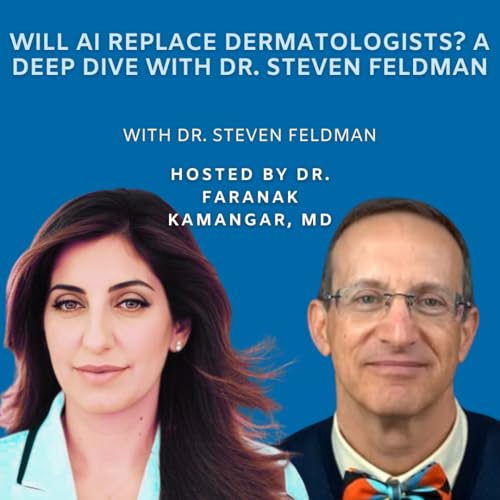
  • Episode 127: Will AI Replace Dermatologists? A Deep Dive with Dr. Steven Feldman | The Future of Dermatology Podcast
    Mar 10 2026

    Summary

    In this episode, Dr. Faranak Kamangar explores the impact of AI on dermatology with Dr. Steven Feldman. This conversation includes AI's potential to enhance or replace certain aspects of medical practice, and the future of AI in healthcare.

    Takeaways

    - AI's potential to replace or augment dermatologists - The role of empathy and skepticism in AI decision-making - AI's impact on medical education and practice - Future applications of AI in patient adherence and diagnostics

    Chapters

    00:00 - Introduction to AI's Role in Dermatology 01:52 - Guest Introduction: Dr. Stephen Feldman 02:30 - Debate: Will AI Replace Dermatologists? 03:26 - AI's Memory and Visual Capabilities 03:58 - Medical Training in the Age of AI 04:38 - AI's Impact on Medical Education and Practice 06:01 - AI Prescribing and Empathy in Healthcare 07:49 - Limitations of AI: Empathy and Skepticism 09:41 - Agentic AI and Multimodal Capabilities 11:38 - AI in Patient Adherence and Monitoring 13:33 - Augmenting Dermatology Practice with AI 15:26 - AI's Infrastructure and Data Challenges 16:26 - Complexity and the Dermatologist's Advantage 17:22 - AI in Patient-Doctor Interaction 19:29 - Prompting and Context in AI Diagnostics 21:00 - Limitations of Current AI Technologies 21:57 - Long-term Outlook: AI Replacing Doctors 23:09 - AI and Access to Care 23:57 - AI's Role in Reducing Administrative Burden 25:16 - The Future: AI's Impact on Healthcare and Dermatology 26:20 - Closing Remarks and Future Predictions

    Más Menos
    29 m
  • Episode 126: The Science Behind Kilgour MD's Hair Products: A Deep Dive | The Future of Dermatology Podcast
    Mar 3 2026

    Summary

    In this episode, Dr. Faranak Kamangar chats with Dr. James Kilgour about the science behind Kilgour MD's innovative scalp and hair products. They discuss the ingredients, clinical trials, and future developments in hair health and dermatology.

    Key Topics

    - Ingredients and science behind Kilgour MD products - Role of dandruff and malassezia in scalp health - Clinical trial evidence for hair growth products - Future R&D and innovations in dermatology and hair care

    Chapters

    00:00 - Introduction and Guest Credibility 01:19 - Personal Experience with Kilgour MD Products 02:25 - Philosophy and Development of Hair Care Products 03:42 - Key Ingredients in Prevention Serum 05:57 - Active Ingredients and Their Effects on Hair Follicles 08:10 - Clinical Trial Evidence for Hair Growth Products 09:11 - Understanding Dandruff and Malassezia's Role 09:46 - Scalp Health and Hair Loss in Menopause 11:58 - Formulation and Efficacy of Anti-Dandruff Treatments 14:20 - Safety and Regulation of Hair Care Ingredients 15:27 - Use of Oils and Botanical Extracts in Hair Care 17:27 - Importance of Clinical Trials in Cosmetic Products 18:24 - Objective Measures in Hair Loss Studies 20:59 - Clinical Significance vs. Perception in Hair Treatments 22:33 - Future R&D and Physician-Led Innovation 25:37 - Upcoming Events and Collaborations 27:15 - Future Directions in Dermatology and Hair Care

    Más Menos
    31 m
  • Episode 125: The Power of Botanicals in Skin Care | The Future of Dermatology Podcast
    Feb 17 2026

    Summary

    In this episode of the Future of Dermatology podcast, Dr. Faranak Kamangar and Dr. Peter Lio discuss significant advancements in dermatology, including the recent approval of an ICD 10 code for topical steroid withdrawal, the exploration of botanicals in skin treatment, and the emerging understanding of the gut-skin connection. They also delve into the role of GLP medications in managing skin conditions and the exciting future developments in dermatology, particularly in the treatment of atopic dermatitis.

    Read the referenced documents at the following sites: - Ancient botanicals and the skin: Defining dermatologic ethnophytoconvergence as a translational framework for pharmacognosy: https://doi.org/10.1016/j.jdrv.2025.12.008 - The Gut-Skin Axis: Exploring the Role of SCFAs, Obesity, and GLP-1 Receptor Agonists in Atopic Dermatitis: https://jintegrativederm.org/article/view/109 - Topical Steroid Withdrawal is a Targetable Excess of Mitochondrial NAD+: https://www.medrxiv.org/content/10.1101/2024.04.17.24305846v1.full-text - Jennifer Fugo information: https://www.skinterrupt.com/book-a-session/

    Takeaways

    - The CDC has approved an ICD 10 code for topical steroid withdrawal. - This approval allows for better study and understanding of TSW. - Diagnostic criteria for TSW are still being developed. - Topical steroid withdrawal may overlap with severe atopic dermatitis. - Non-steroidal treatments are becoming more prominent in dermatology. - Botanicals have been used across cultures for skin treatment. - The gut-skin connection is gaining attention in dermatology. - GLP medications may play a significant role in dermatological treatments. - The future of dermatology is promising with new treatments on the horizon. - A holistic approach to skin health is essential for effective treatment.

    Chapters

    00:00 - Introduction to Dermatology Innovations 01:43 - Topical Steroid Withdrawal Breakthroughs 06:53 - Exploring Botanicals in Dermatology 09:15 - Gut-Skin Connection and Metabolic Health 13:42 - The Role of GLPs in Dermatology 19:42 - Future of Dermatology: Exciting Developments

    Más Menos
    22 m
  • Episode 124: A Day in the Life of a Dermatologist | The Future of Dermatology Podcast
    Feb 10 2026

    Summary

    In this episode of the Future of Dermatology podcast, Dr. Faranak Kamangar speaks with Dr. Garrett Coman about the integration of AI in dermatology, the challenges of high patient volumes, and effective communication strategies in a busy practice. They discuss the importance of efficient workflows, the role of AI in reducing administrative burdens, and the need for dermatologists to focus on patient care rather than paperwork. Dr. Coman shares insights from his high-volume practice and emphasizes the importance of having a supportive team to manage patient communication and documentation effectively.

    Takeaways

    - Dr. Coman manages a high-volume dermatology practice with 30-34 patients daily. - Efficient patient communication is crucial for timely care. - AI can significantly reduce administrative burdens in dermatology. - Not all patient messages require a doctor's attention immediately. - Documentation should be streamlined to save time and reduce burnout. - Templates for notes can enhance efficiency in documentation. - Training staff to handle patient messages can improve workflow. - The focus should be on patient interaction rather than paperwork. - AI can assist in complex cases but should not replace human interaction. - The future of dermatology lies in balancing technology with patient care.

    Chapters

    00:00 - Introduction to Dermatology and AI Innovations 01:04 - A Day in the Life of a High-Volume Dermatologist 06:56 - Managing Patient Communication Effectively 13:04 - Streamlining Documentation and Note-Taking 17:56 - The Future of AI in Dermatology Workflows

    Más Menos
    25 m
  • Episode 123: The Ethical Integration of AI in Dermatology | The Future of Dermatology Podcast
    Feb 3 2026

    Summary

    In this episode of the Future of Dermatology Podcast, Dr. Faranak Kamangar and Dr. Ivy Lee discuss the integration of artificial intelligence (AI) in dermatology, focusing on ethical considerations, the importance of domain expertise, and the need for AI literacy among medical professionals. They explore how telehealth can expand access to care, the role of education in understanding AI tools, and the potential risks associated with AI in clinical practice. The conversation emphasizes the importance of maintaining patient trust and ensuring that AI tools are developed with a focus on diverse populations and ethical standards.

    Takeaways

    - AI is rapidly integrating into clinical practice, necessitating ethical considerations. - Understanding decision-making in healthcare is crucial for effective AI implementation. - Telehealth can significantly expand access to dermatological care. - Domain experts must be involved in the development of AI tools. - AI literacy is essential for medical professionals to evaluate AI systems effectively. - Patients need guidance on digital literacy to navigate AI tools. - Ethical concerns include data privacy and the potential for over-reliance on AI. - AI tools should enhance, not replace, clinical skills and decision-making. - The future of dermatology will be shaped by collaboration and innovation in AI. - Continuous education and experimentation with AI tools are vital for healthcare professionals.

    Chapters

    00:00 - Introduction to AI in Dermatology 02:22 - The Intersection of Economics and Dermatology 05:00 - Telehealth and Expanding Access to Care 09:47 - The Role of Domain Experts in AI Development 12:12 - AI Literacy and Education in Medicine 17:09 - Ethics and Safety in AI Utilization 21:50 - Navigating Patient Interactions with AI 28:50 - The Future of AI in Dermatology

    Más Menos
    38 m
  • Episode 122: Trusting AI: A New Era in Medicine | The Future of Dermatology Podcast
    Jan 27 2026

    Summary

    In this episode of the Future of Dermatology Podcast, Dr. Faranak Kamangar and Dr. Jonathan Chen discuss the intersection of artificial intelligence and dermatology. They explore the trust paradox of AI in medical diagnostics, the implications for medical education, and the evolving role of physicians in an AI-driven landscape. The conversation highlights the importance of empathy, judgment, and the need for effective prompting techniques when working with AI tools. They also touch on the future of AI in healthcare and its potential to enhance patient care while acknowledging the limitations and ethical considerations involved.

    Learn more at: https://med.stanford.edu/ai-in-meded/resources-and-tools.html https://bench.arise-ai.org/

    Takeaways

    - AI can outperform physicians in certain tasks. - The trust paradox raises questions about AI in diagnostics. - Humans may hinder AI's effectiveness in medical decision-making. - Medical education must adapt to include AI training. - Prompting techniques are crucial for effective AI use. - Empathy and judgment remain essential in healthcare. - AI can assist in complex patient conversations. - AI is already integrated into medical practice. - Rethinking medical education is necessary for future doctors. - AI's role in dermatology is rapidly evolving.

    Chapters

    00:00 - Introduction to AI in Dermatology 02:10 - The Trust Paradox of AI in Medicine 05:07 - AI vs. Human Physicians: A New Paradigm 09:46 - Medical Education in the Age of AI 13:05 - Prompting AI: Best Practices for Clinicians 17:57 - The Role of Empathy and Judgment in Medicine 21:11 - AI in Complex Patient Conversations 26:16 - Future Directions in AI and Dermatology

    Más Menos
    35 m