Episodios

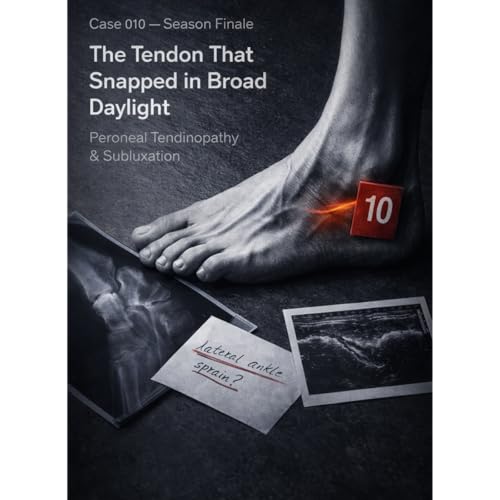
  • Case 010 - The Season Finale - The Tendon That Snapped in Broad Daylight
    Mar 6 2026

    They'll call it a lateral ankle sprain. They'll ice it, tape it, and be back four weeks later with the same problem — because a peroneal tendon injury doesn't follow the same rules.

    The outer ankle is a crime scene with multiple possible perpetrators. In this episode, we work through all five: the sprain that brought the tendons down with it, the overuse pattern built on cambered roads, the shallow groove that lets the tendon escape with every step, the longitudinal split tear that standard MRI misses, and the high-arched foot that loaded the predisposition until something gave way.

    We cover how to map peroneal pain away from ligament pain, the one question most clinicians never ask, why dynamic ultrasound catches what static imaging misses, and how the management pathway splits entirely depending on whether you're dealing with tendinopathy, a tear, or a tendon that's regularly leaving its groove.

    This one's for every runner whose ankle sprain never quite resolved.

    Más Menos
    6 m
  • case 009 - The Fracture That Wasn't on the X-Ray
    Mar 6 2026

    A deep midfoot ache. Weeks of it. A normal X-ray. A green light to keep training. And then — a complete fracture.

    The navicular stress fracture is running medicine's most deceptive case. The bone sits at the apex of the medial arch, absorbs enormous compressive force at push-off, and carries a blood supply too poor to tolerate a missed diagnosis. Get it wrong and a stress reaction becomes a fracture. Get that wrong and you're in surgery.

    In this episode, we work through the five suspects — athlete profile, foot geometry, training errors, RED-S, and the early warning signal that runners keep training through. We cover the N-spot, the hop test, and why a normal X-ray is not reassurance. We explain why CT and MRI are non-negotiable, why immediate removal from running is the only appropriate response to clinical suspicion, and how fracture grade determines everything that follows.

    This one's for every runner who was told their X-ray was fine and went back to training anyway.

    Más Menos
    7 m
  • Case 008 - The Slow Confession
    Mar 6 2026

    They'll call it a stiff big toe. They'll say they've always had it. They'll tell you they've just adapted. But adaptations are compensations in disguise — and compensations leave a trail.

    Hallux rigidus is one of running's slowest-moving cases. The first metatarsophalangeal joint quietly loses its range. The runner quietly adjusts. And by the time pain arrives, the joint has been making compromises for years.

    In this episode, we follow the evidence. We work through the five suspects driving degenerative change — from anatomical variants and old trauma to gait patterns, shoe history, and systemic arthritis. We cover how to read the gait for avoidance patterns, why weight-bearing range matters more than passive range, and how X-ray staging changes the management decision entirely.

    Then we build the plan: load management through equipment, preserving the range that remains, addressing the compensating chain — and having the honest conversation about when conservative care has a ceiling and surgery becomes the right call.

    This one's for the runner who's been quietly working around their big toe for years and calling it normal.

    Más Menos
    7 m
  • Case 007 - The Nerve That Went Underground
    Mar 6 2026

    t's not always the fascia. Sometimes it's the nerve — and the nerve doesn't lie.

    Tarsal tunnel syndrome is one of the most misdiagnosed conditions in injured runners. The foot burns. The arch tingles. It gets worse at rest, not on first steps. And yet it gets handed a plantar fasciitis diagnosis and a night splint, and sent on its way.

    In this episode, we follow the tibial nerve into the tarsal tunnel — a narrow corridor of bone and retinaculum — and work through every suspect that could be squeezing it: space invaders, swollen tendons, pronating mechanics, post-traumatic scar tissue, and systemic nerve vulnerability.

    We cover how to read the pattern, what Tinel's sign tells us, why nerve conduction studies can mislead early on, and what a proper rehabilitation plan actually looks like — from load modification to neural mobilisation to surgical decompression when all else fails.

    This one's for the runners who've been told it's their fascia for six months. It might not be.

    Más Menos
    6 m
  • Case 006 - The Inside Job - Tibialis Posterior Tendonopathy
    Feb 26 2026

    In Case 006: The Inside Job, Sole Trace investigates the quiet culprit behind medial ankle pain and a collapsing arch: tibialis posterior tendinopathy. It rarely storms in. It creeps—dull ache behind the inside ankle after long runs, morning stiffness that “warms out,” and an arch that looks flatter than it did last season.

    This episode flips the usual script: the arch isn’t the villain—it’s the victim. Sole Trace tracks the real offender, the tibialis posterior tendon, and rounds up the main suspects: mileage creep (especially cambered roads/trails), a heavily pronating foot under fatigue, shoe transitions that suddenly shift load medially (minimalist/zero-drop/ditching orthotics), the “sedentary ambush” of collapsing feet all day on hard floors, and systemic risk amplifiers that change the stakes. You’ll hear how he cracks the case with key clinical clues—pinpoint tenderness (behind the medial malleolus vs navicular insertion), the single-leg heel raise (does the heel invert or collapse?), gait signs like “too many toes,” and when imaging is warranted to rule out progression toward rupture and acquired flatfoot.

    Sole Trace lays out the evidence-led plan: reduce provocative demand without disappearing, strengthen with slow, progressive tendon loading (isometrics/eccentrics/heavy calf work), rebuild dynamic arch support through foot intrinsics and hip capacity, and manage all-day footwear so rehab actually sticks. Plus, the red flags that mean this isn’t routine tendinopathy and needs urgent assessment.

    Feet don’t lie. I just follow the clues.

    Más Menos
    7 m
  • Case 005 - Phantom of the Ankle - Chronic Ankle Sprain
    Feb 26 2026

    In Case 005: The Phantom of the Ankle, Sole Trace investigates the injury that never truly leaves the scene — chronic ankle instability. It doesn’t announce itself with a bang. It whispers: a roll here, a near-miss there… until one day you step off a kerb and the ankle decides, not today.

    This episode exposes why repeated sprains aren’t “weak ankles” or bad luck, but often a rehab debt left unpaid. Sole Trace rounds up the repeat offenders: incomplete rehab after the first sprain, true ligament laxity (ATFL/CFL), delayed peroneal reaction time after mechanoreceptor damage, chain breakdowns (foot posture, hip fatigue, stiff joints), and terrain that turns small errors into full rollovers. You’ll learn how he cracks the case by treating the system, not just the ankle — testing proprioception properly, spotting accomplices above and below, and rebuilding stability with progressive balance, reactive control, and strength that’s fast as well as strong. Plus, when bracing helps, when it hides the problem, and the red flags that need imaging.

    Feet don’t lie. I just follow the clues.

    Más Menos
    6 m
  • Case 004 - The Murder of the Metatarsal
    Feb 26 2026

    In Case 004: The Murder of the Metatarsal, Sole Trace investigates the forefoot case that starts as a whisper… then turns into a sharp, match-snap pain under load. Is it “just metatarsalgia,” or is a metatarsal being quietly overloaded toward a stress reaction / stress fracture?

    This episode follows the clues: one-finger focal pain, swelling that wasn’t there last week, pain that escalates after runs, and the 24-hour truth (if tomorrow’s walking is worse, the bone is speaking). Sole Trace rounds up the main suspects—training spikes, hard surfaces, shoe changes, stiff big toe/ankle mechanics, and the hidden motive of bone health and recovery—then lays out the evidence-led plan: offload early, remove the trigger, protect walking, maintain fitness without impact, and rebuild capacity before a controlled return to running. Plus, the red flags that mean you don’t tough it out—you get assessed properly.

    Feet don’t lie. I just follow the clues.

    Más Menos
    5 m
  • Case 003 Mortons Neuroma
    Feb 20 2026

    In Case 003, Sole Trace investigates the forefoot culprit that feels like a pebble in your shoe—but never is: Morton’s Neuroma. This episode follows the nerve’s calling cards—burning pain, tingling, numbness, and that electric “zing” between the toes—then rounds up the main suspects: narrow toe boxes, speedwork and hill spikes, stiff forefoot mechanics, and the squeeze of swelling and load.

    Sole Trace explains why it’s often not a true “neuroma” but an irritated nerve trapped in a space that’s too small, and how he cracks the case by spotting the pattern: compression worse, space better. You’ll get the evidence-led game plan: widen the shoe, reduce forefoot dose, use a metatarsal pad to create space, rebuild calf/foot capacity, and know when persistent or worsening symptoms need proper assessment.

    Feet don’t lie. I just follow the clues.

    Más Menos
    7 m