Episodios

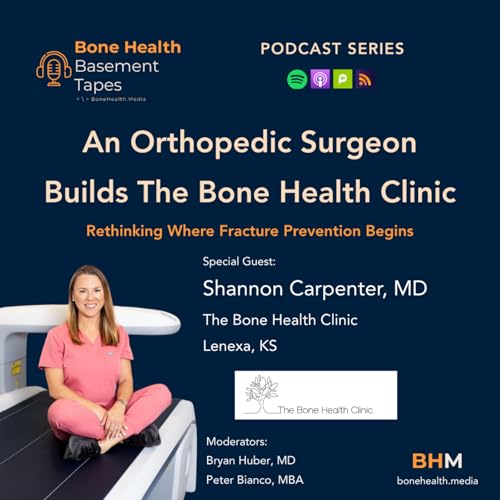
  • An Orthopedic Surgeon Builds The Bone Health Clinic with Dr. Shannon Carpenter
    Apr 7 2026

    Bone health is often addressed only after a fracture occurs, leaving a large gap between scientific knowledge and everyday clinical practice. In this episode of The Bone Health Basement Tapes, we sit down with Dr. Shannon Carpenter, an orthopedic surgeon who took an unconventional path—building a clinical practice dedicated specifically to bone health.

    Dr. Carpenter founded The Bone Health Clinic to focus on early identification of skeletal risk, comprehensive evaluation, and long-term management of bone health. Rather than treating fractures alone, her model is designed to identify patients at risk before those fractures happen.

    The conversation explores what led an orthopedic surgeon to move upstream into prevention, the operational realities of building a dedicated bone health practice, and the broader implications for how bone health care may evolve in the coming years. As diagnostic technologies improve and fracture risk becomes more visible earlier in the patient journey, practice models like this may represent an early signal of a larger shift in how skeletal health is delivered.

    This episode examines what happens when bone health becomes the central focus of a clinical practice—and what that might mean for the future of fracture prevention.

    Más Menos
    45 m
  • the Biology of Aging Bone - A Conversation with Sundeep Khosla, MD
    Mar 25 2026

    In this episode of The Bone Health Basement Tapes, we sit down with Dr. Sundeep Khosla — endocrinologist, researcher, and one of the central scientific figures in modern bone health. Dr. Khosla has spent his career at the Mayo Clinic asking foundational questions about why the skeleton ages and fails, and his answers helped change how the field thinks about bone loss in both women and men. His research on sex steroids and skeletal aging revealed that estrogen is not just a female story — it plays a quiet but decisive role in male bone health as well, a finding that reshaped clinical thinking and opened new lines of research.

    In this conversation, we trace the arc of that scientific journey: how skeletal biology evolved from descriptive observation into molecular and cellular precision, what the field got wrong along the way, and how decades of careful research eventually produced drugs capable of reducing fracture risk by as much as 70%. We also examine the troubling gap between what science achieved and what medicine delivered — including Dr. Khosla's 2016 paper documenting a dramatic collapse in osteoporosis treatment rates at exactly the moment the tools to prevent fractures had never been better.

    It is a conversation about discovery, about the institutions and mentors that make science possible, and about what happens when a field wins the scientific battle but struggles to translate it into care.

    Más Menos
    45 m
  • Bringing Bone Health Care Back to the Center of Women’s Health
    Mar 10 2026

    In this episode of The Bone Health Basement Tapes, we welcome Dr. Kristi Tough DeSapri, founder of Bone & Body Women’s Health, a practice built around a simple but powerful idea: bone health should be central to women’s healthcare—not an afterthought addressed only after risk becomes severe.

    Dr. DeSapri’s work sits at the intersection of menopause medicine, endocrinology, metabolic health, and skeletal health. Through her practice, she focuses on helping women understand and manage bone health earlier in life—particularly during the midlife hormonal transitions when bone loss often accelerates but remains largely invisible within traditional care pathways.

    During our conversation, we explore why bone health has historically been fragmented across specialties and how that fragmentation affects patient care. Dr. DeSapri shares her perspective on the importance of addressing skeletal health as part of a broader conversation about longevity, strength, and healthy aging.

    We also discuss what led her to establish Bone & Body Women’s Health, the kinds of patients she serves, and how an integrated semi-concierge practice model can better connect menopause care, metabolic health, muscle health, and bone density into a single clinical framework.

    At a time when awareness around menopause and proactive health is rapidly expanding, this conversation highlights why bone health may be entering a new phase of visibility. Practices like Dr. DeSapri’s suggest that skeletal health is beginning to move upstream—becoming part of earlier conversations about prevention, risk, and long-term vitality.

    For clinicians, this episode offers insight into how bone health can be more thoughtfully integrated into women’s care. For patients, it’s a reminder that understanding bone health earlier in life can play a critical role in maintaining strength, mobility, and independence in the decades ahead.

    Más Menos
    Aún no se conoce
  • From Movement to Infrastructure: ASOP’s Evolution and the Bone Health's “Big Bang”
    Mar 2 2026

    Episode Summary — Basement Tapes Recording (Feb 27, 2026)

    Speakers: Peter Bianco, Matt Bruns (DNP), Dudley Phipps Core themes: certification, infrastructure, risk visibility, workforce training, collaboration, ecosystem maturation, tech + capital readiness

    In this episode, Peter, Matt, and Dudley step back from day-to-day tactics to explain what’s changing in the bone health ecosystem—and why the change matters right now. The conversation is framed as a pivot toward maturity, not contraction: after a year-plus of “mapping the ocean floor” (a detailed look at the real-world barriers to scalable osteoporosis care), the team concludes that the work must now split into three distinct but complementary lanes so each can execute with focus.

    Dudley outlines ASOP’s primary lane: standardized training and subspecialty certification to build a credible, scalable workforce infrastructure for bone health. The group argues that guidelines alone aren’t enough—without a recognized certification pathway and competence standard, bone health remains “the Wild West,” limiting policy leverage, reimbursement clarity, and repeatable clinic operations. Matt emphasizes certification as a practical signal to both patients and referring providers: in a space where “no one owns” osteoporosis across the lifespan, certification helps identify true subject-matter expertise and improves referral accuracy.

    Peter connects this organizational maturation to the broader “Big Bang” thesis for the season: the field is moving from disease visibility (reacting after fracture) toward risk visibility (identifying and managing fracture risk across the lifespan). They discuss how current care remains too event-driven—“conception to death” prevention requires a wider lens that also elevates adjacent “orphan” domains like fall risk and nutrition, which demand training and workflow ownership.

    A second lane emerging from their work is the role of The Bone Health Basement Tapes itself: what started as an experiment to “shout into the canyon” has become a surprisingly strong signal of demand, with growing downloads and inbound interest. The team positions the show as more than a podcast—an ecosystem convening channel that supports the cultural and informational infrastructure needed for change.

    The third lane is the “outside-the-society” execution layer: Peter describes the move toward Bone Health Media and a more analytic platform approach—including the developing Bone Health Index—to provide the “speedometer and temperature gauge” the sector lacks. The idea is to make bone health legible not only to clinicians, but to investors, employers, and technology builders who currently don’t have a clear entry point into the vertical. The episode closes with a direct call for collaboration across societies and stakeholders, arguing that clearly defined lanes make collaboration easier—and that without greater cooperation and serious infrastructure investment, the field won’t move the numbers that have been stagnant for decades.

    Bottom line: This episode is a “state of the mission” reset—positioning certification, media/convening, and execution infrastructure as coordinated pillars for scaling fracture prevention, attracting investment, and shifting the field from reactive care to lifecycle risk management.

    Más Menos
    39 m
  • Bone Health’s Big Bang? Care, Scale, and the Lessons of Diabetes
    Jan 28 2026

    Episode Focus

    This season-opening episode examines whether bone health is approaching a “Big Bang” moment similar to diabetes 15 years ago—and, critically, how to ensure that the scaling of bone health care does not repeat the moral and practical mistakes that accompanied diabetes’ transformation.

    The episode is anchored by a conversation with Victor Montori, MD, Professor of Medicine and endocrinologist the Mayo Clinic, author of Why We Revolt, and founder of the Patient Revolution, followed by a panel discussion with bone health clinicians.

    Why This Conversation Matters Now

    Diabetes care transformed rapidly once previously fragmented forces—screening, therapeutics, reimbursement, and technology—converged. That transformation improved outcomes, but it also introduced new burdens: over-reliance on metrics, protocol-driven care, administrative overload, and erosion of patient and clinician agency.

    Bone health today shows many of the same pre-transformation conditions:

    • A large, mostly undiagnosed at-risk population
    • Fragmented ownership of care
    • Reliance on single metrics (e.g., T-scores) to make complex decisions
    • Growing technological capability without fully formed care models
    • Increasing economic pressure from preventable fractures

    This episode explores whether bone health is on the verge of a similar inflection point—and what lessons from diabetes must guide its evolution.

    Core Conceptual Comparisons

    • HbA1c <> T-score: Both are population-level summary metrics that became over-empowered as individual care decision-makers.
    • CGM <> bone health monitoring: Diabetes advanced not by finding a better number, but by capturing lived, dynamic risk. Bone health has not yet had an equivalent “continuous risk” moment.
    • Fragmented care ownership: Just as diabetes once belonged to “everyone and no one,” bone health risk today lacks clear longitudinal accountability.
    • Undiagnosed disease burden: In both conditions, risk is widespread, silent, and often only recognized after harm occurs.

    The Patient Revolution Lens

    Dr. Montori’s work frames healthcare reform as a moral project, not merely a technical one. Key principles guiding the episode include:

    • Care must fit into patients’ lives, not the reverse
    • Metrics should inform conversation, not replace it
    • Scale without humility risks industrializing fragility
    • Clinician and patient burden are ethical concerns, not side effects

    These principles serve as a safeguard as bone health care begins to scale.

    Panelists:

    Bryan Huber, MD, Orthopedic Surgeon

    Dudley Phipps, PA-C, CEO/Executive Director, American Society of Osteoporosis Providers

    Peter T. Bianco, MBA, Moderator, The Bone Health Basement Tapes

    Más Menos
    46 m
  • Season 3 Trailer: Bone Health’s Big Bang?
    Jan 22 2026

    Season 3 Trailer: Bone Health’s Big Bang?

    Bone health has never lacked importance. Fragility fractures are predictable, costly, and life-altering—and clinicians have long known how much better outcomes could be with earlier intervention.

    So why does prevention still feel so hard to sustain?

    In Season 3 of Bone Health Basement Tapes, we explore a possibility—one we’re not yet sure we believe.

    What if bone health is approaching its own Big Bang?

    Not a sudden breakthrough. Not a guaranteed transformation. But a moment where long-standing forces—clinical capability, workforce expertise, practice leadership, technology, and system design—may finally be starting to align.

    Across the season, we dig into the realities providers and practice leaders live with every day.

    We explore why fragility risk is often visible long before a fracture—but acting on that risk can still be inconsistent and difficult. Why bone health programs can succeed locally yet struggle to survive or scale. Why effective therapies and digital tools exist, yet operational, staffing, and financial friction remain. And why prevention so often depends on individual effort rather than durable systems.

    We also examine the evolving role of technology in bone health—advanced imaging, analytics, workflow tools, and digital platforms that increasingly make risk visible and care more measurable. Not as silver bullets, but as catalysts that raise an important question: If we can see more, measure more, and know more—why is it still so hard to act consistently?

    Along the way, we look at how bone health fits into the broader healthcare ecosystem—how it intersects with surgery, post-acute care, employers, and families—and why the value of prevention is widely felt, but unevenly captured.

    We draw careful comparisons to other disease areas, like diabetes, where meaningful change only happened once technology, accountability, workforce development, and investment caught up with clinical knowledge. Not as a promise—but as a lens for asking better questions.

    Season 3 also turns its attention to the people doing the work: the growing importance of specialized training, clearer roles, and deeper expertise—and why workforce development may be one of the most underappreciated foundations of sustainable bone health care.

    This is not a technology showcase. And it’s not an investor pitch.

    It’s a grounded, practice-first conversation about how bone health actually works today—and what would need to change for prevention and optimization to become easier to deliver, not harder.

    We’re not declaring a transformation. We’re exploring whether the conditions for one might finally be emerging.

    Welcome to Season 3 of Bone Health Basement Tapes: Bone Health’s Big Bang?

    Más Menos
    4 m
  • Inside the ASOP Provider Bone Health Certification Pilot — Results, Lessons & Frontline Perspective
    Oct 7 2025

    This episode goes inside ASOP’s Provider Certification pilot—the first step toward a scalable, provider-focused training and credentialing path for bone health.

    We unpack why the curriculum was built, how the pilot was structured, and what the early results suggest about standardizing care pathways to meet rising demand.

    You’ll hear what worked, what needs refinement, and how certification can translate into practice-ready workflows that improve identification, treatment initiation, and follow-up—without adding friction to busy clinics.

    Our guest, Alexandra Rocco, PA-C (Utah Orthopaedics), brings a frontline view from the pilot: how the coursework shaped team roles, documentation, imaging, and treatment protocols; what barriers remain; and where certification can accelerate access before a first fracture. If you’re a clinician, practice leader, or payer, this conversation outlines how certifying providers can turn overlooked fracture risk into proactive, reimbursable care at scale.

    Más Menos
    46 m
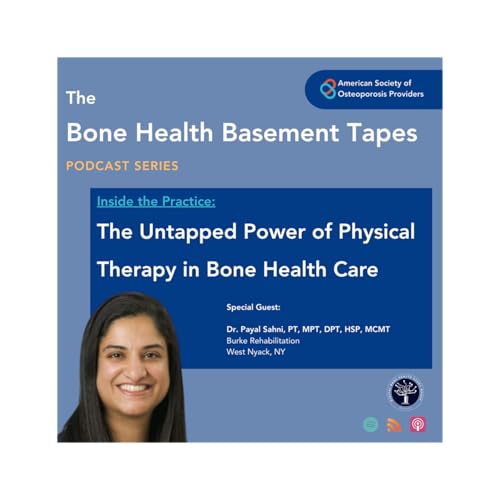
  • The Untapped Power of Physical Therapy in Bone Health Care
    Sep 25 2025

    Physical therapy is one of the most powerful tools we have to reduce fracture risk, restore mobility, and preserve independence—yet it remains underutilized and overlooked in most osteoporosis care models.

    In this episode of The Bone Health Basement Tapes, we’re joined by Dr. Payal Sahni, PT, DPT, Sr. Physical Therapist at Burke Comprehensive Spine and Orthopedic Rehabilitation Center, the former Program Director of the New York State Osteoporosis Prevention and Education Program (NYSOPEP) at Helen Hayes Hospital and a nationally recognized leader in bone health rehabilitation.

    Together, we examine the systemic blind spots that have excluded physical therapists from the core of osteoporosis management: reimbursement structures that undervalue movement-based care, siloed specialty practices, and a cultural overreliance on medication over muscle.

    Dr. Sahni shares insights from her two decades of work at the intersection of clinical care, research, and community outreach—including how evidence-based PT programs are preventing falls, treating complex fracture cases, and reshaping what post-diagnosis support can look like.

    This conversation challenges conventional frameworks and asks a provocative question: What would bone health look like if physical therapy were treated as essential—not optional?

    Bio:

    Dr. Payal Sahni, PT, DPT, HSP, MCMT, is a distinguished physical therapist and educator with over two decades of experience in orthopedic rehabilitation, specializing in bone health and osteoporosis care. She is a Senior Physical Therapist at Burke Comprehensive Spine and Orthopedic Rehabilitation Center in West Nyack, NY. She has also served as the Program Director of the New York State Osteoporosis Prevention and Education Program (NYSOPEP) at Helen Hayes Hospital in West Haverstraw, New York.

    Dr. Sahni's academic journey began in India, where she earned her Bachelor's in Physiotherapy from Rajiv Gandhi University of Health Sciences, Bangalore and her Master's in Physical Therapy from SBSI Dehradun. She later obtained her Doctor of Physical Therapy (DPT) degree from Dominican University in Orangeburg, New York.

    Throughout her career, Dr. Sahni has been a fervent advocate for integrating physical therapy into bone health management. She has developed evidence-based exercise programs focusing on osteoporosis, balance, fall prevention, and ergonomic assessments. Her commitment to education extends to lecturing at outreach programs for clinicians and patients, emphasizing the importance of strength training and nutrition in maintaining bone health. She has also been at the forefront of developing and teaching osteoporosis-related continuing education programs for rehabilitation professionals.

    Dr. Sahni's research contributions include publication of the first long term case report on the rehabilitation of pregnancy and lactation-associated osteoporosis and vertebral fractures, in The Musculoskeletal Journal of Hospital for Special Surgery. She has presented numerous papers on osteoporosis rehabilitation at the Combined Sections Meeting of the American Physical Therapy Association.

    In addition to her clinical and research endeavors, Dr. Sahni served as a medical advisor for Wellen (acquired by OsteoBoost), a platform dedicated to bone health and is a member of the Bone Health & Osteoporosis Foundation’s Ambassador Council.

    Dr. Sahni's holistic approach to patient care and her dedication to advancing the role of physical therapy in bone health make her a leading voice in the field.

    Más Menos
    40 m