Episodios

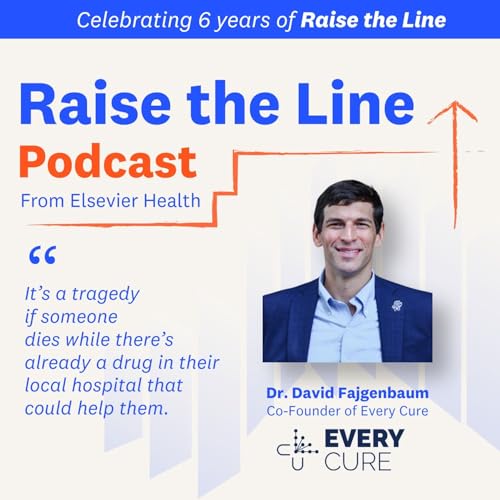
  • Saving Lives Using Repurposed Medications: Dr. David Fajgenbaum, Co-Founder of Every Cure
    Apr 16 2026

    To mark the sixth anniversary of Raise the Line from Elsevier we're revisiting one of the most remarkable stories we've had the privilege of sharing over the last 575 episodes. To do that, we're delighted to welcome back Dr. David Fajgenbaum, a physician-scientist who repurposed an existing medication that saved his own life from Castleman disease, an ultra-rare condition that nearly killed him on five occasions. Because there was no treatment specifically for Castleman, Dr. Fajgenbaum set out to find a previously approved medication that might work. “I eventually found a drug that was made for another disease 50 years ago. It's been over 12 years that I've been doing great on this medicine.”

    When he first joined us in 2022, Dr. Fajgenbaum was just launching a non-profit organization called Every Cure with the hope of replicating the success he achieved in his own case, and as you’ll learn in this inspiring interview with host Lindsey Smith, its work has already saved thousands of lives. “It's a tragedy if someone dies while there's already a drug in their local hospital that could help them.”

    In the latest installment of our Year of the Zebra series on rare conditions, you’ll hear an inspiring example of a life saved by this approach and also learn about:

    • The role of artificial intelligence in scanning thousands of medications and diseases to find possible matches;
    • How Every Cure decides which drugs merit the costly research needed to confirm a match;
    • Dr. Fajgenbaum’s philosophy of “living in overtime.”

    Mentioned in this episode:
    Every Cure

    Osmosis Video on Castleman Disease

    Dr. Fajgenbaum's Bestselling Memoir, Chasing My Cure

    If you like this podcast, please share it on your social channels. You can also subscribe to the series and check out all of our episodes at www.osmosis.org/podcast

    Más Menos
    26 m
  • How AI Could Strengthen the Doctor-Patient Relationship: Dr. Ashwin Vasan, Senior Fellow in Health Policy and Global Affairs at Yale School of Public Health
    Apr 9 2026

    How AI Could Strengthen the Doctor-Patient Relationship: Dr. Ashwin Vasan, Senior Fellow in Health Policy and Global Affairs at Yale School of Public Health and Affiliate Faculty at Yale Jackson School of Global Affairs

    “Ultimately, AI needs to be a tool that doesn't break down trust or empathy or clinical judgment, but rather helps enhance those things.” That aspirational perspective from Dr. Ashwin Vasan, Senior Fellow in Health Policy and Global Affairs at the Yale School of Public Health and Affiliate Faculty at the Yale Jackson School of Global Affairs, frames a nuanced conversation about one of healthcare’s most consequential changes. Drawing on his experience as New York City Health Commissioner during the COVID-19 crisis and decades in global and public health, Dr. Vasan argues that the future of AI in medicine should be shaped less by the technology itself than by the values guiding its implementation, and that physicians need to play an active role in this process. “I think it behooves us to engage with this technology and steer it in the directions that we want as a society.”

    This timely discussion also offers Dr. Vasan’s thoughtful perspectives on:

    • How AI could allow physicians to focus on the human side of care;
    • The risks of AI reinforcing inequities and driving costs higher;
    • Public health as the marriage of science, society and trust.

    Join host Lindsey Smith for a valuable Raise the Line episode on how AI can be harnessed to benefit patients and provides alike.

    Mentioned in this episode:

    Yale School of Public Health

    Yale Jackson School of Public Affairs

    If you like this podcast, please share it on your social channels. You can also subscribe to the series and check out all of our episodes at www.osmosis.org/podcast

    Más Menos
    41 m
  • How AI Is Transforming Education By Making “Precision Learning” Possible: Paul Crockett, Chief AI Officer at Elsevier
    Apr 2 2026

    Imagine you had a tutor who was with you every time you were studying and, because they knew your learning style, strengths and weaknesses, could hand you the right content at the moment you needed it to deepen your understanding of a topic. That’s the pedagogically powerful experience students are having with AI-enhanced learning systems such as Osmosis AI, making possible what our guest, Elsevier’s Chief AI Officer Paul Crockett, describes as a new era of precision learning. “We now have signal from how students actually engage with content – such as where they get stuck and how they learn – and that behavioral data can tell you more about what a learner needs than any sort of static assessment. That's a profound transformation,” he says. In this fascinating conversation with Raise the Line host Lindsey Smith, Crockett also highlights how AI enables tutoring-like interactions with students which supports deeper reasoning rather than rote memorization. That in turn, helps Elsevier achieve the goal of getting students ready to practice medicine, not just ready to take tests. In addition, limiting the AI’s sources to the evidence-based material in the Osmosis and Elsevier content libraries provides both students and faculty with the level of trust and verifiability they desire. Tune in to learn how this meaningful shift from static content delivery to dynamic, data-informed learning experiences is changing healthcare education.

    Mentioned in this episode:

    Osmosis AI

    If you like this podcast, please share it on your social channels. You can also subscribe to the series and check out all of our episodes at www.osmosis.org/podcast

    Más Menos
    26 m
  • Advancing Public Health Through Community Partnerships: Dr. LaMar Hasbrouck, Managing Director of DLM LLC
    Mar 26 2026

    “Everything I’m not, made me everything I am.” For Dr. LaMar Hasbrouck, that song lyric captures how growing up in a community marked by food insecurity and limited access to healthcare shaped a lifelong mission to improve health on a broad scale. Dr. LaMar, as he’s known, has pursued that mission in a variety of impactful roles, including CDC disease detective, director of the Illinois Department of Public Health, and executive director of the National Association of County and City Health Officials. Reflecting on today’s public health challenges, Dr. LaMar sees the biggest problem not as a specific disease, but rather the constant “noise” of modern life and the social isolation that fuels sedentary lifestyles and chronic disease.

    This thoughtful and wide-ranging conversation with host Lindsey Smith also explores:

    • The rise of the “know-it-all-ogist” and the dangers of misinformation;
    • The importance of transparent communication and humility when navigating public health crises;
    • Going beyond community engagement to being a true community partner.

    This is a great opportunity to hear from a seasoned and encouraging voice at a time of unprecedented challenges for public health professionals and programs.

    Mentioned in this episode:

    DLM LLC

    If you like this podcast, please share it on your social channels. You can also subscribe to the series and check out all of our episodes at www.osmosis.org/podcast

    Más Menos
    32 m
  • Offering Kindness and Respect to Every Patient: Madison Donnelly, PA-C, Community Care Physicians
    Mar 19 2026

    “Every person deserves kindness, dignity, and respect, regardless of what their medical situation is,” says Madison Donnelly, PA-C, who joins host Dr. Parsa Mohri on the latest installment of our NextGen Journeys series. As you’ll hear in this thoughtful conversation, Madison is bringing that commitment to patient advocacy and equitable care to her patients at Community Care Physicians in Albany, New York. A graduate of Hofstra University’s PA program, Madison describes how the profession’s flexibility and team-based approach enables clinicians to expand access to care, particularly in high-demand specialties like women’s health and primary care. Drawing on her work in obstetrics and gynecology, she highlights persistent gaps in women’s health, including America’s troubling maternal mortality rates and the long delays many patients face in receiving diagnoses for endometriosis and other conditions. “There’s a difference between telling someone something and being heard,” she notes, emphasizing that women’s symptoms are still too often dismissed in clinical settings. The episode also explores overlooked populations -- including NICU families and patients with eating disorders -- where stigma, mental health challenges, and fragmented follow-up care can leave people vulnerable long after the initial medical crisis. Don’t miss this Raise the Line dialogue about the evolving role of physician associates and how early-career clinicians can help build a more humane and responsive system.

    Mentioned in this episode:

    Community Care Physicians

    Hofstra University Physician Assistant Program

    If you like this podcast, please share it on your social channels. You can also subscribe to the series and check out all of our episodes at www.osmosis.org/podcast

    Más Menos
    28 m
  • Why We Need the Independent Practice Model in Medicine: Dr. Alexander Vaccaro, President of Rothman Orthopaedic Institute
    Mar 12 2026

    We’ve spoken with many guests about clinical and technological trends impacting healthcare providers, but less so about the trends on the business side of practicing medicine. So on this episode, we’re going to make up for that by spending our time with Dr. Alexander Vaccaro, an influential spine surgeon and president of one of the largest musculoskeletal practices in the U.S. -- Rothman Orthopaedic Institute -- which treats patients at over 40 locations in Pennsylvania, New Jersey, New York and Florida. While Dr. Vaccaro understands the desire for financial stability that’s increasingly driving young physicians into the arms of hospital systems, he worries about what’s being lost with the resulting decline in the number of independent practices. “If you didn't have private practice advocating for the doctor, the insurance companies would bully the healthcare profession.”

    Join Raise the Line host Michael Carrese for a candid and lively conversation that also covers:

    • How physician autonomy and entrepreneurship can drive innovation;
    • The economic and policy forces reshaping private practice medicine;
    • The role of research partnerships between private practices and universities.

    Mentioned in this episode:
    Rothman Orthopaedics

    If you like this podcast, please share it on your social channels. You can also subscribe to the series and check out all of our episodes at www.osmosis.org/podcast

    Más Menos
    29 m
  • The Science Behind Effective Health Communication: Dr. Tesfa Alexander, Lerner Center for Public Health Advocacy at the Johns Hopkins Bloomberg School of Public Health
    Mar 5 2026

    We've had many conversations on Raise the Line about the challenges of health communication in today's world of information overload, but none of our guests have the kind of expertise Dr. Tesfa Alexander has acquired in a career that has taken him from Madison Avenue to the halls of government and academia. From guiding tobacco education research at the FDA to leading public health initiatives at MITRE, Dr. Alexander has developed a deep understanding of the science and strategy behind effective health communication. “Successful campaigns keep the long game in mind where you want to develop a lasting relationship with your target audience,” he tells host Lindsey Smith. That relationship needs to be built on understanding culture, beliefs, priorities and daily realities, and only then can you develop messaging that will resonate, he explains. Dr. Alexander also believes these relationships can be leveraged to help people sort out facts from misleading or inaccurate claims. “I strongly recommend shifting our focus from combating misinformation head on, and instead working with the communities who we are seeking to serve.”

    This fascinating look at communication science also covers:

    • How stories drive belief;
    • The importance of working with community partners who are trusted messengers;
    • The power of audience segmentation.

    Tune in as Dr. Alexander unpacks what it takes to influence beliefs, and ultimately behaviors, in an era defined by misinformation and institutional mistrust.

    Mentioned in this episode:
    Lerner Center for Public Health Advocacy

    If you like this podcast, please share it on your social channels. You can also subscribe to the series and check out all of our episodes at www.osmosis.org/podcast

    Más Menos
    24 m
  • A Personal Struggle Fuels National Advocacy for Rare Disease Patients: Shanti Hegde, Board Member of Hemophilia Federation of America
    Feb 26 2026

    We’re marking Rare Disease Month 2026 by highlighting the powerful story of Shanthi Hegde, a young patient advocate working to transform how bleeding disorders are understood, treated, and supported. This work is fueled by her own arduous journey with two rare bleeding disorders and immune dysregulatory syndrome, and an extended diagnostic odyssey marked by dismissal, underdiagnosis, and structural bias. “I was told many times by many providers that these disorders are not common in Indians and that my bruises were there just because I'm brown.” Admirably, Shanthi pushed past this mistreatment, advocated for her medical needs, and devoted herself to tackling a range of issues confronting rare disease patients from mental health access to affordable drug pricing to research equity.

    In this remarkable Year of the Zebra conversation with host Lindsey Smith, you’ll also learn about:

    • Shanti’s work with the Hemophilia Federation of America;
    • How gaps extend beyond treatment to include insurance coverage, provider training, and substance use care;
    • What clinicians can do to improve the work they do with rare disease patients.

    Join us for a conversation that connects patient voice to system change, and explores what real equity for rare disease communities will require.

    Mentioned in this episode:
    Hemophilia Federation of America
    Shanthi's LinkedIn Profile

    If you like this podcast, please share it on your social channels. You can also subscribe to the series and check out all of our episodes at www.osmosis.org/podcast

    Más Menos
    45 m