Episodios

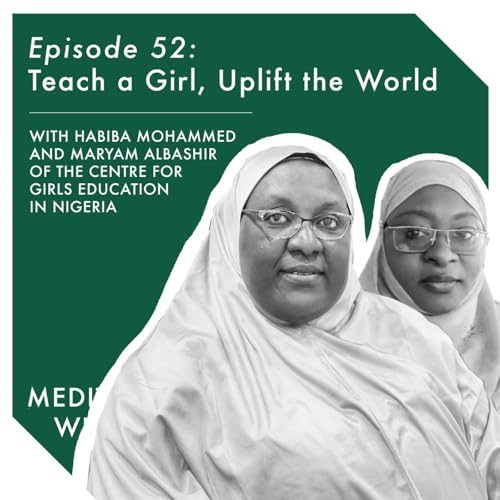
  • Teach a Girl, Uplift the World with Habiba Mohammed and Maryam Albashir of the Centre for Girls Education in Nigeria
    Dec 19 2024

    It’s hard to imagine in the western world, but in Nigeria, girls as young as ten are married and four out of every ten girls are married before the age of eighteen, eight out of ten in the northern region. When a girl is forced into marriage, sometimes to a man old enough to be her grandfather, she often cannot continue her education unless her husband allows it, she is likely to live her life illiterate, and she faces a higher risk of death from childbirth due to being neither physically or emotionally ready.

    In this episode, we speak with Habiba Mohammed and Maryam Albashir, the co-director and deputy director respectively of the Centre for Girls’ Education in Nigeria. These women have dedicated their lives to helping girls through educational programs, safe spaces, Gender-based violence prevention, vocational and leadership training and other mentorship programs through the Centre which has helped thousands of girls since it opened in 2007.


    Until this interview, we did not understand just how far reaching the issue of child marriage was in the Sahel region of Africa, and we were blown away by the incredible impact these women have had in improving the lives of so many girls.

    We believe that if we want to see more peace in this world, it starts with empowering the girls and women and Habiba and Maryam are showing all of us how.

    You can learn more about or make a donation to the Centre for Girls Education HERE.

    2.08: Marital Age in Northern Nigeria
    7.23 Education of Habiba Mohammed
    8.17 “My mother, she always tells me that the schooling is not for anybody but for me. So I should understand that I am not doing anybody a favor by going to school. I am doing myself. So I need to know that I want to change my life, I will be who I want to be, if I go to school. It can influence the husband that I marry, it can influence the friends that I have, and it will influence the way I want to live my life.” Habiba Mohammed
    9.24 Maryam Albashir´s Story

    12.20 A Mother to All

    13.00 Arranged and non arranged marriages
    15.00 Going to the communities
    16.31 “At the safe spaces we encourage the girls to go back home and discuss what they are learning in the safe spaces to their mothers and their aunties and their other siblings. So this helped us to get very acceptance in the communities.” Habiba Mohammed
    16.57 Number of girls they have helped educate
    20.00 Things the girls learn at the safe spaces

    20.30 “What we do at the safe spaces is also to empower her, for her to know her self worth, for her to be able to identify what she wants to become in life. Some of these girls, depending on the category of project that we enroll them into, we empower them with vocational skills. So along the line, if they start earning an income it gives them an upperhand in their homes, it gives them a voice to say who they want to be or what they want to become in life.” Maryam Albashir
    23.00 1st story of success, story of Sakina
    27.30 Favorite part of their job
    29.50 Their message to the world
    “Every girl, wherever she is, needs an education. And she needs to be empowered and she needs to be who she wants to be in life. So if we are educated and we are given that opportunity the sky is not our limit, the sky will be our starting point.” Habiba Mohammed

    Más Menos
    32 m
  • Bringing Love and Healing to Israel with Nechama Shaina
    Dec 4 2024

    With all eyes on the conflict in Isreal, Lebanon and Gaza, it can be easy to sink into despair witnessing the endless stream of news stories of violence and devastation. However, there are some who are like lights in the darkness, spreading peace and love at the center of the strife.

    We are so honored to have one of those people on our podcast, Nechama Shaina, an expressive arts therapist originally from the Chabad community in the Bay Area of California who currently resides in Israel with her two teenage children. She has a background in clinical psychology and uses dance, drama and visual arts in her therapy. She has been playing an active role in healing those who have been so horribly affected by the current conflict there including giving hands-on treatments for the Kibbutz Be’eri survivors of the October 7th attack where Hamas-led terrorists killed 101 people in that kibbutz alone. She also organizes healing retreats for the grieving Druze women who lost their children during the Hezbollah attack on the soccer field in Majdal Shams this past summer.

    Speaking with Nechama, we were in tears listening to how she brings her life journey of creativity, her passion for the sacred feminine and her deep knowledge of the Jewish tradition to anyone who has need allowing those she treats the space to heal on the level of mind, body, heart and soul.

    She is a true pioneer, and her diverse background puts her in the unique position to be of great service at this particular time in Israel’s history. We feel like we got a glimpse into what it is really like to be there now at the center of the conflict, and surprisingly, miraculously, it was a glimpse of hope.

    Meditation Without Borders is currently raising funds to go to Isreal in 2025 in collaboration with Nechama Shaina to teach Vedic meditation to the women and mothers in Isreal of various backgrounds who are most effected by the current conflict. If you would like to contribute to this effort, please consider donating HERE.


    Show Notes:

    .30 Intro to Nechama

    2.00 Nechama´s current work
    3.19 Druze Community

    6.18 “Once you connect to the people that have been at the edge of life and death there is something very sacred there.” Nechama

    7.53 Nechama means comfort
    9.25 “He said I want to continue learning Arabic cause I want to learn how to speak to the Palestinian people and not fight with weapons.” Israeli Soldier
    14.00 Nechama´s story in her own words
    14.20 “My Mom and Dad raised me with one of the many many foundations of the belief system that we are being breathed into existence every moment by the divine. It's not the divine that created us and this universe and just took a walk. That we are being intended or dreamed into this planet.” Nechama

    15.00 The Hasidic Community
    16.30 The Role of Women in Judaism
    18.28 Being a Scribe and the Ketubah

    22.00 Inspiration for Ketubah Piece

    25.52 Collective Consciousness of Israel right now
    29.30 Methods of Healing

    33.50 Priestess and Weavers
    35.00 The Feminine in Judaism

    37.49 “Our words are so powerful right? Our words create reality. Our thoughts create reality. How much more so do our words create reality when we bring in the divine feminine in our prayers, in our words. So we are bringing her in reality, in our presence, in our consciousness.” Nechama
    38.38 The Feminine Rising as Controversial in Different Traditions

    40.46 Different therapies and Body work therapy for working with communities in Israel

    43.00 Breathing Techniques

    50.27 Pilgrimage Dream
    52.07 “I felt like this dream was about opening the gates of prayer for each other. Like we are opening those gates together and praying in different languages. And that's actually what I did back in the year 2000. There was a whole group of Christians, Muslims and Jews, Israelis that came together overlooking the temple mount and the mosque and the western wall. and right in between the Jewish and Muslim quarter in the old city and we would come together, pray in different languages, talk, sing.” Nechama

    52.27 “I've had this strange opportunity and it's weird to say it's an opportunity to be here in this country for really challenging times. And opportunities for a lot of growth and healing.” Nechama

    Más Menos
    55 m
  • The Feminine is Power
    Nov 6 2024

    Recorded October 2024

    While it seems like the patriarchy is at its peak and brutality is rampant around the world, it can feel like we’re all tumbling towards darkness. However, when we take a wider view, we see that there is a larger movement at play, and there is hope of a phoenix rising from the destruction–the rising of the Feminine.

    In this episode, Isabel and Kristen discuss the nature of the Feminine as infinite organizing power and how to spot its promising emergence on the world stage and in our own lives. We hope our conversation can help ease some of the anxiety around what is going on in the collective and inspire mobilization for positive change.

    Show notes:

    2.00 The Safe space between Women

    4.20 Tide Shift of the Feminine no longer receding

    7.00 The New Role

    8.00 Kali Yuga

    9.00 The Receding of the Feminine

    12.00 The Women in Rwanda
    13.00 “The feminine has in it this quality in which it sees everybody as equal.If you imagine a mother, all her children are equal to her. And so there is something about that forgiveness and that seeing everyone as the same that is required when there is such extreme division in order to come out of it.” Kristen Vandivier.

    18.00 Honoring our bodies

    21.00 The Role of the Masculine Rising

    27.00 “How does the feminine fight? The feminine makes her enemies her devotees. Its an incorporation” Kristen Vandivier

    30.00 Feminine Empowered

    38.00 Setting Boundaries and Kali Mode

    45.00 Betrayal

    49.00 Inclusivity
    53.00 Women Are Never Losers

    Más Menos
    56 m
  • Mood Making and Authenticity
    Jul 10 2024

    You’ve seen them, people trying too hard, taking themselves too seriously, putting on a show, straining to appear of a higher status or consciousness state or social status than maybe they are. Perhaps you have caught yourself giving off an impression as opposed to just being your sweet but not-always-so-glamorous self.

    You’d think in spiritual communities, we’d be beyond this type of behavior, but instead the environment seems to encourage it instead. So much so Maharishi Mahesh Yogi had a name for this behavior, he called it “mood making.”

    In this episode, Isabel and Kristen talk about how enlightenment doesn’t have to look a certain way. They delve into the reasons why we find ourselves occasionally engaging in this cringe-worthy behavior (while sharing some of their own self-deprecating moments) and discuss how to bring yourself back to your true “warts and all” authentic self, which ironically, is the most attractive way to be.

    Originally recorded in March 2024

    Show Notes:

    .53 What is mood making?

    2.30 Mimicking what we think enlightenment looks like

    4.00 Taking ourselves too seriously

    4.30 Aspirational vs Relatable

    6.00 Different expressions of enlightenment

    7.30 “Embracing who we are, whoever that is, gets us past the mood making.” Kristen

    8.00 Self-doubt and insecurity

    “Realizing that whoever it is that I want to be is already me. It’s just more me. It’s me being totally comfortable with that me.” Kristen

    17.30 Rice Krispies Guru
    18.00 “We can’t put that consciousness state in a box. A person who is in enlightenment or has a certain percentage of enlightenment is going to act in whatever way is relevant to inspire those around him or her.” Kristen

    18.30 Dualistic way of looking at things

    21.26 Authenticity

    “When we meditate twice a day we are going to the place that is the true us, that is the authentic `I´, it’s the big `I´, it’s that layer of being, the source of everything that is our true self.” Kristen Vandivier

    22.00 Identity

    23.57 “The important thing is this, to be able at any moment to sacrifice what we are for what we could become.” Maharishi Mahesh Yogi

    25.00 Enlightenment – appreciation of creation

    30.40 Our true self

    31.00 Stardust

    33.00 Big Bang

    36.30 Unique traits

    38.00 Let go of the idea of enlightenment

    40.00 I guess this is us

    Más Menos
    42 m
  • The Man Behind "Be Here Nowra" with Barron Hanson
    Jun 19 2024

    Meditation is a solitary practice right? Not necessarily. Our latest guest on our podcast is not only creating community through this individual practice, he is also pioneering a study on the effect of deep meditation on the collective consciousness.

    We are delighted to have Barron Hanson on our podcast. Barron is a fellow Vedic Meditation teacher based in Australia, and has a long history of bringing people together, designing transformative experiences, creating films, and generally working to make the world a better place. His latest project, more like a family of projects, is centered on researching and documenting the “Maharishi Effect” which suggests that if 1% of a geographic population starts meditating, it can have a seismic effect on the collective. Barron wanted to see what would happen if 1% of his community in Nowra learned to meditate, and the study and documentary about the initiative is called “Be Here Nowra.”

    As a compliment to “Be Here Nowra,” Barron also is spearheading a festival called “Here In Nowra” to invite meditators from all over the world to enjoy a month-long festival in October 2024 devoted to vedic philosophy, practices and teachings. It also will play a role in a study through the University of Wollongong to explore the effects of collective consciousness within the community.

    And….Meditation Without Borders is going to be there as to host a talk, a teacher’s workshop on outreach teaching, and a 5-day women’s rounding retreat.

    We couldn’t wait to sit down with Barron to hear how all of this came about, and to learn more about the personal journey of birthing such an ambitious and inspiring project.

    If you would like to learn more about the Here In Nowra Festival, here is the link: https://www.here-in.world/

    Notes:

    3.00 Arriving in NYC

    6.32 “I´ve always had lots of energy, the problem was channeling it.” Barron Hanson

    6.52 “I started to move into things that could be more relevant and helpful to share a state of consciousness and making the world a better place.” Barron Hanson

    7.10 Maharishi Effect

    11.00 Challenges

    11.16 “It’s not the size of the group med, it’s what you do with it.”

    12.50 Importing meditators and studies on it

    15.00 Invitation to come to Nowra and studies

    17.40 Be Here Nowra Festival

    18.00 Lighthouses and Loneliness

    20.00 Individual flavors of different teachers

    23.00 Experiences of building a community for Isabel and Kristen

    30.00 Waves and consciousness

    34.00 Coming back home to Nowra

    42.00 Geysers of Creativity and Consciousness

    “The story of Nowra is trying to express itself through me. I’m helping Nowra to express its own story. I’m not the driver of this, I’m the conduit.” Barron Hanson

    46.40 Meditation Without Borders in Nowra

    47.00 Be Here Nowra events

    48.00 Call to Action

    50.00 The feeling of service that comes with meditation

    51.00 The feminine becoming lively

    Contact Info

    Here-in.world

    Más Menos
    53 m
  • A Story of Survival and Recovery with Odette Nyiramilimo
    May 13 2024

    It is hard to imagine violence on the scale that occurred 30 years ago this spring in Rwanda. But for our guest, Odette Nyiramilimo, she doesn’t have to imagine, she can remember.

    We are so honored to have Odette on our podcast. She is not only a medical doctor who with her husband founded the first private maternity and pediatrics clinic in Rwanda as well as being a doctor for the Peace Corps, she also served as a senator and as Minister of State for Social Affairs under the government of Paul Kagame. Her account of the genocide is featured heavily in book “We Wish to Inform You That Tomorrow We Will Be Killed With Our Families” by Philip Gourevitch and is also depicted as a character in the film Hotel Rwanda. She now believes that wellness is the path to helping continue the reconstruction, so she founded the Rushel Kivu Lodge on Lake Kivu, where we had our meditation retreat.

    Last month when we were in Rwanda, we got to sit down with Odette in person and listened to her life story of what it was like growing up in that country during the growing escalation and then the genocide that took so many including 16 of her 17 siblings and other family members. We also got to hear about how, through her work in both medicine and politics, she played a major role in the rising of Rwanda from the ashes.

    We hope you appreciate hearing Odette’s story as much as we do. By hearing her firsthand account, it made the atrocities that happened in Rwanda all those years ago seem very real for us and so much more than a historical event.

    We wish to acknowledge with utmost respect the lives of all those who lost their homes, their families, their livelihood, their health, or their lives during the violence of the 1994 genocide and all the Rwandan conflicts the late 20th century.

    “From that time, I never sit. I work every day. I cry when I am telling those stories but the other time I say no crying. I need to make sure no more genocide happen in Rwanda. That my children, my grandchildren, my neighbor’s children they need to have a country
    where they feel safe. Not the country where I grew up.” -
    Odette Nyiramilimo


    Show Notes:

    2.00 Odette´s Childhood
    6.30 1959 and the beginnings of the Genocide
    10.30 “If we have to die, we die together, but here.” Odette´s Father.
    13.00 First Private Clinic in Rwanda and the Peace Corps
    15.40 Surviving the Genocide
    23.40 “We think the war is finished. She didn´t understand it was the beginning.” Odette
    25.00 Hiding in the convent
    27.00 Military men
    34.00 Hiding in the swamp
    51.00 Interrogation with the police
    53.00 “After, he has been killed. And he was a hutu. Because he protected us, and he
    protected his wife and some other people maybe.”
    Odette.
    56.00 Taken for dead
    59.00 Calling friends
    1.02 Hotel Rwanda
    1.04 Character in the movie
    1.07 “From that time, I never sit. I work every day. I cry when I am telling those stories but
    the other time I say no crying. I need to make sure no more genocide happen in Rwanda.
    That my children, my grandchildren, my neighbor’s children they need to have a country
    where they feel safe. Not the country where I grew up.”
    Odette
    1.08 Peace Corps Medical Officer and Doctor at the American Embassy
    1.09 Orphans living with Odette
    1.11 Odette as a Minister of State
    1.21 Going back home
    1.25 A promise of light

    Más Menos
    1 h y 29 m
  • Raising Up Women, Raising Up Rwanda with Mary Balikungeri of the Rwanda Women's Network
    Jan 10 2024
    Thirty years ago, the world stood by as over 800,000 people were brutally killed in Rwanda over a period of three and a half months. The aftermath seemed insurmountable, yet today, Rwanda stands as one of Africa's safest destinations, boasting a stable political environment. This remarkable transformation is indebted, in large part, to resilient individuals like Mary Kalikungeri.We are so honored to have Mary as this month’s guest. She is the director of the Rwanda Women’s Network, as well as a member of the UN Women VAW – Peace and Security Reference Team, who has been at the vanguard of rebuilding and restoring Rwanda since 1995. Beyond her fascinating personal story, Mary illuminates how she and other trailblazers recognized that women, as givers of life, held the key to rejuvenating their homeland. She created safe spaces for women who endured violence and empowering them to turn inward and recognize their inherent value. Mary's vision was transformative, cultivating women as leaders and catalysts for change within their communities and the nation at large. The journey she and her counterparts undertook to turn their vision of a peaceful Rwanda into reality serves as a blueprint not only for regions entrenched in conflict worldwide but also as inspiration for individuals navigating their way out of profound darkness towards the light In a collaborative effort, our non-profit organization, Meditation Without Borders, and Mary's organization, the Rwanda Women’s Network are joining forces to introduce Vedic Meditation to women in Rwanda. Together, we will host a four-day meditation retreat for women community leaders and changemakers, as well as going into the safe spaces to teach women who are victims of gender-based violence. For more information on this project or to contribute to this cause, please visit our page.Show Notes:2.18 Mary’s background “Everything around us is about love. It´s about caring, it´s about welcoming people into the home. And it’s about giving yourself to others. Growing up feeling that way, it has accompanied me all my life all the way through.” Mary Balikungeri 6.30 All about family 9.00 Safe Spaces and the Journey of Women beyond the Genocide “We came up with such an innovative idea of creating the safe spaces for women which allows the women to converge and eventually find each other; go through the process of healing. At the same time be able to rebuild the new communities, build the solidarity among themselves, and at the same time identify actual critical needs and beginning to plan their lives based on their priorities. And from that journey onwards we really have seen the lives of women transformed. Transformed in their own homes, taking leadership in their own communities. At the same time, also daring to take up leadership at the national level where we now see most of our women becoming women parliamentarians and even serving in the government.” Mary Balikungeri 11.50 Reconstructing the family – reconstructing the country “The first cohort group of women started coming to the safe space. There were women who were looking sad. And the journey we took them through helped them to look inwardly and be able to think through on how to live in a better and a new Rwanda we were all yearning for.” Mary Balikungeri 14.00 The vision and journey of the women“In putting the vision of what we are looking women to be for the future helped them also to accelerate and to get out of that bitterness, sadness; to really make them see themselves as women who are going to transform what has been impossible.” Mary Balikungeri 20.00 Emerging from the darkest darkness 26.00 Promoting gender equality through women empowerment“We make sure that the women understood the power in herself.” Mary Balikungeri 30.00 Victimhood as a state of consciousness 32.00 Replicating this project in other countries 40.00 Othering 45.00 How to help “We need to go through our self-healing. We do so much, and we forget ourselves.” Mary Balikungeri 52.00 Mary’s personal challenges and being a mother “I think the whole in the line is to becoming a model mother that helps them also to see that your struggle was also for them. And I think the day I discovered that they saw that I felt I was at peace.” Mary Balikungeri 56.00 Generational Challenges 58.00 Meditation Without Borders in Rwanda and how to help
    Más Menos
    1 h y 1 m
  • Bringing Peace to the Middle East
    Nov 28 2023
    The world has been a witness to one of the deadliest conflicts in recent memory this fall with the Isreali/Palestinian conflict, and so many of us are feeling an urgency to help with no clear direction as to how. In this episode, we interview our colleagues, David Lahav and Emily McCarthy, two Vedic Meditation teachers based in Colorado who have recently started an organization called Meditate For World Peace as a response to the current strife in Isreal and Gaza. Lahav, formerly an Isreali military officer, and McCarthy are looking to teach thousands of people in Isreal in the next couple of years Vedic Meditation as a way to cool the collective in the area. We are very grateful to David and Emily for discussing this very sensitive topic with us as we discuss everything from the political minefield of the situation to how collective peace is established on the individual level of consciousness to the ripple healing effect of meditation. If you are interested in supporting Meditate for World Peace, you learn more about their mission and donate to their cause via their website: https://www.meditateforworldpeace.org/Show Notes:Meditate for World Peace Notes 1.24 Mission: What is it that we can do to actually help the current situation, apart from being on social media and talking to people about it and wanting to do something. “There is a big need to bring Vedic Meditation and teach many people in Israel to help individuals with the stress and grief that is happening. And also, me teaching many many people to create a collective effect that happens in the community, a coherence effect that’s happening when a larger percent of the population begins meditating.” David 3.00 How does a big change in a region happen?4.00 Maharishi effect: 1% of the population meditating creates a change in a specific region. 5.30 Meditators feeling the effects of what is happening in the world “When something is happening on the other side of the ocean, all the waves feel it.” Kristen 7.00 Meditation deexcites and organizes. 8.30 The land of Israel as a focal point of conscious awareness. 10.30 The world as a body – all the cells feel it. We want to go to the axe wound. “No one is going to be safe if a conflict of this level is left unchecked.” Kristen 14.20 Political minefield 17.00 Ripple effect: Meditating for world peace is starting in Israel but it is not just about Israel. “The mission is not about us. We have a technique that we know how to teach, that we know creates change and the first project is beginning in Israel.” Emily 19.10 We want the bad guy meditating (it doesn´t matter who it is). “No matter what you believe, even if you think of Israel as the aggressor, they´re the bad guy in this whole scenario, well you want the bad guy meditating. You want their consciousness pulled. Or if you think the Palestinian´s are the bad guys. First of all, there is no bad guy in the Vedic view. It doesn´t matter what your stance is, this is going to help.” Kristen 20.26 Mission is teaching 1% of the population of Israel. In 2024 teaching 10,000 people. 21.23 Every $100 USD donated to the cause sponsors a meditation course for someone in Israel. 22.40 “Even for students in Israel who are not ready to talk about peace because there is so much emotion and feeling and trauma around this, then even for someone that´s not ready for that, it´s about healing on the individual layer. And all of the trauma that has occurred from the day-to-day life that is happening there and just healing yourself. We don’t even need to talk about peace and world peace if people aren’t ready for that right now. And that’s okay. Meditation is here to reduce anxiety and bring greater happiness.” Emily 23.30 Peace comes from the individual 24.00 Leaders represent their people 25.00 With meditation everyone becomes extended self 26.00 David in the military experiencing unity with the other side “Our practice has the power to enact that, that experience of what is it like to be you. It really can be challenging to have experiences from the same level of consciousness from which we are creating the problem to begin with. And so, we introduce meditation, we begin to shift our state of consciousness and then the experience of what it is like to be another unfolds naturally and effortlessly. And if all of us were asking that question, more often, day to day, `what is it like to be you? ´ I feel like there would be a really powerful change in how we treat and view and see one another.” Emily 29.23 Masculine and Feminine energies 35.00 People living in flight or fight in Israel for decades 36.00 Life in Israel now 41.00 When we go off balance we crave things that take us further off balance43.00 Meditation is a virtuous cycle45.00 Stress and trauma 50.00 Meditation and community
    Más Menos
    52 m
adbl_web_global_use_to_activate_DT_webcro_1694_expandible_banner_T1