Episodios

  • Bliss Group CEO: “I’ve reinvented my career about four times”
    Dec 12 2025

    Cortney Stapleton, CEO of the Bliss Group, outlines her journey from the non-profit sector to leading the 50-year-old marketing and comm firm, emphasizing a leadership philosophy grounded in intellectual curiosity where employees are given an opportunity to innovate and learn from failure.


    In this week's episode, she discusses the firm's proactive response to industry disruption, specifically their co-development of a custom, agentic AI tool designed to generate deep B2B insights while maintaining client security. She also covers her strategies for navigating a polarised media landscape and her role as a co-founder of Exponent Women, an organisation dedicated to empowering women in the deal-making profession.


    Credits:

    Presenter: Éilis Cronin

    Producer: Inga Marsden

    Artwork: Jenny Hardy

    Hosted on Acast. See acast.com/privacy for more information.

    Más Menos
    28 m
  • Dune London founder on affordable luxury, weathering the retail apocalypse and becoming a ‘sole survivor’
    Dec 4 2025

    Self confessed "shoe obsessive" Daniel Rubin launched fashion brand Dune London more than 30 years ago. Since then the brand has expanded from a shop on Oxford Street to locations across more than 130 countries.


    In this week's episode, Rubin discusses his new book - Sole Survivor: How I Built a Global Shoe Brand, which documents the brand's journey and the leadership lessons he learned along the way. He also dives into the challenges facing the modern day fashion industry.


    Credits:

    Presenter: Éilis Cronin

    Producer: Inga Marsden

    Artwork: Jenny Hardy

    Hosted on Acast. See acast.com/privacy for more information.

    Más Menos
    24 m
  • Steph Edusei on tackling ‘imposter phenomenon’ and ‘taking up space’ as a Black leader
    Oct 30 2025

    Steph Edusei’s leadership strategy can be encapsulated in two philosophies: “be a little bit naughty” and “push the boundaries”.


    This mindset of challenging the status quo, paired with a commitment to compassionate, human-centred leadership, defines her career trajectory from the rigid NHS structure to the caring culture of the charitable hospice sector. Edusei spent almost 20 years in the NHS, where she experienced a culture of immense pressure, constant reorganisation and a sense of being a “small cog in a huge machine”.


    Her appointment in 2020 as CEO of St Oswald’s Hospice – a charitable hospice based in the north east – presented a stark contrast.


    Credits:

    Presenter: Éilis Cronin

    Producer: Inga Marsden

    Artwork: Jenny Hardy

    Hosted on Acast. See acast.com/privacy for more information.

    Más Menos
    37 m
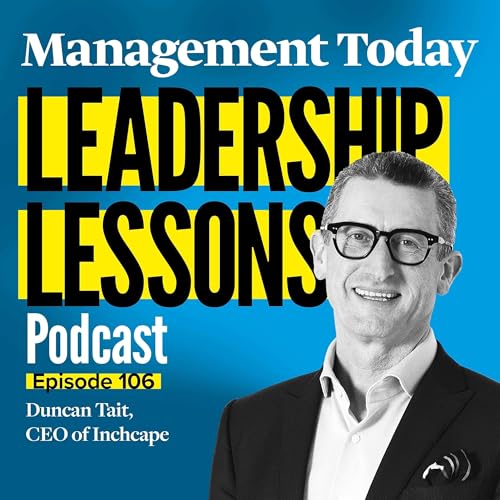
  • How Inchcape’s CEO is navigating the ‘polycrisis’
    Oct 9 2025

    As the world grapples with an ongoing wave of global disruptions, which many have dubbed the “supply chain polycrisis”, automotive distributor Inchcape has been forced to adapt quickly.


    CEO Duncan Tait, who took the helm during the Covid pandemic, is putting his more than 30 years of tech experience to good use, steering the almost 180-year-old company through this turbulent period.


    On the latest episode of Leadership Lessons, Tait talks leveraging technology, understanding emerging markets, and driving long-term growth for Inchcape.


    Credits:

    Presenter: Éilis Cronin

    Producer: Inga Marsden

    Artwork: Jenny Hardy


    Hosted on Acast. See acast.com/privacy for more information.

    Más Menos
    25 m
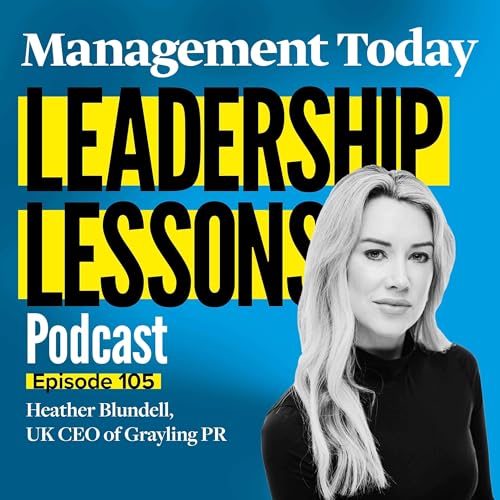
  • Grayling PR’s CEO on leadership, agency growth, and the importance of DEI
    Oct 2 2025

    Visa, Birmingham City Football Club, and Grindr. What do these companies have in common? They're all clients of PR firm Grayling, headed up by CEO Heather Blundell, who will grace the stage as a speaker at this years' Women in Work Summit.


    In this week's episode, Blundell reflects on her career trajectory; from a rigorous start at Edelman, which she describes as SAS training, to taking on a managing director role at Weber Shandwick at age 29.


    Now leading Grayling, Blundell explains the strategic shifts she's driving, including the launch of Grayling Media, and discusses how the agency’s diverse client base serves as the perfect business case for why DEI is a business necessity, not just a 'tick box exercise'."


    Credits:

    Presenter: Éilis Cronin

    Producer: Inga Marsden

    Artwork: Jenny Hardy


    Hosted on Acast. See acast.com/privacy for more information.

    Más Menos
    31 m
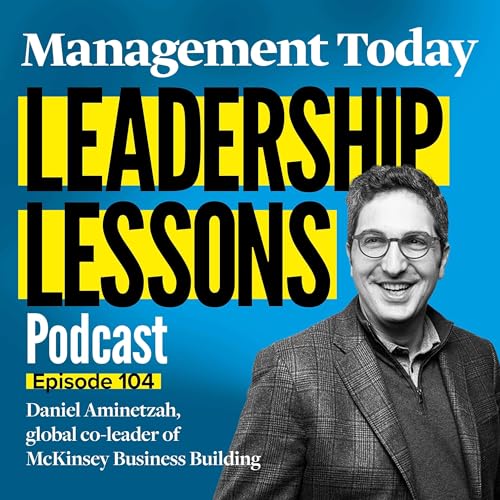
  • McKinsey’s head of business building on why all leaders need to be innovators
    Sep 25 2025

    New ideas are the engine of corporate growth, but all too often established businesses find innovation too cumbersome and too distracting from the day job – which means it’s the preserve of nimbler start-ups.


    Daniel Aminetzah is a McKinsey consultant on a mission to change that. The global co-leader of McKinsey Business Building wants companies to pursue new revenue streams and act more like start-ups, even in deeply traditional industries.


    As he puts it: “We can allow ourselves to unleash our entrepreneurial muscle in many more contexts, including traditional corporates or professional firms. You don’t have to go to a garage and do it with another founder.”


    On the latest episode of MT’s Leadership Lessons podcast, Aminetzah explained how he helps firms upgrade their business building capacity. And despite the current macroeconomic uncertainty, he said many are ready to take the plunge.


    Credits:

    Presenter: Antonia Garrett Peel

    Producer: Inga Marsden

    Artwork: Jenny Hardy

    Hosted on Acast. See acast.com/privacy for more information.

    Más Menos
    25 m
  • Julian Birkinshaw: 'Established companies are way more resilient than people give them credit for'
    Sep 5 2025

    American author F. Scott Fitzgerald famously wrote that: “The test of a first-rate intelligence is the ability to hold two opposed ideas in the mind at the same time, and still retain the ability to function.”


    This is also, according to dean of Ivey Business School Julian Birkinshaw and ex-Pearson CEO John Fallon, who have co-authored a new book on established companies in an age of digital change, a good definition of the mindset needed to navigate this kind of disruption. You can think of it, Birkinshaw told MT’s Leadership Lessons, as “being paranoid and pragmatic at the same time”.


    “So you have to have a certain level of paranoia that any new technology could be something that will make your life very difficult, that will be a threat. The pragmatic bit says, ‘we've lived through many, many rounds of digital changes…Most of our big organisations are still with us’.”


    To be more precise, as of 2020, only 35 of the Fortune 500 cohort from 1995 - when the internet revolution was really getting underway - had gone bankrupt. Today, its constituents that didn’t exist in 1995 number only 27.


    The prevailing narrative about established firms, Birkinshaw says, casts them as “relics of a bygone era” - dinosaurs pitted against the unicorns and other fleet-footed disruptors of the digital era. But this narrative, he and Fallon argue in Resurgent: How established organisations can fight back and thrive in an age of digital transformation, ignores many of the inherent strengths that have made these companies market leaders.


    For many organisations, haunted by the fear of falling victim to their own ‘Kodak moment’, the temptation when faced with a new technology might be to react quickly to counter the perceived threat. Not only, however, are the firms that fail to adapt to digital disruption “the absolute exception” that proves the general rule (namely that “big companies are way more resilient than people give them credit for”), but it’s important to recognise that people tend to overestimate the speed of change and executives therefore often have more time than they might think to work out whether, when and how much to invest in a new technology.


    Credits:

    Presenter: Antonia Garrett Peel

    Producer: Inga Marsden

    Artwork: Jenny Hardy


    Hosted on Acast. See acast.com/privacy for more information.

    Más Menos
    26 m
  • AI’s impact on professional services and getting employees comfortable with change
    Aug 21 2025

    On this week’s episode, MT’s editorial team discusses the impact of AI on professional services and the role of psychological safety in business transformation.


    Is AI coming for your job? If you’re a consultant that question might have been hard to shake in recent months, after a slew of headlines warned of the impact on the profession and data showed that the Big 4 scaled back their entry-level hiring programmes last year – by as much as 33% in KPMG’s case (compared with 2023). It’s clear that AI is squeezing employment in professional services firms, London Business School professor Michael Jacobides wrote in a recent piece for MT. He suggests, however, that “the death of the firm is greatly exaggerated”. We consider his argument.


    Humans, famously, are uncomfortable with change - but transformation, by definition, requires us to disrupt what’s familiar. That tension is at the heart of many large-scale organisational change projects, and could be one reason why the success rate for such initiatives remains dismally low. In a recent piece for MT, Lesley Cooper outlines the role of company culture in driving innovation, engagement, and in helping employees to get comfortable with the unfamiliar. We discuss how leaders can create a psychologically safe environment.


    Credits:

    Presenters: Éilis Cronin and Antonia Garrett Peel

    Producer: Inga Marsden

    Artwork: Jenny Hardy

    Hosted on Acast. See acast.com/privacy for more information.

    Más Menos
    8 m