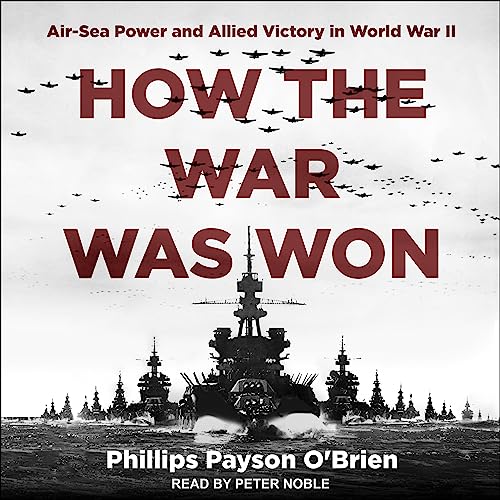
How the War Was Won Audiolibro Por Phillips Payson O'Brien arte de portada

How the War Was Won

Air-Sea Power and Allied Victory in World War II

Vista previa

Prueba gratis de 30 días de Audible Standard

Prueba Standard gratis
Selecciona 1 audiolibro al mes de nuestra colección completa de más de 1 millón de títulos.
Es tuyo mientras seas miembro.
Obtén acceso ilimitado a los podcasts con mayor demanda.
Plan Standard se renueva automáticamente por $8.99 al mes después de 30 días. Cancela en cualquier momento.

How the War Was Won

De: Phillips Payson O'Brien
Narrado por: Peter Noble
Prueba Standard gratis

$8.99 al mes después de 30 días. Cancela en cualquier momento.

Compra ahora por $30.76

Compra ahora por $30.76

World War II is usually seen as a titanic land battle, decided by mass armies, most importantly those on the Eastern Front. Phillips Payson O'Brien shows us the war in a completely different light. In this compelling new history of the Allied path to victory, he argues that in terms of production, technology, and economic power, the war was far more a contest of air and sea than of land supremacy. He shows how the Allies developed a predominance of air and sea power which put unbearable pressure on Germany and Japan's entire war-fighting machine from Europe and the Mediterranean to the Pacific. Air and sea power dramatically expanded the area of battle and allowed the Allies to destroy over half of the Axis's equipment before it had even reached the traditional 'battlefield'. Battles such as El Alamein, Stalingrad, and Kursk did not win World War II; air and sea power did.

©2015 Phillips Payson O’Brien (P)2023 Tantor
Segunda Guerra Mundial Fuerza Aérea de US Guerras y Conflictos Fuerzas Armadas Fuerza Aérea Militar Guerra Periodo de entreguerras Japón imperial Fuerzas Navales Franklin D. Roosevelt Imperialismo Submarino
Enlightening Analysis • Well-researched History • Convincing Arguments • Insightful Perspective • Educational Content

Con calificación alta para:

Todas las estrellas
Más relevante
The details are insane literally someone can write a book about this book and have not done it justice
If you don’t like details stay home

The details are insane literally

Se ha producido un error. Vuelve a intentarlo dentro de unos minutos.

I had always thought that World War II had a grand strategy determined at the top and carried out by the generals. What I learned from this book was that each service commander had their own ideas of what was best and that they often worked at cross purposes. Each wanted their own service to lead the war effort. Ernest King the commander of the American Navy spent far more resources in the Pacific than the President directed, and he ignored the less glamorous need to safeguard the convoys in the Atlantic, costing many lives and ships. Similarly, the key Air Force commanders were much more interested in destroying cities rather than destroying the enemy’s means of transportation. This meant the wasting of allied resources and the prolonging of the war.

Gave a new understanding of World War II

Se ha producido un error. Vuelve a intentarlo dentro de unos minutos.

A compelling analysis of industrial priorities in WWII . Definitely worth the read but this book is heavy on facts and statistics. Don’t read this book unless you are already very familiar with the general history of WWII.

A look at the numbers

Se ha producido un error. Vuelve a intentarlo dentro de unos minutos.

Very interesting and convincing arguments, but the story lacks due to too many repeating paragraphs

Very interesting arguments

Se ha producido un error. Vuelve a intentarlo dentro de unos minutos.

As a book, this is a great history, well researched and lots of supporting evidence. However, as an audio book, it’s too detailed and repetitive. I can’t quickly skim over content that has been addressed previously or presents detailed statistics.

Excellent history, but repetitive

Se ha producido un error. Vuelve a intentarlo dentro de unos minutos.

Ver más opiniones