

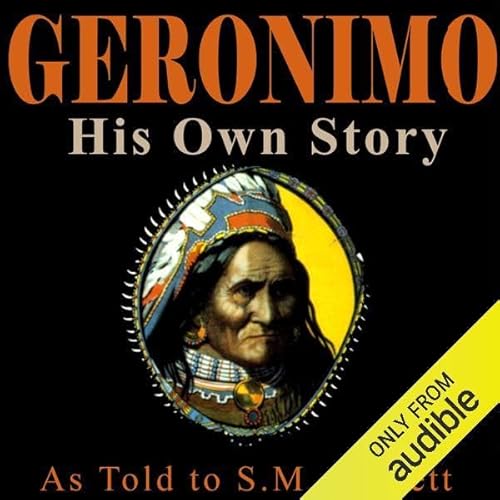
Geronimo
His Own Story: The Autobiography of a Great Patriot Warrior
No se pudo agregar al carrito
Add to Cart failed.
Error al Agregar a Lista de Deseos.
Error al eliminar de la lista de deseos.
Error al añadir a tu biblioteca
Error al seguir el podcast
Error al dejar de seguir el podcast
Obtén 30 días de Standard gratis
Compra ahora por $14.08
-
Narrado por:
-
Pat Bottino
-
De:
-
S. M. Barrett
During 1905 and 1906, Geronimo, the legendary Apache warrior and honorary war chief, dictated his story through a native interpreter to S. M. Barrett, then superintendent of schools in Lawton, Oklahoma. As Geronimo was by then a prisoner of war, Barrett had to appeal all the way up the chain of command to President Teddy Roosevelt for permission to record the words of the "Indian outlaw".
Geronimo came to each interview knowing exactly what he wanted to cover, beginning with the telling of the Apache creation story. When, at the end of the first session, Barrett posed a question, the only answer he received was a pronouncement: "Write what I have spoken".
Public Domain (P)1998 Blackstone Audio, Inc.Los oyentes también disfrutaron:


Reseñas de la Crítica
Las personas que vieron esto también vieron:

fascinating.
Se ha producido un error. Vuelve a intentarlo dentro de unos minutos.
Great listen
Se ha producido un error. Vuelve a intentarlo dentro de unos minutos.
Great story
Se ha producido un error. Vuelve a intentarlo dentro de unos minutos.
Geronimo wasn’t a real chief, yet is perhaps the most famous Apache, rivaled only by Cochise. Known for his bold courage in leading war parties, he was treated like a chief. He became a warrior at 17, married his longtime sweetheart, and had three children. After his father's death, he cared for his mother, who always camped next to him. At 29, while trading in Mexico, his tribe's camp was attacked by Mexican troops, who killed many, including Geronimo's wife, children, and mother, drastically changing him, fueling a lifelong quest for vengeance against Mexicans.
Geronimo’s first contact with white men, probably surveyors, was positive; he found them honest and trustworthy. Later, his thoughts of the US Army were far less favorable. When Mangus-Colorado, his band's chief, and Cochise, another Apache chief, were lured into a peace meeting with the Army and murdered, Geronimo lost all trust, though not with the same hatred as for Mexicans. From 1850 to 1886, he allied with three other Apache bands to raid primarily in Mexico’s Chihuahua and Sonora but increasingly against the US Army in New Mexico and Arizona. His near captures and miraculous escapes became legendary.
In the last decade of the conflict, Geronimo voluntarily surrendered three times just riding with his band to a reservation. However, adjusting to a sedentary life was hard, and his frustration with broken agreements kept leading him to escape. His final escape sparked a year-long pursuit by a large force. He ultimately surrendered to an Apache-speaking officer whom he had met earlier and respected. Though witnesses claimed the surrender was conditional, General Miles later declared it unconditional, making Geronimo a prisoner of war and moving him to Fort Bowie, and then with 27 other Apaches by train to Florida to join the rest of the previously exiledChiricahua tribe there.
Geronimo spent the rest of his life as a prisoner of war, there and in southern Alabam where many of his fellow prisoners died due to the harsh climate. Later, he was moved to Fort Sill, Oklahoma, where he dictated his story. Over time, he was paraded as a trophy and became a kind of celebrity.
His story begins with the Apache creation myth and their history and customs, then describes his early life fondly recalling his wife decorating their teepee after their marriage. He tells of finding his murdered family in a direct, unemotional way, yet it's moving as he describes his long silence, refusal to eat, and following his tribe from a distance. He details leading raids into Mexico and, later, against the Army and settlers. He shows intimate knowledge of Army leaders. He also claimed to have converted to Christianity, saying it was superior to their traditional beliefs, though his understanding is unclear.
The Army did not want Geronimo's writings to be published, so Barrett needed special permission from President Theodore Roosevelt. Geronimo expressed his thanks, writing, “I am thankful that the President of the United States has given me permission to tell my story. I hope that he and those in authority under him will read my story and judge whether my people have been rightly treated.”
After Geronimo’s story was finished, Barrett added notes on US and Mexican raids to support Geronimo's actions and included references to corroborating sources including witnesses supporting Geronimo’s version of the surrender. Geronimo had set the agenda for each session with Barrett. When asked a question at the end of the first session, Geronimo simply said, “Write what I have spoken.” But, the Army had to approve the final draft and removed significant parts to protect itself from public criticism.
The book was published in 1906. Geronimo never returned to Arizona. He died in 1909 and was buried at the Fort Sill Indian Agency Cemetery with some family and Apache prisoners. Geronimo still thought of his people. The book ends with these words: “If this cannot be done during my lifetime–if I must die in bondage–I hope that the remnant of the Apache tribe may, when I am gone, be granted the one privilege which they request–to return to Arizona.”
This short book presents Geronimo’s side of the story, and evokes mixed feelings. He killed many, not all of whom were directly guilty, but given the betrayals he faced, his distrust and resistance are understandable. Despite being edited by those he fought against, it remains a firsthand account. Yes, it’s one-sided, but the other side got to edit it. I would love to read what cut and history would have greatly benefited also. Recommended.
In his words, sadly redacted by the Army
Se ha producido un error. Vuelve a intentarlo dentro de unos minutos.
Fascinating....
Se ha producido un error. Vuelve a intentarlo dentro de unos minutos.