


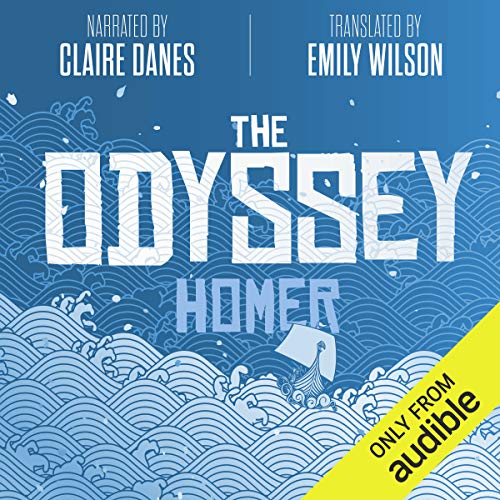
The Odyssey
Audible Iliad & Odyssey, Book 2
No se pudo agregar al carrito
Add to Cart failed.
Error al Agregar a Lista de Deseos.
Error al eliminar de la lista de deseos.
Error al añadir a tu biblioteca
Error al seguir el podcast
Error al dejar de seguir el podcast
Obtén 3 meses por US$0.99 al mes
 Exclusivo para miembros Prime: ¿Nuevo en Audible? Obtén 2 audiolibros gratis con tu prueba.

The Odyssey
Compra ahora por $3.99
-
Narrado por:
-
Claire Danes
Acclaimed actress Claire Danes burnishes an epic story of heroes, gods, and monsters in a groundbreaking translation of The Odyssey, the first great adventure story in the Western literary tradition. When the wily warrior-king Odysseus sets off for home after the Trojan War, he doesn’t realize this simple undertaking will become a perilous journey of 10 years. Beset at every turn, he encounters obstacles, detours, and temptations—both supernatural and human—while his wife Penelope fends off would-be suitors desperate to take the throne.
Emily Wilson is the first woman to take on the daunting task of translating over 100,000 lines of a three-millennium-old poem from Ancient Greek to modern-day English. Her breathtaking rendition captures the poetic immediacy of the original text, while allowing listeners to experience The Odyssey with an honesty and directness few other versions have achieved. The result is a lean, fleet-footed translation that recaptures Homer’s “nimble gallop” and brings an ancient epic to new life. A fascinating introduction provides an informative overview of the Bronze Age milieu that produced the epic, the major themes of the poem, the controversies about its origins, and the unparalleled scope of its impact and influence.
PLEASE NOTE: When you purchase this title, the accompanying PDF will be available in your Audible Library along with the audio.
©2018 Emily Wilson (translation), Adrian Kitzinger (maps copyright) (P)2018 Audible, Inc.Los oyentes también disfrutaron:




Go Behind the Scenes with Claire Danes
Our favorite moments from The Odyssey

- The Odyssey
- De:Homer, Emily Wilson - translator
- Narrado por:Claire Danes
- The Odyssey
- De:Homer, Emily Wilson - translator
- Narrado por:Claire Danes
- The Odyssey
- De:Homer, Emily Wilson - translator
- Narrado por:Claire Danes
- The Odyssey
- The suitors reveal Penelope’s ruse
- The Odyssey
- Odysseus begs the cyclops Polyphemus for mercy
- The Odyssey
- The enchantress Circe tries to bewitch Odysseus

About the Performer
Claire Danes is an Audie and Emmy Award-winning actress and star of the TV series Homeland, the 2010 HBO movie Temple Grandin, and much more. In 2013, Danes received the Audie Award for best spoken-word performance in Fiction. Danes is also the recipient of four Golden Globes and two Screen Actors Guild Awards.

About the Author
The Iliad and the Odyssey were not invented from scratch by any individual. These great written poems make artful use of a long oral tradition, developed over centuries by many illiterate singer-songwriters. The two epics were composed perhaps in the seventh century BC, by one person or several people, about whom we know nothing. Whoever she, he, or they were, Homer was the most popular poet of antiquity, known simply as The Poet. These metrical, musical, dramatic, thrilling, fast-moving, multi-vocal poems were often performed orally by professional poetry-actors (rhapsodes), and were well-known to everybody in the ancient world: old, young, female, male, rich, poor, educated, illiterate, slave, and free.—Emily Wilson

About the Translator
Emily Wilson is a professor of classical studies and chair of the program in Comparative Literature and Literary Theory at the University of Pennsylvania. She received a BA in Classics and an MPhil. in English Renaissance Literature from Oxford, and earned her PhD. from Yale in Classics and Comparative Literature. Wilson is the author of three books, and has translated works by Seneca and Euripides. Her acclaimed line-for-line verse translation of The Odyssey, in regular iambic pentameter, aims to capture the poetic magic and rich, complex characterization of the original poem. Wilson has been reading Homer in Greek for over thirty years, and was first exposed to the story of The Odyssey at the age of eight, when she appeared as Athena in her elementary school play.





Las personas que vieron esto también vieron:


Emily Wilson's translation is a breath of fresh air. Wilson commented on the fact that simply because the source material is old, does not mean old English is necessary for a proper and effective translation. She explains in her introductory comments, her aim was for an accurate translation using the language of this modern generation and not our parents or grandparents. She hit the nail on the head. This translation should become a required textbook for any middle or high school level reading of The Odyssey. It's clear and easily understood. I remember reading The Odyssey in school and I might as well have been reading the original Greek text, for all I understood of it. If college or AP professors want to challenge their students with deciphering ancient English, fine, but Wilson's work is much deserving of middle or high school textbook status.
Is it inconsiderate of me to add that I hope she translates The Iliad as well?
My only reason for docking the story down to 4 starts is due to the lengthy introduction. Although intriguing, after about the first fifteen or twenty minutes of history lesson at the beginning, I was ready for the story to start, but it didn't. It went on for three hours, followed by thirty minutes of translator's notes. I can see the challenge of trying to place that information anywhere within the text. If it were at the end, listeners might simply stop listening without finishing, but at the beginning, I nearly stopped listening before starting. I think, personally, I would have liked it better in small snippets at the end of each book (chapter), almost as if it were an analysis of what was just read, but Wilson was probably trying to avoid giving readers the feeling of reading a textbook with constant interruptions to the flow of the story. If you want to skip the intro and comments, go to chapter 4 of the audiobook, just over three and a half hours in, but be aware that I do think they are worth reading. In fact, I highly recommend and appreciate the analysis, but for me it was a bit much, right at the start, when I just wanted to dive into the story.
Overall thoughts: Before I had finished listening, I was already praising the narration and translation to family, friends, and coworkers. I think I've convinced my wife to listen to it, and I'm certain I'll listen again, and share with the kids as they grow up. Wilson's translation is a deserving addition to any library, and Danes' narration is emotional and right on key.
It's been a pleasure to listen to and understand!
Se ha producido un error. Vuelve a intentarlo dentro de unos minutos.
It brought tears to my eyes!
Se ha producido un error. Vuelve a intentarlo dentro de unos minutos.
I’m particularly interested in the way the translator (the first woman to translate the entire Odyssey into English) interprets the women in this text. One of the things that struck me was that she used the word “slave,” instead of the more popular “maid,” or “servant.” This forced me as a modern reader to reckon with the brutality of Ancient Greek society. Odysseus was a hero - but he also had 50 female slaves and had 12 of them murdered.
In this translation, Calypso speaks with a candor and understanding about her beauty (refreshing and impressive in a world where women are encouraged to be demure and self effacing) and Helen is no longer “dog-faced.” Instead, she has the face that “hounded” men to war. As in Homer’s original, she also refrains from blaming herself for the violence men have done in her name.
Wilson states in her extensive introduction (a piece that is worth reading all on its own) that she has worked to avoid modern sexism in this translation. In my humble opinion at least, she has succeeded. Although my favorite version will always be that of Mr. Pope, this translation is a masterpiece in its own right. Wilson forces the reader to grapple with the concept of a society that, although idealized, takes the horror of slavery for granted and in which heroes are much less “heroic,” than they appear at first glance.
Highly recommended for all fans of the Odyssey. Even if you’re familiar with the text, this translation will help you experience in a way that is entirely different.
Combats Sexism
Se ha producido un error. Vuelve a intentarlo dentro de unos minutos.
Nice translation
Se ha producido un error. Vuelve a intentarlo dentro de unos minutos.
Impossible to narrate better.
Se ha producido un error. Vuelve a intentarlo dentro de unos minutos.