Note: Text has been lightly edited for clarity and does not match audio exactly.
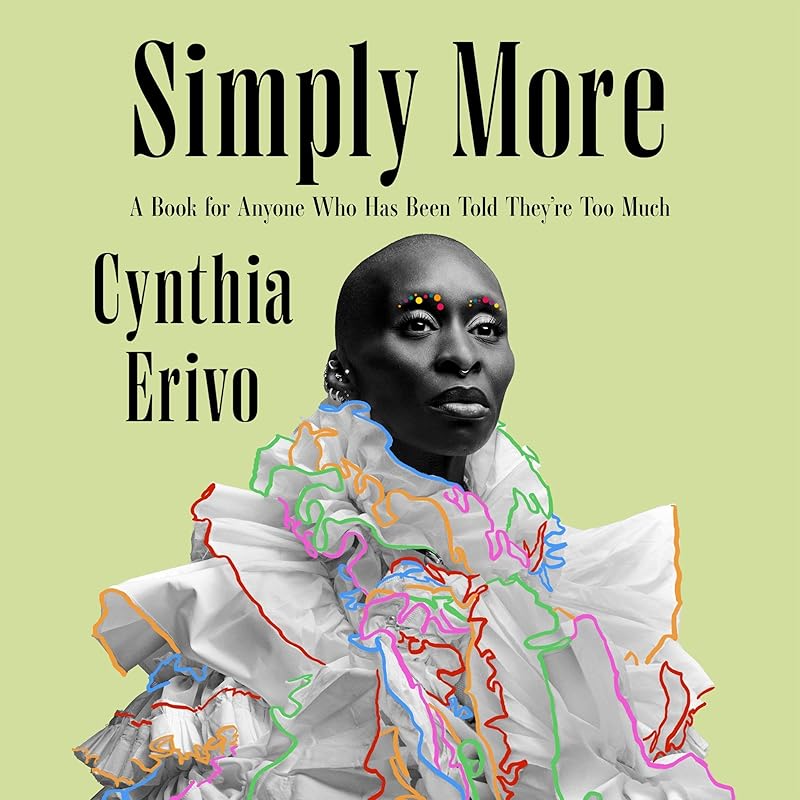
Katie O'Connor: Hi, listeners. I'm Audible Editor Katie O'Connor, and today I am thrillified to be speaking with Academy Award-nominated and Emmy, Grammy, and Tony Award-winning superstar Cynthia Erivo about her book Simply More. Welcome, Cynthia.
Cynthia Erivo: Hello.
KO: Thank you so much for joining us today. I have to say, listening to Simply More felt meditative for me. Your voice, your messages, they were like my own personal set of affirmations. What did it feel like to you recording it and knowing you were going to share it out with the world?
CE: I felt like it was a sort of a natural thing for me. I obviously love music and I sing, and so to be able to read my own book to people felt like the right thing to do, because I knew how I wrote it, I knew what the intention was, and I wanted it to feel like you had a friend who sat with you having a conversation. So it wasn't just me telling you what to do and asking you questions, but asking myself questions, things that I've asked of myself and had to deal with and go through. I wanted it to feel like the listener had someone that was confiding in them and giving them the space to confide in me, too. I wanted to feel close to the listener, as close as I could be. So, to record it felt like a natural progression of things. Actually, I was really excited to do it. I've done a few other audiobooks for other people and writers that I love, but to be able to do it for my own book felt really, really special and kind of important, to be honest.
KO: I want to talk about the title of the book. You vulnerably share how you sometimes felt like you were too much for people. And that this word too entered your vocabulary at school when a teacher you normally felt safe with asked you to leave the room because you wouldn't stop asking questions. I love how this entire book is really a reframe of that experience. You're not too much, you're Simply More. Was there a particular moment when you felt like that reframe first happened for you?
CE: I felt like the reframe sort of came a little later in my life, when I realized that every time I asked a question of someone, which I feel is one of the primary ways of feeling like you are doing too much, a person asks for more, because essentially that's what it is when you ask a question—when you're asking for more information, you're asking for more of another person, so that you can give more of yourself. I think that's sort of the initial way a person can be too much. I started realizing that whenever I asked questions, whenever I asked for more information, when I asked for more context, more, I don't know, anything, anyone who didn't answer the question or couldn't answer the question, essentially was sort of denying me the ability to expand. And anyone who answered the question for me allowed me the choice. I think that's when I started reframing what it meant to be too much. If someone is not answering your questions, if someone is pushing back on you wanting to know more, do more, be more, then that is not a you thing, that is not on you. The quest then is to search out those who will allow you to keep expanding.
KO: That's really beautiful. Something that delighted me with this audiobook is how you structured it. You're a big runner, and all of your stories are anchored through a metaphor of you running a marathon. You break down the arc of your narrative into what you call the three phases of running a marathon. Run the first 10 miles with your head, run the next 10 miles with your legs, and then let your heart carry you the rest of the way. Outside of the context of the book, sort of within the larger arc of your whole life, including your future, which phase do you feel like you're in right now?
CE: Right now, in this very present, I think I'm running with my heart. And what's interesting is that you never stop, so I'll definitely go back to a phase where I'm running with my legs again. And then I have to run with my head. And then I'll go back to running with my heart. But I think the reason I say I'm running with my heart right now is it's been such a big, busy year, which I'm really grateful for, but you get to a point where there's no energy. You can't rely on your legs anymore, and I can't rely on my head anymore, so it really has to come from a deeper place, a within place, to keep moving forward, to keep going, because there's more to do. Then, by the end of the year, that'll be the break. And then I'll start again with my legs, because I'll have enough energy to do that. But also there's this wonderful, beautiful thing that happens when you are running with your heart, that it is all instinct, that it is all about what you need, what you want, and what you love, and how far you're willing to go for it. I kind of love the fact that I'm in that space right now, and I'm aware of it.
"I've done a few other audiobooks for other people and writers that I love, but to be able to do it for my own book felt really, really special and kind of important, to be honest."
KO: Yeah, I think being aware is critical. It brings a level of intentionality that might not be there otherwise. But I do like the idea of starting a new year running with your legs [laughs]. One very vulnerable moment that you share is how your mother and your sister have been slow to accept your queerness. You are remarkably compassionate to their perspectives, saying that it must be hard for them and that while your mother worries what people think, she's realizing that you don't, and has then begun shifting what she hopes for you. Have you always been in that compassionate place? Or did it take time and effort to get there?
CE: I want to make sure I'm answering really honestly. I think I've been in a place of compassion, but not as patient as I am now. You see what I'm saying? You hope that people just sort of jump at it immediately. But I don't think that's really fair, because if someone has known you one way for a really long time, and of course they want you to be happy, it will take a time, because it takes time for yourself to adjust to who you want to become and who you are. And so they have to have an adjustment period, too.
I don't think I ever expected it to be immediate. What I do know is that the love for me didn't go anywhere. I know that that never went anywhere. It's just about reframing what they knew of me to what they now know of me, which actually has been an interesting sort of beautiful process that, strangely, I've allowed myself to get to know them more. Because I think I realized that, for a time, I was seeing my mom just as my mom, but whilst expecting her to see me as a full human being. Which is a complete imbalance. And in wanting her to see me as the complete human being who is having her own experience that isn't necessarily tied to the dreams and wants that she wants for me, that they are completely and totally separate, and they're of me, and what I decide for myself has to come from me first, I also had to allow that for my mother. I also had to give her the space to tell me who she is as a human being, because for years and years, I've known her as my mom, as opposed to knowing her as the person who, yes, gave birth to me, but before me, before I existed, she existed. She had her own life and she made her own choices, and there are choices that she still wants to make.
So, what it's allowed for me in the process of compassion and allowing her to find her own way to the acceptance of who I am, and now she sort of sees what I want for me first, as opposed to what other people want. I think it's actually adjusting how she sees herself as well. I get to get to know her more, which has been really kind of fun. And the same for my sister, really. I think she's been my little sister for such a long time, and then, again, I had to reframe, “Well, she's also a grown woman, and has her own hopes and dreams and aspirations, and her own plans. The way she wants to navigate her life is very different to the way I want to navigate my life." In revealing something more of my life, it meant that I opened up the aperture to see her more as well, to talk to her about her dreams and the plans that she has for herself, which I think I realized I hadn't really been asking, I hadn't really been curious enough about. So, I had compassion, but I have even more now. I have a curiosity about who they are as people.
KO: Yeah, that curiosity feels like it's really the key there. It's so easy, as you were saying, to just put the people in your life into different boxes based on how they relate to you in some way. But I think that curiosity just makes for expanding relationships.
CE: That's right.
KO: Another moment that surprised me in Simply More was your relationship with RADA, the Royal Academy of Dramatic Arts. You didn't have the best experience there, and you definitely faced some different prejudices. But now you're back as VP at RADA. Why was it important to you to come back in this capacity?
CE: Well, because I realized that some things there had changed since I had left. Faculty had changed. The ethos has slightly changed as well. But I also knew that when you're at drama school, it's such a formative time. It's a real moment of trying to discover who you are and trying to discover what kind of actor you are, which means you have to kind of discover what kind of person you want to be. Having had the experience I had had, I just wanted to be there for more students. I wanted to be a person who could show up for students, who had the capacity for the emotional sort of upheaval that happens when you're at a drama school. I think people underestimate just how much you have to deal with when you're there, especially if you're young.
I was lucky because I was about 20-something years old, so I could sort of make a lot of decisions whilst I was there and change my mind about certain things. But even then, I still could have used more guidance. I was lucky because I had a few voices, but you can always use more. I think I just desperately want to be able to be there to help more students and be someone to lean on who's had an experience that isn't necessarily the same as the teachers who are already there.
KO: Yeah, kind of be the resource that perhaps you even needed, right?
CE: That's right. That's right.
KO: While you were at RADA, you found refuge in singing songs from Wicked with your friend Michael. And now here you are, this generation's Elphaba. Wicked: For Good is out in the world and is absolutely beautiful. This chapter in your life is coming to a close. What is the word that comes to mind when you reflect back on this time in your life?
CE: Cyclical. That's the word. Cyclical. That everything sort of happens in its circular nature. That things come and things go, and it always ends up leading back to where you began in its own sort of way, which I think I'm discovering more often. You always find these links to things that you've wanted in your life, and you don't realize you're in it when it's happening, and then it happens. I think that's the beautiful thing about life, really, isn't it? It keeps moving. The beginning of the circle may shift, where you're starting might shift, you still end up moving round to where you might have begun. It's happened so many times in my life at this point, I've sort of stopped questioning it. I think whatever this beginning is, it's going to lead to something. I think I'll just follow it to wherever it goes.
"If someone is not answering your questions, if someone is pushing back on you wanting to know more, do more, be more, then that is not a you thing, that is not on you."
You have to just trust it. I think that's the same thing, really. I think Wicked kept showing up, and whether or not I was paying attention, and I don't know if I was, really, until I had to pay attention. This is where it is, and it will keep showing up until it reaches its endpoint. Now it's sort of at an endpoint, and this is one sort of beautiful chapter that I can, not even put down but shift to the side, and it will do what it does on its own without me needing to do very much for it anymore. It will grow and it will become a part of my life in a way that sort of—the word mystical comes to mind. It'll show up in a conversation, or it'll show up in a picture years from now, or it'll show up in the songs that you hear. I'll always be able to go back to it. But now it's time to finish off whatever circle started another few years ago that I didn't realize it was starting, you know? And that will show up however it wants to show up.
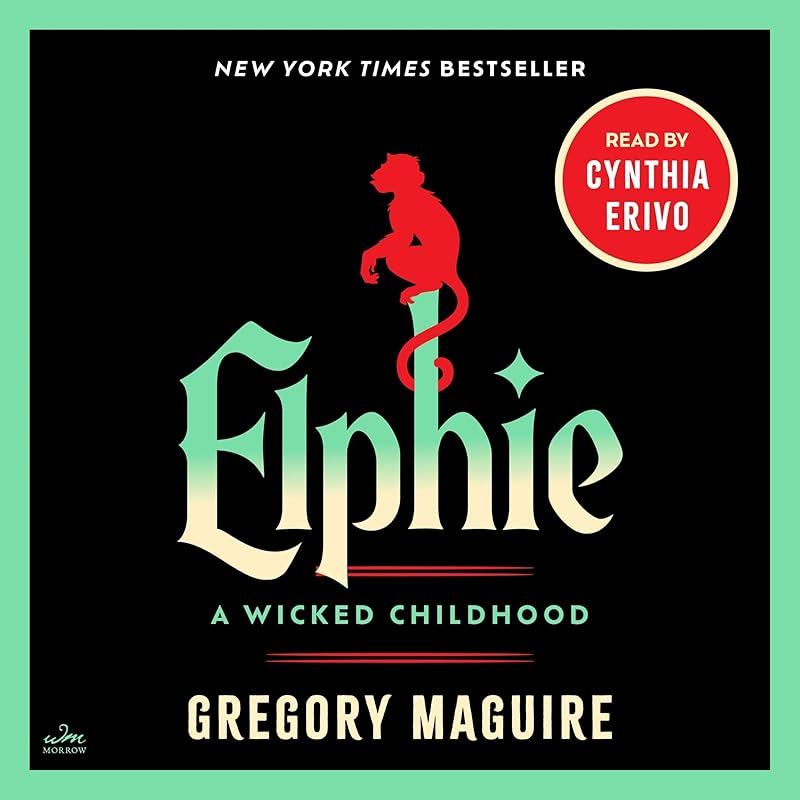
KO: Yeah, it feels like there's no accidents almost, right? Everything is sort of mapped in a certain way. I like that feeling. As you hat-tipped to earlier, you are no stranger to narration. Of course, you voice Simply More. You're the narrator of Wicked and Elphie: A Wicked Childhood, both by Gregory Maguire. You performed on the Audible Original 1984, on Tomi Adeyemi's Children of Anguish and Anarchy. The list goes on. What appeals to you about this medium?
CE: Oh, I just love the way in which I can discover the book again by reading it aloud. I think it's just another way of creating characters in my head. I can read it in my head, but when I get to speak out loud, I get to give voices to these characters that I can live with on my own, and I get to share it with other people. I love the experience of doing it. I remember when I was reading Elphie, I got really emotional because I felt like you hear it in a different way when you can speak the character's words and say what they're thinking aloud. And if you have a character for the narrator of a piece, you discover that they also have a point of view. Which I think I didn't necessarily realize until I started doing these Audible books, that actually each character, all the characters are included, including the narrator that always has something to say, has a point of view on what's happening within the context of the piece.
I just kind of love that. It's this sort of secret I uncovered for myself. "Ah, the narrator of this piece has a point of view as well as the characters." It feels like there's an all-seeing eye in each piece that I read, and I love being that all-seeing eye and taking the audience through and the listener through each of the pieces, like holding their hand and guiding them through the tale of the story that's happening.
KO: I love that description of a narrator. Your little guide holding your hand. It's beautiful. Did you learn anything about yourself in the process of writing and sharing Simply More?
CE: That I've gained a lot more patience as I've gotten older. Even just reading it back to myself, I think I realized how impatient I was in some situations. Actually, I think I was a little petrified of sharing it, because I know I'm not perfect, but you always think that there are many people who think of you as someone who is perfect, who has it together, who knows everything and never steps a foot wrong. But, actually, the thing I really wanted with this piece as well was to acknowledge that I am very much a human being who makes mistakes and who has got it wrong from time to time, and who hasn't necessarily been her best self, even if the choices weren't necessarily mine. If there was no choice to make, or if I didn't realize that there was a choice to make, I was still learning. And that I am still learning, because the book doesn't necessarily end; the last chapter is the last chapter for now. But there's so much more to do, so much more to learn, so much more to become. I think I'm really excited for what the next bit of my life looks like.
KO: And possibly something more to write down.
CE: I think so. I think so.
KO: I hope so.
CE: I actually really enjoyed the process of doing it. I didn't think I would want to go back and find more to share or impart. At the very beginning, I thought this might be sort of one for the next 10 years. Like, "Maybe I'll do it in five years." But I think I'm really excited about what other things I have learned that I want to share. I'm sort of eager to get back to it, which I didn't think would happen. I didn't think that that would happen. But all good things do.
KO: Well, we would all be eager to listen. What would you say fuels your creativity?
CE: Curiosity. You know, we spoke about it before. And sharing a little bit more of myself each time with it, and what it does for me as a person who's learning. I always said I never want to be the smartest person in the room. The creativity that I have is about learning. Like, "What else can I do? How can I do it? Which other way can I try something?" I think that's what sort of drives me, really. What else can I learn about myself and about the thing that I'm creating?
"There's so much more to do, so much more to learn, so much more to become. I think I'm really excited for what the next bit of my life looks like."
KO: That pursuit of being a lifelong learner, I think that's very critical. So, we know you're a fan of Fourth Wing by Rebecca Yarros.
CE: Yes [laughs].
KO: I'm curious, what else are you enjoying reading or listening to?
CE: Oh, what was I just reading? I've been doing a lot of reading of Japanese literature. Oh, this is not the book, but I was just reading What I Ate in One Year by Stanley Tucci, because I really loved his first book, Taste. What I loved about it is that it's really actually, yes, it's about food, but I think it's about humanity and how he relates to it. And where Taste was sort of about how he relates to food as it related to his loss of the ability to eat because he had an illness, What I Ate in One Year is actually about, strangely, I think the people that he meets within the year, which I just think is really beautiful. And the book I was talking about before is The Tale of Genji. It's like an epic. There are two volumes. I'm sort of in the middle of volume one. It's this epic tale of this dignitary finding love, but it sort of lays down every single detail of the world that he lives in and the traditions in the Japanese court in the 1800s. It's very heady.
KO: It sounds epic.
CE: It's very heady, but it's very, very, very good. I just finished reading Never Flinch by Stephen King, which was really cool because it's a slightly different kind of thriller. It's not gory at all, but it ticks all the boxes when it comes to a psychological thriller, which I love. Those are the things that I'm reading at the moment.
KO: I love it.
CE: Oh, and I'm reading Ocean Vuong. I'm reading The Emperor of—
KO: The Emperor of Gladness? So good.
CE: It's heartbreaking and beautiful. It's so good. I think Ocean Vuong is a beautiful writer.
KO: I agree.
CE: But listening to it is something—it just sort of transports you.
KO: Yeah. That's a good word for it.
CE: You can feel everything, you can smell everything. There's something really special about listening to his writing, because it feels almost tactile to listen to.
KO: Those are some excellent answers. So, you just opened the Macy's Thanksgiving Day Parade. Your song “Be Okay,” from your album I Forgive You is Grammy-nominated, as is “Defying Gravity,” alongside Ariana Grande.
CE: Insane, yeah.
KO: Awards-show season is coming up. Dare I ask, what's next for you?
CE: Well, what's next for me is stage. I'm going back to the stage. I'm going to be doing a production of Dracula with director Kip Williams. It's a one-woman adaptation of Dracula, Bram Stoker. And it's adventurous, to say the least. We have just had our first couple rehearsals. It will be a feat. I'm a little bit petrified, but I'm kind of excited. If we can land it, then I'm really excited for what it can be. It will be a fun thing for me to break into and discover a lot of things about myself, and how to pace myself through it, if I will pace myself, if I'll allow myself that. I think there'll definitely be days where I get carried away and forget to pace myself and get to the end of it and be on the floor. But I think I'm kind of looking forward to those days, too.
Then immediately after that, I'm going to go on holiday at the end of this year, after a bit of rehearsal for that. We'll take Christmas off. We'll come back in the new year, we'll get back into rehearsals, and we'll go all the way through to the end of May. And then I'll take a little time off maybe, which might result in me writing a couple things.
KO: Well, that is very exciting. As is Dracula. I did see you announce that last week. It sounds spectacular. And I think the perfect opportunity to bring back your running metaphor to kind of carry yourself through.
CE: Yes. We've started. We've begun. I never really put running down, but that is definitely where we can reinstate the running metaphor. That will definitely be what will power through.
KO: Perfect.
CE: I think that'd be the perfect thing for it, yeah.
KO: Cynthia, thank you so much for your time today. It was an absolute joy getting to speak with you.
CE: This was a really lovely conversation, so thank you very much for doing it.
KO: And listeners, you can get Simply More by Cynthia Erivo right now on Audible.