

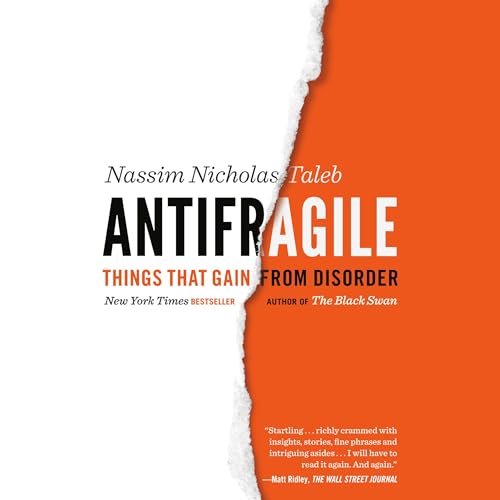
Antifragile
Things That Gain from Disorder
Failed to add items
Sorry, we are unable to add the item because your shopping cart is already at capacity.
Add to Cart failed.
Please try again later
Add to Wish List failed.
Please try again later
Remove from wishlist failed.
Please try again later
Adding to library failed
Please try again
Follow podcast failed
Please try again
Unfollow podcast failed
Please try again
 Prime members: New to Audible?
Get 2 free audiobooks during trial.
Pick 1 audiobook a month from our unmatched collection.
Listen all you want to thousands of included audiobooks, Originals, and podcasts.
Access exclusive sales and deals.
Premium Plus auto-renews for $14.95/mo after 30 days. Cancel anytime.

Antifragile
Narrated by:
Joe Ochman
Buy for $20.25
-
Narrated by:
-
Joe Ochman
Nassim Nicholas Taleb, the bestselling author of The Black Swan and one of the foremost thinkers of our time, reveals how to thrive in an uncertain world.
Just as human bones get stronger when subjected to stress and tension, and rumors or riots intensify when someone tries to repress them, many things in life benefit from stress, disorder, volatility, and turmoil. What Taleb has identified and calls “antifragile” is that category of things that not only gain from chaos but need it in order to survive and flourish.
In The Black Swan, Taleb showed us that highly improbable and unpredictable events underlie almost everything about our world. In Antifragile, Taleb stands uncertainty on its head, making it desirable, even necessary, and proposes that things be built in an antifragile manner. The antifragile is beyond the resilient or robust. The resilient resists shocks and stays the same; the antifragile gets better and better.
Furthermore, the antifragile is immune to prediction errors and protected from adverse events. Why is the city-state better than the nation-state, why is debt bad for you, and why is what we call “efficient” not efficient at all? Why do government responses and social policies protect the strong and hurt the weak? Why should you write your resignation letter before even starting on the job? How did the sinking of the Titanic save lives? The book spans innovation by trial and error, life decisions, politics, urban planning, war, personal finance, economic systems, and medicine. And throughout, in addition to the street wisdom of Fat Tony of Brooklyn, the voices and recipes of ancient wisdom, from Roman, Greek, Semitic, and medieval sources, are loud and clear.
Antifragile is a blueprint for living in a Black Swan world.
Erudite, witty, and iconoclastic, Taleb’s message is revolutionary: The antifragile, and only the antifragile, will make it.
Includes a bonus PDF of supplemental charts and graphics
Please note that that bleeps in the audio are intentional and are as written by the author. No material is censored, and no audio content is missing.
Praise for Antifragile
“Ambitious and thought-provoking . . . highly entertaining.”—The Economist
“A bold book explaining how and why we should embrace uncertainty, randomness, and error . . . It may just change our lives.”—Newsweek
“Revelatory . . . [Taleb] pulls the reader along with the logic of a Socrates.”—Chicago Tribune
“Startling . . . richly crammed with insights, stories, fine phrases and intriguing asides . . . I will have to read it again. And again.”—Matt Ridley, The Wall Street Journal
“Trenchant and persuasive . . . Taleb’s insatiable polymathic curiosity knows no bounds. . . . You finish the book feeling braver and uplifted.”—New Statesman
“Antifragility isn’t just sound economic and political doctrine. It’s also the key to a good life.”—Fortune
“At once thought-provoking and brilliant.”—Los Angeles Times
Listeners also enjoyed...




Critic reviews
“Ambitious and thought-provoking . . . highly entertaining.”—The Economist
“A bold book explaining how and why we should embrace uncertainty, randomness, and error . . . It may just change our lives.”—Newsweek
“Revelatory . . . [Taleb] pulls the reader along with the logic of a Socrates.”—Chicago Tribune
“Startling . . . richly crammed with insights, stories, fine phrases and intriguing asides . . . I will have to read it again. And again.”—Matt Ridley, The Wall Street Journal
“Trenchant and persuasive . . . Taleb’s insatiable polymathic curiosity knows no bounds. . . . You finish the book feeling braver and uplifted.”—New Statesman
“Antifragility isn’t just sound economic and political doctrine. It’s also the key to a good life.”—Fortune
“At once thought-provoking and brilliant.”—Los Angeles Times
“[Taleb] writes as if he were the illegitimate spawn of David Hume and Rev. Bayes, with some DNA mixed in from Norbert Weiner and Laurence Sterne. . . . Taleb is writing original stuff—not only within the management space but for readers of any literature—and . . . you will learn more about more things from this book and be challenged in more ways than by any other book you have read this year. Trust me on this.”—Harvard Business Review
“By far my favorite book among several good ones published in 2012. In addition to being an enjoyable and interesting read, Taleb’s new book advances general understanding of how different systems operate, the great variation in how they respond to unthinkables, and how to make them more adaptable and agile. His systemic insights extend very well to company-specific operational issues—from ensuring that mistakes provide a learning process to the importance of ensuring sufficient transparency to the myriad of specific risk issues.”—Mohamed El-Erian, CEO of PIMCO, Bloomberg
“A bold book explaining how and why we should embrace uncertainty, randomness, and error . . . It may just change our lives.”—Newsweek
“Revelatory . . . [Taleb] pulls the reader along with the logic of a Socrates.”—Chicago Tribune
“Startling . . . richly crammed with insights, stories, fine phrases and intriguing asides . . . I will have to read it again. And again.”—Matt Ridley, The Wall Street Journal
“Trenchant and persuasive . . . Taleb’s insatiable polymathic curiosity knows no bounds. . . . You finish the book feeling braver and uplifted.”—New Statesman
“Antifragility isn’t just sound economic and political doctrine. It’s also the key to a good life.”—Fortune
“At once thought-provoking and brilliant.”—Los Angeles Times
“[Taleb] writes as if he were the illegitimate spawn of David Hume and Rev. Bayes, with some DNA mixed in from Norbert Weiner and Laurence Sterne. . . . Taleb is writing original stuff—not only within the management space but for readers of any literature—and . . . you will learn more about more things from this book and be challenged in more ways than by any other book you have read this year. Trust me on this.”—Harvard Business Review
“By far my favorite book among several good ones published in 2012. In addition to being an enjoyable and interesting read, Taleb’s new book advances general understanding of how different systems operate, the great variation in how they respond to unthinkables, and how to make them more adaptable and agile. His systemic insights extend very well to company-specific operational issues—from ensuring that mistakes provide a learning process to the importance of ensuring sufficient transparency to the myriad of specific risk issues.”—Mohamed El-Erian, CEO of PIMCO, Bloomberg
People who viewed this also viewed...


![Antifrágil (Nova edição) [Antifragile (New Edition)] Audiobook By Nassim Nicholas Taleb, Renato Marques - tradutor cover art](https://m.media-amazon.com/images/I/411hGpWPn6L._SL240_.jpg)
If you could sum up Antifragile in three words, what would they be?
Captivating, applicable, snarky.What did you like best about this story?
Taleb does a good job of linking his overall points to experiences in day to day life.How did the narrator detract from the book?
The narrator did an acceptable job. What was unacceptable was the decision to bleep out swear-words. This isn't a children's book, and the occasional "bullsh*t" and "f*ck-you" are very much in Taleb's style of communicating. Bleeping them out was distracting and very disruptive.Any additional comments?
I have to ask, why would someone bleep out swear words in a book like this? It's not quite as bad as censoring a book like Orwell's 1984, but it's close.Why was this censored?
Something went wrong. Please try again in a few minutes.
Taleb’s technical papers have contributed some to the development of this new paradigm, but his great contribution is the creation of an accessible philosophy built around this new science. This philosophical construction started with Fooled by Randomness, progressed in The Black Swan, and now culminates in Anti-Fragile.
To “get it” you probably have to just read the books, but I’ll try to explain. In Fooled by Randomness he examines the oft practiced money manager con, where you are sold a betting system is right 80% of the time. Sounds like a winner, but beware, the losses when the scheme is wrong are more than 4 times the winning when it’s right. Many a high wage earner has been bilked by myriad versions of this con. In The Black Swan he follows the question of how such cons are constructed, to propose that reality is partitioned into two types of probability distributions: those like the distribution of the height of people and those like the distributions of the wealth of people. The latter distribution is incomprehensibly more varied than the former. He then asserts that randomness fools use when we confusion the two kinds of randomness. In the Anti-Fragile he considers how the two types of randomness are constructed. It is well known that the low variance type arise from combining lots of independent events and the high variability type arise form feedback between lots of connected events.
And then his punch line is … large systems with lots of feedback among the connected parts can be fragile as when the connections cause cascading failures, or they can be anti-fragile as when small failures lead to compensations that strengthen the system. This insight leads to a way of about almost everything.
Oh yea, the alternate title might be, “The Quasi-Organized Ranting of a Misunderstood Genius”. He has learned that anti-fragile things benefit from verity, adversity, and controversy; and has concluded that writing popular books falls in this category. So in each book he increases the narcissus, the adolescence, and the taunting. In this book I think the new high water mark was when he said his former boss was constipated. I hope he hasn’t crossed a threshold were the anti-fragile is simply annihilated.
My Pick, Book of the Year, 2013
Something went wrong. Please try again in a few minutes.
Must
Something went wrong. Please try again in a few minutes.
Brilliant concepts with narrative to match
Something went wrong. Please try again in a few minutes.
Outstanding.
Something went wrong. Please try again in a few minutes.