The Homeboy Way Podcast Por The Homeboy Way arte de portada

The Homeboy Way

The Homeboy Way

De: The Homeboy Way
Escúchala gratis

The Homeboy Way Podcast invites listeners into stories of healing, kinship, and transformation. Hosted by Tom Vozzo, former longtime CEO of Homeboy Industries, alongside Fr. Greg Boyle, S.J., and illuminating guests, the show explores what happens when people are seen, cherished, and given space to heal. The Homeboy team will talk about trauma, redemption, social justice, faith, and business efforts that foster healing, but more than anything, we talk about belonging and what happens when you meet people where they're at. The Homeboy Way, a movement of radical kinship.The Homeboy Way Economía Gestión Gestión y Liderazgo
Episodios
  • Breaking Cycles: A Mother's Fight for Change and a Son's Path to Recovery with Natalie Venegas and Daniel Aguilar
    Apr 1 2026
    Imagine your children being taken from your home at gunpoint. That searing, shame-filled moment becomes the catalyst. Not for more destruction, but for a journey that leads you from prison yards to the director’s chair, and eventually, to finding freedom in a sun-drenched square in Barcelona. This is Natalie’s story.In this episode of The Homeboy Way, host Tom Vozzo sits down with Natalie Venegas, Director of Case Management at Homeboy Industries, her son Daniel Aguilar, and longtime Homeboy leader Hector Verdugo to explore the long arc of transformation and generational healing. Natalie reflects on her 15-year journey from leaving prison as a four-time felon, carrying the trauma of her children being taken at gunpoint, to rising into senior leadership while pursuing clinical licensure. She shares how addiction, rejection, and survival masks once shaped her life, and how therapy, education, and unconditional love helped her learn how to live, parent, and lead. Daniel offers his perspective on choosing recovery for himself, while Hector reflects on witnessing Natalie’s evolution firsthand. Together, their stories reveal how kinship and consistency reshape not just individual lives, but entire family trajectories.Key TakeawaysHealing begins when survival endsNatalie shares how emotional shutdown and stoicism kept her alive but also kept her stuck. Healing began only when she felt safe enough to be vulnerable.Consistency builds trust where words cannotHomeboy’s steady presence taught Natalie how to be consistent for herself, her children, and others, something she never experienced growing up.Unconditional love creates capacity Being loved without prerequisites allowed Natalie to believe in herself, pursue education, enter therapy, and step into leadership.Healing is generational Daniel’s recovery is connected to his mother’s healing. Homeboy’s model shows how helping one person reshapes an entire family’s future.You cannot do it alone, and you are not meant to Walking alongside others through sponsors, staff, and peers makes transformation sustainable and real.In This Episode:00:00 – Introduction00:42 – Natalie’s early years and repeated incarceration02:09 – Being taken from her children at gunpoint03:59 – Choosing not to numb out in prison06:28 – A letter from her son that changed everything08:09 – The Greyhound bus, temptation, and choosing sobriety10:36 – Entering a program and first encounters with Homeboy12:18 – “You don’t fit our profile”: misjudgment and persistence14:58 – Vulnerability breaks through stoicism17:22 – Learning how to live on the outside18:36 – Education, therapy, and discovering a calling21:10 – From survival to service23:09 – Daniel shares his recovery journey28:25 – Parenting, boundaries, and letting go31:26 – How Homeboy changes entire family trajectories33:01 – Traveling the world as formerly incarcerated leaders35:26 – Belonging without labelsNotable Quotes“I didn’t know how to live out here. I knew how to hustle, but not how to be a mom.” — Natalie Venegas [17:02]“I’m the only one who’s going to fix my life.” — Daniel Aguilar [26:35]“Homeboy loves people, gives people hugs until they learn how to love themselves.” — Natalie [23:01]Resources and LinksHomeboy Industrieshttps://homeboyindustries.org/https://www.youtube.com/@HomeboyIndustries_LA/videosDonate: https://homeboyindustries.org/donate/donate-online/Homeboy Media https://homeboyindustries.org/social-enterprises/homeboy-media/Natalie Venegashttps://www.linkedin.com/in/natalie-venegas-1327b0a3/Hector Verdugohttps://www.linkedin.com/in/hector-verdugo-7297a684Thomas Vozzohttps://www.linkedin.com/in/thomasvozzoThe Homeboy Way: A Radical Approach to Business and Life: https://www.amazon.com/Homeboy-Way-Radical-Approach-Business/dp/082945456XCredits:Hosted by: Tom VozzoProduced by: Podify, and Alexa Rousso and Melody Carter of Homeboy Media
    Más Menos
    38 m
  • From Gang Member to Case Manager: Robert Valles on 20 Years of Addiction and Recovery
    Mar 25 2026
    When Robert Valles first walked through the doors of Homeboy Industries, he wasn’t looking for healing. He was looking for a job. After more than fifteen interviews and repeated rejection because of his federal record, he arrived skeptical and unsure of what to expect.What he found instead was something he had never experienced before: a place where people are, in his words, “paid to heal.”In this episode, Tom Vozzo and Hector Verdugo sit down with Robert to reflect on the long road that brought him there. Once a gang member and federal prisoner, Robert spent years numbing pain through addiction. When sobriety finally forced him to face his life, he was confronted with shame, loss, and the devastating moment his children were taken away.Not knowing where his kids were for forty days became the turning point that pushed him to surrender and change.Today, Robert serves as a Case Manager, helping others rebuild their lives. His story reveals how healing begins, how love can feel unfamiliar at first, and how serving others can become a powerful form of recovery.Key TakeawaysWhen a federal record becomes a barrierRobert went on 15 job interviews before coming to Homeboy. Despite being likable and qualified, his federal record, which can never be expunged, kept doors closed until he found Homeboy.Getting paid to healRobert was initially upset about the low pay. But through self-help classes, he discovered: "You get paid in a different way here. I'm getting paid to heal." His story now helps others heal, too.Healing as a couple, with boundariesRobert was skeptical about doing the program with his wife. But it worked because they understood: "You have your program, I have my program. Once we're healed, then maybe we can heal our marriage.""If I could do it, you could do it"Robert tells trainees daily: "Gang member, incarcerated, addicted 20 years, kids taken away. If there's a box, check it." His lived experience gives others hope.A touch of love makes a differencePeople who experienced even some love in childhood recognize it at Homeboy and thrive quickly. That thread of love, however tangled, matters.When there is no love, healing takes longerThose who were tortured as kids, who experienced no love, often leave when shown love. They return, leave again, and stay longer each time. Healing just takes more time.In This Episode:00:00 – Introduction00:53 – Robert’s role and journey at Homeboy02:43 – Transformation from gang life03:26 – Ozzy the Navigator moment04:50 – Getting paid to heal 05:20 – Determination to get his children back06:09 – Skepticism about his wife joining07:15 – What Robert tells new trainees11:33 – Confronting shame12:44 – Watching his children walk away13:11 – Faith, surrender, and recovery16:36 – Restoring relationships with children18:05 – Breaking generational cycles19:25 – Robert’s future goals in 5-10 years 20:31 – Growing up with addiction and abuse in the home22:48 – The power of love and healing at Homeboy26:29 – The future of Homeboy is strongNotable Quotes“I'm getting paid to heal.” — Robert [04:55]“If I could do it, you could do it because I'm no different from you.” — Robert [07:18]“ Just that simple, are you okay? And how are you doing today? Could change your life..” — Robert [07:59]“ My fear as a parent is my kids growing up doing what I was doing.” — Robert [18:05]Resources and LinksHomeboy Industrieshttps://homeboyindustries.org/https://www.youtube.com/@HomeboyIndustries_LA/videosDonate: https://homeboyindustries.org/donate/donate-online/Homeboy Media https://homeboyindustries.org/social-enterprises/homeboy-media/Hector Verdugohttps://www.linkedin.com/in/hector-verdugoThomas Vozzohttps://www.linkedin.com/in/thomasvozzoThe Homeboy Way: A Radical Approach to Business and Life: https://www.amazon.com/Homeboy-Way-Radical-Approach-Business/dp/082945456XCredits:Hosted by: Tom VozzoProduced by: Podify, and Alexa Rousso and Melody Carter of Homeboy Media
    Más Menos
    27 m
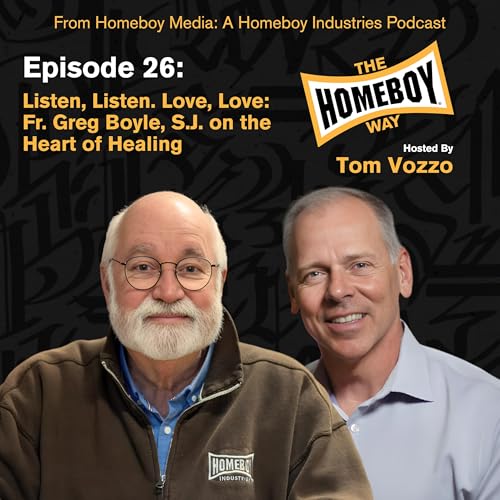
  • Listen, Listen. Love, Love: Fr. Greg Boyle, S.J. on the Heart of Healing
    Mar 18 2026
    At Homeboy Industries, healing rarely happens through a single method. It unfolds through therapy, community, compassion, and the steady presence of people who care.In this episode, Tom Vozzo sits down with Fr. Greg Boyle, S.J. to explore how healing really happens for people carrying deep trauma. Fr. Greg describes it as the “cumulative dosing effect of cherishing” when someone is consistently seen, known, and valued. Yet that kind of love can feel overwhelming. Some homies even walk away at first because they do not know how to receive it.Fr. Greg reflects on the early days of Homeboy, when therapy carried heavy stigma. Today, the demand is so great that there are waiting lists. He shares stories of people wrestling with addiction, hearing voices, and confronting wounds they once tried to bury.Through decades of experience, Fr. Greg reveals a deeper truth. Healing does not happen only in therapy. It happens in a community where people discover they are no longer alone.Key TakeawaysOverwhelm from love is real.Fr. Greg shares about a homie who left Homeboy not because things were bad, but because he “didn’t know how to handle all the love.” For people used to trauma, steady care and belonging can feel unfamiliar or overwhelming, so some leave and return when they are ready.Community dosing surrounds and amplifies therapy.Beyond methods like talk therapy and EMDR, healing also happens through daily relationships. Consistent care from staff, mentors, and volunteers helps build resilience.The three profiles of gang members (and all of us).Fr. Greg breaks down that everyone falls into one of three categories: despair (can't imagine a future), trauma (high ACEs score), or mental illness.Luck and privilege shape our lives more than we admit.Fr. Greg reminds us that success is not only about hard work. Many benefit from unseen advantages, and recognizing this can foster humility and compassion.In This Episode:00:00 – Introduction 01:00 –  How healing happens02:28 – Why therapy must be voluntary03:09 – The early days and the need for therapy at Homeboy (ACEs)05:50 – What surrendering to healing looks like07:44 – When love feels overwhelming09:14 – Challenges finding therapists and homies to try therapy12:29 – The rise of therapy and volunteer clinicians14:35 – Listening and loving as the foundation of healing16:05 – Alternative therapies and healing experiences20:32 – Why there is no “one-size-fits-all” healing23:37 – Compassion and forgiveness in the healing process26:38 – What it means to be a “stranger to yourself”30:43 – Three profiles of gang members33:44 – Excavating generational wounds in everyday life36:31 – The role of luck, privilege, and circumstance38:46 – Reducing stigma around mental health40:35 – Mental illness and societal misunderstanding45:39 – Why healing is reliable and ongoingNotable Quotes“I don't think healing is so formulaic. I think if you believe in how the cumulative dosing effect of cherishing is, you can observe it.” — Fr. Greg Boyle, S.J. [01:00]“Listen, listen. Love, love.” — Fr. Greg Boyle, S.J. [14:01]“If you don’t welcome your own wound, you will be tempted to despise the wounded.” — Fr. Greg Boyle, S.J. [28:01]“How do you transform your pain so you no longer transmit it?” — Fr. Greg Boyle, S.J. [31:41]Homeboy Industrieshttps://homeboyindustries.org/https://www.youtube.com/@HomeboyIndustries_LA/videosDonate: https://homeboyindustries.org/donate/donate-online/Homeboy Media https://homeboyindustries.org/social-enterprises/homeboy-media/Father Greg Boylelinkedin.com/in/greg-boyle-s-j-05458514Thomas Vozzohttps://www.linkedin.com/in/thomasvozzoThe Homeboy Way: A Radical Approach to Business and Life: https://www.amazon.com/Homeboy-Way-Radical-Approach-Business/dp/082945456XCredits:Hosted by: Tom VozzoProduced by: Podify, and Alexa Rousso and Melody Carter of Homeboy Media
    Más Menos
    47 m
Todavía no hay opiniones