Episodios

  • Breaking Cycles: A Mother's Fight for Change and a Son's Path to Recovery with Natalie Venegas and Daniel Aguilar
    Apr 1 2026
    Imagine your children being taken from your home at gunpoint. That searing, shame-filled moment becomes the catalyst. Not for more destruction, but for a journey that leads you from prison yards to the director’s chair, and eventually, to finding freedom in a sun-drenched square in Barcelona. This is Natalie’s story.In this episode of The Homeboy Way, host Tom Vozzo sits down with Natalie Venegas, Director of Case Management at Homeboy Industries, her son Daniel Aguilar, and longtime Homeboy leader Hector Verdugo to explore the long arc of transformation and generational healing. Natalie reflects on her 15-year journey from leaving prison as a four-time felon, carrying the trauma of her children being taken at gunpoint, to rising into senior leadership while pursuing clinical licensure. She shares how addiction, rejection, and survival masks once shaped her life, and how therapy, education, and unconditional love helped her learn how to live, parent, and lead. Daniel offers his perspective on choosing recovery for himself, while Hector reflects on witnessing Natalie’s evolution firsthand. Together, their stories reveal how kinship and consistency reshape not just individual lives, but entire family trajectories.Key TakeawaysHealing begins when survival endsNatalie shares how emotional shutdown and stoicism kept her alive but also kept her stuck. Healing began only when she felt safe enough to be vulnerable.Consistency builds trust where words cannotHomeboy’s steady presence taught Natalie how to be consistent for herself, her children, and others, something she never experienced growing up.Unconditional love creates capacity Being loved without prerequisites allowed Natalie to believe in herself, pursue education, enter therapy, and step into leadership.Healing is generational Daniel’s recovery is connected to his mother’s healing. Homeboy’s model shows how helping one person reshapes an entire family’s future.You cannot do it alone, and you are not meant to Walking alongside others through sponsors, staff, and peers makes transformation sustainable and real.In This Episode:00:00 – Introduction00:42 – Natalie’s early years and repeated incarceration02:09 – Being taken from her children at gunpoint03:59 – Choosing not to numb out in prison06:28 – A letter from her son that changed everything08:09 – The Greyhound bus, temptation, and choosing sobriety10:36 – Entering a program and first encounters with Homeboy12:18 – “You don’t fit our profile”: misjudgment and persistence14:58 – Vulnerability breaks through stoicism17:22 – Learning how to live on the outside18:36 – Education, therapy, and discovering a calling21:10 – From survival to service23:09 – Daniel shares his recovery journey28:25 – Parenting, boundaries, and letting go31:26 – How Homeboy changes entire family trajectories33:01 – Traveling the world as formerly incarcerated leaders35:26 – Belonging without labelsNotable Quotes“I didn’t know how to live out here. I knew how to hustle, but not how to be a mom.” — Natalie Venegas [17:02]“I’m the only one who’s going to fix my life.” — Daniel Aguilar [26:35]“Homeboy loves people, gives people hugs until they learn how to love themselves.” — Natalie [23:01]Resources and LinksHomeboy Industrieshttps://homeboyindustries.org/https://www.youtube.com/@HomeboyIndustries_LA/videosDonate: https://homeboyindustries.org/donate/donate-online/Homeboy Media https://homeboyindustries.org/social-enterprises/homeboy-media/Natalie Venegashttps://www.linkedin.com/in/natalie-venegas-1327b0a3/Hector Verdugohttps://www.linkedin.com/in/hector-verdugo-7297a684Thomas Vozzohttps://www.linkedin.com/in/thomasvozzoThe Homeboy Way: A Radical Approach to Business and Life: https://www.amazon.com/Homeboy-Way-Radical-Approach-Business/dp/082945456XCredits:Hosted by: Tom VozzoProduced by: Podify, and Alexa Rousso and Melody Carter of Homeboy Media
    Más Menos
    38 m
  • From Gang Member to Case Manager: Robert Valles on 20 Years of Addiction and Recovery
    Mar 25 2026
    When Robert Valles first walked through the doors of Homeboy Industries, he wasn’t looking for healing. He was looking for a job. After more than fifteen interviews and repeated rejection because of his federal record, he arrived skeptical and unsure of what to expect.What he found instead was something he had never experienced before: a place where people are, in his words, “paid to heal.”In this episode, Tom Vozzo and Hector Verdugo sit down with Robert to reflect on the long road that brought him there. Once a gang member and federal prisoner, Robert spent years numbing pain through addiction. When sobriety finally forced him to face his life, he was confronted with shame, loss, and the devastating moment his children were taken away.Not knowing where his kids were for forty days became the turning point that pushed him to surrender and change.Today, Robert serves as a Case Manager, helping others rebuild their lives. His story reveals how healing begins, how love can feel unfamiliar at first, and how serving others can become a powerful form of recovery.Key TakeawaysWhen a federal record becomes a barrierRobert went on 15 job interviews before coming to Homeboy. Despite being likable and qualified, his federal record, which can never be expunged, kept doors closed until he found Homeboy.Getting paid to healRobert was initially upset about the low pay. But through self-help classes, he discovered: "You get paid in a different way here. I'm getting paid to heal." His story now helps others heal, too.Healing as a couple, with boundariesRobert was skeptical about doing the program with his wife. But it worked because they understood: "You have your program, I have my program. Once we're healed, then maybe we can heal our marriage.""If I could do it, you could do it"Robert tells trainees daily: "Gang member, incarcerated, addicted 20 years, kids taken away. If there's a box, check it." His lived experience gives others hope.A touch of love makes a differencePeople who experienced even some love in childhood recognize it at Homeboy and thrive quickly. That thread of love, however tangled, matters.When there is no love, healing takes longerThose who were tortured as kids, who experienced no love, often leave when shown love. They return, leave again, and stay longer each time. Healing just takes more time.In This Episode:00:00 – Introduction00:53 – Robert’s role and journey at Homeboy02:43 – Transformation from gang life03:26 – Ozzy the Navigator moment04:50 – Getting paid to heal 05:20 – Determination to get his children back06:09 – Skepticism about his wife joining07:15 – What Robert tells new trainees11:33 – Confronting shame12:44 – Watching his children walk away13:11 – Faith, surrender, and recovery16:36 – Restoring relationships with children18:05 – Breaking generational cycles19:25 – Robert’s future goals in 5-10 years 20:31 – Growing up with addiction and abuse in the home22:48 – The power of love and healing at Homeboy26:29 – The future of Homeboy is strongNotable Quotes“I'm getting paid to heal.” — Robert [04:55]“If I could do it, you could do it because I'm no different from you.” — Robert [07:18]“ Just that simple, are you okay? And how are you doing today? Could change your life..” — Robert [07:59]“ My fear as a parent is my kids growing up doing what I was doing.” — Robert [18:05]Resources and LinksHomeboy Industrieshttps://homeboyindustries.org/https://www.youtube.com/@HomeboyIndustries_LA/videosDonate: https://homeboyindustries.org/donate/donate-online/Homeboy Media https://homeboyindustries.org/social-enterprises/homeboy-media/Hector Verdugohttps://www.linkedin.com/in/hector-verdugoThomas Vozzohttps://www.linkedin.com/in/thomasvozzoThe Homeboy Way: A Radical Approach to Business and Life: https://www.amazon.com/Homeboy-Way-Radical-Approach-Business/dp/082945456XCredits:Hosted by: Tom VozzoProduced by: Podify, and Alexa Rousso and Melody Carter of Homeboy Media
    Más Menos
    27 m
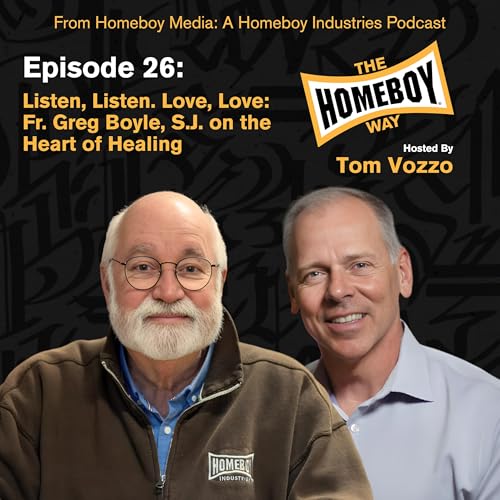
  • Listen, Listen. Love, Love: Fr. Greg Boyle, S.J. on the Heart of Healing
    Mar 18 2026
    At Homeboy Industries, healing rarely happens through a single method. It unfolds through therapy, community, compassion, and the steady presence of people who care.In this episode, Tom Vozzo sits down with Fr. Greg Boyle, S.J. to explore how healing really happens for people carrying deep trauma. Fr. Greg describes it as the “cumulative dosing effect of cherishing” when someone is consistently seen, known, and valued. Yet that kind of love can feel overwhelming. Some homies even walk away at first because they do not know how to receive it.Fr. Greg reflects on the early days of Homeboy, when therapy carried heavy stigma. Today, the demand is so great that there are waiting lists. He shares stories of people wrestling with addiction, hearing voices, and confronting wounds they once tried to bury.Through decades of experience, Fr. Greg reveals a deeper truth. Healing does not happen only in therapy. It happens in a community where people discover they are no longer alone.Key TakeawaysOverwhelm from love is real.Fr. Greg shares about a homie who left Homeboy not because things were bad, but because he “didn’t know how to handle all the love.” For people used to trauma, steady care and belonging can feel unfamiliar or overwhelming, so some leave and return when they are ready.Community dosing surrounds and amplifies therapy.Beyond methods like talk therapy and EMDR, healing also happens through daily relationships. Consistent care from staff, mentors, and volunteers helps build resilience.The three profiles of gang members (and all of us).Fr. Greg breaks down that everyone falls into one of three categories: despair (can't imagine a future), trauma (high ACEs score), or mental illness.Luck and privilege shape our lives more than we admit.Fr. Greg reminds us that success is not only about hard work. Many benefit from unseen advantages, and recognizing this can foster humility and compassion.In This Episode:00:00 – Introduction 01:00 –  How healing happens02:28 – Why therapy must be voluntary03:09 – The early days and the need for therapy at Homeboy (ACEs)05:50 – What surrendering to healing looks like07:44 – When love feels overwhelming09:14 – Challenges finding therapists and homies to try therapy12:29 – The rise of therapy and volunteer clinicians14:35 – Listening and loving as the foundation of healing16:05 – Alternative therapies and healing experiences20:32 – Why there is no “one-size-fits-all” healing23:37 – Compassion and forgiveness in the healing process26:38 – What it means to be a “stranger to yourself”30:43 – Three profiles of gang members33:44 – Excavating generational wounds in everyday life36:31 – The role of luck, privilege, and circumstance38:46 – Reducing stigma around mental health40:35 – Mental illness and societal misunderstanding45:39 – Why healing is reliable and ongoingNotable Quotes“I don't think healing is so formulaic. I think if you believe in how the cumulative dosing effect of cherishing is, you can observe it.” — Fr. Greg Boyle, S.J. [01:00]“Listen, listen. Love, love.” — Fr. Greg Boyle, S.J. [14:01]“If you don’t welcome your own wound, you will be tempted to despise the wounded.” — Fr. Greg Boyle, S.J. [28:01]“How do you transform your pain so you no longer transmit it?” — Fr. Greg Boyle, S.J. [31:41]Homeboy Industrieshttps://homeboyindustries.org/https://www.youtube.com/@HomeboyIndustries_LA/videosDonate: https://homeboyindustries.org/donate/donate-online/Homeboy Media https://homeboyindustries.org/social-enterprises/homeboy-media/Father Greg Boylelinkedin.com/in/greg-boyle-s-j-05458514Thomas Vozzohttps://www.linkedin.com/in/thomasvozzoThe Homeboy Way: A Radical Approach to Business and Life: https://www.amazon.com/Homeboy-Way-Radical-Approach-Business/dp/082945456XCredits:Hosted by: Tom VozzoProduced by: Podify, and Alexa Rousso and Melody Carter of Homeboy Media
    Más Menos
    47 m
  • Jane Fonda on Why The Homeboy Way Matters Now
    Mar 11 2026
    Jane Fonda, Oscar-winning actress and lifelong activist, first learned about Homeboy Industries in the 1980s through her then-husband, Tom Hayden. He came home energized by a Jesuit priest who had opened a bakery employing formerly incarcerated gang members. Years later, at a Homeboy gala, she finally heard Father Greg Boyle speak and knew she wanted to be part of something so transformative.In this episode, Tom Vozzo sits down with Jane to reflect on her seven years as a board member and what continues to draw her to a community built on healing and second chances. She shares how walking through Homeboy’s doors feels like “sinking into a warm bath,” and why, at 88, she still finds herself learning from the homegirls she calls “smarter than me in so many ways.” For Jane, leadership begins with humility, and real change starts by listening from the heart.Key TakeawaysJobs are not enough. Healing comes first. Father Greg realized quickly that employment alone would not create lasting change. Deep trauma, left unaddressed, leads people back into trouble. Homeboy evolved into a healing-centered community where recovery comes before placement.Cherish, don’t judge.To cherish someone is to fully receive them into your heart. Healing begins there.Transformation requires proximity. It's wonderful when rich people throw money out from their homes up on the hill to people who need it," Jane says. Generosity from a distance is good. But real change happens shoulder to shoulder. Being present, listening, and building relationships transforms everyone involved.Hate the behavior, not the personBad behavior is often the language of trauma. You can reject harm while still honoring human dignity.We give because we see ourselves. Homeboy’s mission resonates because we are all broken in some way. Watching others heal reminds us that transformation is possible for us too.Women are the glue. "In every class, in every rung of society, and in every ethnicity and race in the world, it's women that hold things together. They're the glue for families and for communities."Life with meaning is better. Jane has lived without meaning and with meaning. "I know that the meaning is a lot better. In This Episode:00:00 – Introduction01:46 – How Jane Fonda first found Father Greg and Homeboy Bakery03:41 – From the Homeboy Bakery to a healing-centered model04:40 – "I need whatever that secret sauce is"06:05 – Kinship and mutuality with people on the margins08:48 – What Jane learns from homegirls13:09 – The meaning of cherishing15:54 – Ignatian spirituality at Homeboy18:32 – Funding the mission19:51 – Gangsters, leaders, and the pressure of machismo21:32 – Homeboy’s culture shift: from toughness to tears22:09 – Poverty, business hiring, and “show by doing”23:30 – Jane Fonda’s activist origin story26:19 – The urgency of activism today28:19 – What Jane would tell her younger self30:06 – The Global Homeboy NetworkNotable Quotes“ Bad behavior, even evil behavior is the language of the traumatized.” — Jane [07:25]" Avoid violence. Violence is our enemy." — Jane [28:04]“ Cherished, to me is even greater than love means I've brought you fully into my full heart in every possible way.” — Jane [13:42]“I've lived without meaning, and I've lived with meaning, and I know that the meaning is a lot better.”— Jane [29:19] Resources and LinksHomeboy Industrieshttps://homeboyindustries.org/https://www.youtube.com/@HomeboyIndustries_LA/videosDonate: https://homeboyindustries.org/donate/donate-online/Homeboy Media https://homeboyindustries.org/social-enterprises/homeboy-media/Jane Fondahttps://www.linkedin.com/in/jane-fonda-2408b4302/Thomas Vozzohttps://www.linkedin.com/in/thomasvozzoThe Homeboy Way: A Radical Approach to Business and Life: https://www.amazon.com/Homeboy-Way-Radical-Approach-Business/dp/082945456XCredits:Hosted by: Tom VozzoProduced by: Podify, and Alexa Rousso and Melody Carter of Homeboy Media
    Más Menos
    35 m
  • Healing Through Art at the Homeboy Art Academy with Fabian Debora and Barbara Fant
    Mar 4 2026
    When Tom Vozzo first walked into Homeboy Industries more than 12 years ago, he was skeptical. “Shouldn’t we be doing work here at ‘Industries’?” he wondered, seeing art classes throughout the building.In this episode, Tom sits down with Fabian Debora, Executive Director of the Homeboy Art Academy, and Program Manager Barbara Fant to explore how art reaches wounds words cannot and why creativity is central to Homeboy’s model of healing and belonging.Fabian shares how, as a child hiding from domestic violence, drawing became his refuge, a sanctuary that carried him through addiction, recovery, and ultimately national recognition as a Heritage Fellow with the National Endowment for the Arts. Barbara reflects on losing her mother at fifteen and turning grief into poetry, using verse as both prayer and therapy.Through the Art Academy, rival youth create side by side, guided by Fabian’s Three R’s: Reconnect, Re-identify, and Reimagine.Key TakeawaysArt is refugeAs a child, Fabian learned art did not just express him, it held him. Hiding under a coffee table from violence, he found safety and hope. That same refuge is what the Art Academy now offers every young person who enters.Mentorship restores what shame steals. When a teacher destroyed Fabian’s artwork, Father Greg Boyle saw him for who he truly was and gave art back. That moment of being seen and reassured that his gift mattered changed everything.Poetry can be prayer.At 15, without therapy, Barbara turned sermon notes into poems, using them to grieve, pray, and make sense of losing her mother.Healing is intentional.The Art Academy practices a healing-centered approach: circles, reflection, the three R’s, creative exercises aligned with specific aspects of healing, and structured closing reflections.Identity can evolve.The young man known for his face tattoo begins with gang writing and gradually discovers artistry, leadership, and gentleness within himself.In This Episode:00:00 – Introduction01:26 – Fabian’s childhood and art as refuge03:32 – Mentorship and artistic development05:28 – Barbara’s story: poetry as prayer11:03 – The Homeboy Art Academy12:32 – Healing-centered approach and the three R’s14:25 – Community, safety, and transformation16:29 – Co-designing the Academy’s modality18:09 – Stories of transformation: Giselle and Jesus20:13 – Managing gang dynamics and building kinship21:55 – Team approach and wraparound services24:03 – Challenges of the work27:07 – Resilience and returning youth28:17 – Fabian’s artistic recognition and advocacy30:21 – Barbara’s writing and influence of Homeboy31:52 – Future vision: accredited school of art32:44 – Graffiti, tagging, and artistic expressionNotable Quotes“People really do heal through the arts.” — Tom [01:16]"Art gave me a sense of purpose, existence, and, most importantly, hope." — Fabian [02:08]“ I started writing as just this way of processing, of talking to God and of prayer.” — Barbara [07:14]“The toughest part of the job has been the heartbreak.”— Tom [26:23] Resources and LinksHomeboy Industrieshttps://homeboyindustries.org/https://www.youtube.com/@HomeboyIndustries_LA/videosDonate: https://homeboyindustries.org/donate/donate-online/Homeboy Media https://homeboyindustries.org/social-enterprises/homeboy-media/Barbara Fanthttps://www.linkedin.com/in/barbara-fant-mfa-8114b633/https://homeboyindustries.org/services/art-academy/Fabian Deborahttps://www.linkedin.com/in/fabian-debora-886279a/https://homeboyindustries.org/services/art-academy/Thomas Vozzohttps://www.linkedin.com/in/thomasvozzoThe Homeboy Way: A Radical Approach to Business and Life: https://www.amazon.com/Homeboy-Way-Radical-Approach-Business/dp/082945456XCredits:Hosted by: Tom VozzoProduced by: Podify, and Alexa Rousso and Melody Carter of Homeboy Media
    Más Menos
    37 m
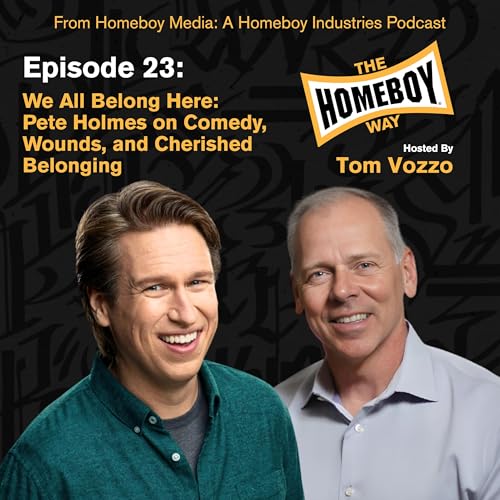
  • We All Belong Here: Pete Holmes on Comedy, Wounds, and Cherished Belonging
    Feb 25 2026
    In this episode, Tom Vozzo sits down with comedian and podcaster Pete Holmes to talk about faith, belonging, and spirituality. Pete shares how discovering Fr. Greg Boyle, S.J. and Homeboy Industries reshaped not just his theology, but the way he walks on stage. Before performing, he often listens to Father Greg to remind himself that “we belong to each other,” shifting comedy from performance to kinship.Pete reflects on coming from the Christian tradition, where being the center of attention can feel almost wicked, like becoming the “special boy.” Comedy, he explains, is not that. He will play the role of the special performer, and the audience plays their role too. But underneath it all, it is just a connection. It is all just sunlight wearing different masks.Reflecting on the story of the prodigal son, Pete explains that you cannot be more of the man’s son in the kingdom and less his son with the pigs. It is about accepting that you are accepted. You are already in. They talk about staying soft when things go wrong, letting anger move through without shame, and resisting the urge to create “the other.”Key TakeawaysWe are sunlight wearing different masks.Pete looks at the audience and does not see strangers. He sees himself in different forms. Each person carries quiet burdens, love and hurt, generosity and selfishness. The gospel draws a crowd.Pete observes that Homeboy’s lobby feels like Disneyland or summer camp. That pull, he argues, is the real sign of the sacred.Pain is not a competition. Your shit is your shit.Pete almost minimizes his own story beside another’s trauma, then realizes suffering is not a scoreboard. Healing begins when we stop ranking wounds and start honoring them.Want to know you’re accepted? Start accepting others.You can't be more the man's son when you're in the kingdom and less his son when you're with the pigs. Tom watched Greg Boyle pause with wealthy donors to attend to a homie with a simple question. Acceptance is not a reward. It’s a practice we extend, especially to the least visible.Grace is getting it wrong and being loved anyway.Tom’s tree story captures the ache of good intentions missing the mark. That tender space between intent and impact is where grace lives.Hating the other is hating yourself.When we label anyone disposable, we quietly say the same about ourselves. Loving those cast aside brings the hidden parts of us back to life.In This Episode:00:00 – Introduction00:53 – Getting involved with Homeboy01:22 – Connecting with Fr. Richard Rohr and Fr. Greg Boyle03:16 – The impact of Homeboy’s teachings04:45 – Performing with compassion07:43 – Lessons from Homeboy16:11 – The power of acceptance and belonging22:39 – Balancing help and personal boundaries27:17 – Spiritual teachings and reflections29:03 – The value of vulnerability29:55 – A humbling medical experience30:44 – Embracing brokenness34:14 – Spirituality in the corporate world35:05 – Discovering true spirituality42:05 – The role of psychedelics in spiritual awakeningNotable Quotes“Every single one of you has an unseen burden.” — Pete Holmes [05:09]"We're all just sunlight wearing different masks." — Pete Holmes [05:43]“If you want to know you're accepted, start by accepting others.” — Tom [25:11]Resources and LinksHomeboy Industrieshttps://homeboyindustries.org/https://www.youtube.com/@HomeboyIndustries_LA/videosDonate: https://homeboyindustries.org/donate/donate-online/Homeboy Media https://homeboyindustries.org/social-enterprises/homeboy-media/Pete Holmeshttps://peteholmes.com/https://www.youtube.com/user/peteholmesThomas Vozzohttps://www.linkedin.com/in/thomasvozzoThe Homeboy Way: A Radical Approach to Business and Life: https://www.amazon.com/Homeboy-Way-Radical-Approach-Business/dp/082945456XCredits:Hosted by: Tom VozzoProduced by: Podify, and Alexa Rousso and Melody Carter of Homeboy Media
    Más Menos
    59 m
  • Fr. Richard Rohr: Everyday Wisdom From a Master Theologian
    Feb 18 2026
    In this episode, Tom Vozzo sits down with renowned Franciscan priest and author Fr. Richard Rohr to explore the emotional and spiritual journey behind anger, sadness, and healing. Fr. Richard explains why so many people, especially men, get stuck in anger and how that reaction often covers a much deeper sadness.Their discussion naturally connects to the lived experiences at Homeboy Industries, where individuals arrive carrying both grief and the desire for a new beginning. Fr. Richard shares why welcoming our sorrow is not weakness but a pathway to compassion, transformation, and spiritual maturity. The result is a warm, honest, and deeply human conversation about what it truly means to grow, to heal, and to become more whole.Key TakeawaysReal transformation begins when anger gives way to sadness.Most people think prophets were angry men. Rohr explains they actually began in anger but moved into sadness and ultimately into compassion, mirroring the inner journey many at Homeboy take.Grief is not weakness; it is the soul’s entrance into maturity.Cultures throughout history had rites teaching boys how to weep. Rohr recounts the Maasai “caves of grief,” where warriors learned that tears were strength, not failure.Control is the enemy of healing.Trying to control emotions keeps people stuck in anger. Letting go allows sadness to rise, which is the pathway to compassion.Suffering is unavoidable and essential.Whether it is the death of a loved one, loss of a pet, or inherited trauma, every person experiences pain. Rohr argues that grief, felt honestly, is the starting point of a real spiritual journey.Joy comes only after walking through grief.True joy is not positive thinking. It is what emerges when we release judgment, righteousness, and the need to perfect the world and ourselves.In This Episode:00:00 – Introduction to The Homeboy Way01:04 – The spiritual lessons of Homeboy and Fr. Richard's writings01:43 – Why the soul must weep: Anger, sadness, and the prophetic journey06:19 – Why men don't weep and how to learn10:42 – Grief as initiation: The Men's Rites of Passage and PTSD14:13 – What the poor know: A critical lens on society and success18:31 – The necessity of suffering and exile for transformation24:30 – Wholeness vs. perfection and the "wounded warrior"27:48 – Occam's Razor: Why the simplest answer is Love33:13 – Certitude vs. faith in spirituality and politics36:04 – From lamentation to doxology: Where true joy is found39:47 – Conclusion and gratitudeNotable Quotes"You're much more sad than you are angry." — Fr. Richard Rohr (04:36)"The ego likes to be angry. It gives you a false sense of power and superiority" — Fr. Richard Rohr (09:02)"The simplest answer is invariably and almost always the correct one… The answer to everything is love." — Fr. Richard Rohr on Occam's Razor (28:35)"The opposite of faith is not doubt. The opposite of faith is certitude." — Fr. Richard Rohr (33:17)"We come to God more by doing it wrong than by doing it right." — Fr. Richard Rohr (38:12)Resources and LinksHomeboy Industrieshttps://homeboyindustries.org/https://www.youtube.com/@HomeboyIndustries_LA/videosDonate: https://homeboyindustries.org/donate/donate-online/Homeboy Media https://homeboyindustries.org/social-enterprises/homeboy-media/Fr. Richard Rohrhttps://cac.org/about/cac-faculty/cac-founder-richard-rohr/https://cac.org/Daily Meditations: https://cac.org/daily-meditations/Books: "The Universal Christ," "Falling Upward," "The Wisdom Pattern," and his latest discussed, "The Tears of Things.Thomas Vozzohttps://www.linkedin.com/in/thomasvozzoThe Homeboy Way: A Radical Approach to Business and Life: https://www.amazon.com/Homeboy-Way-Radical-Approach-Business/dp/082945456XCredits:Hosted by: Tom VozzoProduced by: Podify, and Alexa Rousso and Melody Carter of Homeboy Media
    Más Menos
    40 m
  • A Lifetime of Perspective on Gangs, Policing, and Poverty with Hector Verdugo and Stephanie Lane
    Feb 11 2026
    In this episode of The Homeboy Way, host Tom Vozzo sits down with Homeboy leaders Hector and Stephanie for a raw, unfiltered conversation about policing, childhood trauma, and the long road from survival to kinship.Through deeply personal stories, they explore how early encounters with law enforcement shaped fear, anger, and identity and how Homeboy Industries created a radical alternative: a place where healing requires moving beyond “us vs. them” and choosing to be fully in, even when it’s uncomfortable.This episode doesn’t simplify pain or excuse harm. Instead, it names the wounds honestly while asking a harder question: What does it take to heal without becoming what hurt you?Key Takeaways“We’re In”: Choosing Kinship Over DivisionHector explains the turning point at Homeboy Industries: realizing the work only functions when everyone commits fully. Not partially. Not conditionally. “It’s not about us and them. It’s just us.” True transformation begins when people decide they’re all in, including with former enemies and authority figures.Seeing Law Enforcement as Human Without Erasing HarmHector reflects on learning to hold two truths at once: acknowledging abuse while recognizing the humanity of those in uniform.Healing, he explains, doesn’t mean pretending harm didn’t happen, it means refusing to let it define the future.Choosing Restraint in the Face of Old RageHector shares a moment years later when he encounters a police officer who had deeply harmed his family. His body reacts instantly but he chooses to walk away. This illustrates the quiet, invisible work of healing: regulating yourself when every instinct tells you to explode.From Fear of Beatings to Fear of DeathStephanie contrasts past and present policing realities. Where earlier generations expected brutality, today’s communities fear being killed especially during mental health or domestic calls. This connects the rise in aggression, distrust, and hyper-vigilance to a deeper, collective fear that has only intensified since COVID.Wearing Homeboy in Public: From Target to SignalStephanie explains why she once avoided wearing Homeboy gear in her neighborhood and how that changed as law enforcement began to understand the mission. This moment reflects the broader shift in how Homeboy Industries is perceived: no longer a “soft place for gang members,” but a proven model of transformation.In This Episode:00:00 – Introduction00:57 – Hector’s experience with police12:15 – Stephanie’s experience with police16:58 – Interactions with law enforcement17:33 – The current state of the streets18:48 – The impact of COVID-19 on gang violence19:47 – Fear and aggression20:59 – Police brutality then and now22:32 – Advice for dealing with police23:57 – Homeboy Industries’ changing perception25:18 – Hopes for Homeboy Industries’ future28:27 – The importance of resources and experiences33:07 – Concluding thoughtsNotable Quotes“It’s not about us and them. It’s just us.” — Hector [05:20]“I grew up believing the police were going to hurt us.” — Stephanie [13:59]“Healing doesn’t mean forgetting. It means choosing differently.” — Hector [17:30]“This place is home. It’s the last stop for a lot of us.” — Stephanie [25:18]Resources and LinksHomeboy Industrieshttps://homeboyindustries.org/https://www.youtube.com/@HomeboyIndustries_LA/videosDonate: https://homeboyindustries.org/donate/donate-online/Homeboy Media https://homeboyindustries.org/social-enterprises/homeboy-media/Stephanie Lanehttps://www.linkedin.com/in/stephanie-lane-757052284/Hector Verdugohttps://www.linkedin.com/in/hector-verdugo-7297a684/Thomas Vozzohttps://www.linkedin.com/in/thomasvozzoThe Homeboy Way: A Radical Approach to Business and Life: https://www.amazon.com/Homeboy-Way-Radical-Approach-Business/dp/082945456XCredits:Hosted by: Tom VozzoProduced by: Podify, and Alexa Rousso and Melody Carter of Homeboy Media
    Más Menos
    34 m