Episodios

  • Crossroads of Commerce: Scaling Beyond DTC
    Apr 14 2026
    Direct-to-consumer (DTC) gave brands control over experience, data, and customer relationships. As brands grow, that model alone becomes limiting. This episode explores how brands move from subscription-based models into retail and multi-channel strategies — and what changes when products leave controlled environments and enter broader distribution. Podcast Overview Fritz Finlay is joined by Reba Hatcher, Chief Commercial Officer at ButcherBox, and Jennifer Cline, CMO of SubSummit. Together, they discuss the transition from DTC to retail, focusing on how brands scale while maintaining consistency across channels. Key Topics Covered - Why DTC alone is no longer sufficient for growth - How brands transition from subscription to retail - The trade-offs between control, scale, and visibility - What changes in product positioning, messaging, and packaging - Operational challenges of multi-channel expansion - How DTC and retail strategies can work together About SubSummit This episode is part of SubSummit (May 13–15, Kansas City), a leading event focused on subscription, commerce, and retail. SubSummit brings together brands and operators working through multi-channel growth, including the shift from DTC to retail environments.
    Más Menos
    30 m
  • How to Sell When Bots are Your Primary Customer with Hanna Andersson
    Apr 13 2026
    Most retailers are still optimizing for a world where a human types a keyword into a bar. But at Hanna Andersson, Matt Ezyk is architecting for a reality where AI agents browse and filter on behalf of the consumer. In this episode, we discuss the architectural survival of brand identity in a decentralized world. - The Bilingual Storefront: LLMs crave data density (fit, texture, origin) that ruins human UX. Use "Accordion" Architecture to hide technical metadata from the human "dopamine hit" while keeping it readable for the bots that control discovery. - LLMO (Large Language Model Optimization): Your brand identity is being reconstructed by AI using Reddit and training data. To stay relevant, return to the basics of structured data to ensure the machine treats your quality as a fact, not a slogan. - The Intuition Guardrail: AI is a rearview mirror. It fails at "newness." Human merchandising "hunches" are the only way to signal relevance for new collections that lack historical data. The Bottom Line: In 2026, building for the click is a legacy strategy. To survive the Agent Era, you must build for the conversation. If your site doesn't speak "bot," your human customers will never find your story.
    Más Menos
    9 m
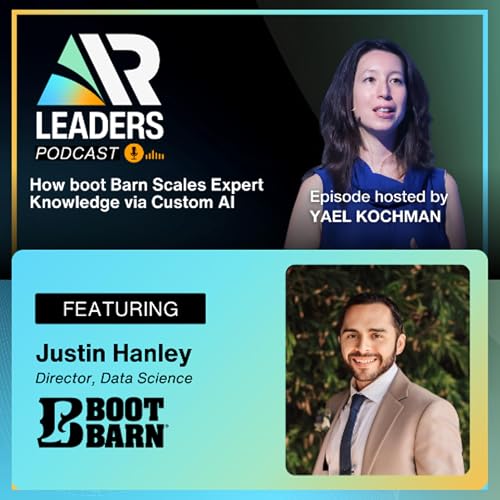
  • How Boot Barn Turns AI Into a Store Associate, Not a Chatbot
    Apr 9 2026
    What if the real problem with AI in retail isn’t intelligence—but expertise? Recorded live at Shoptalk Spring in Las Vegas, this conversation breaks down how Boot Barn is tackling one of retail’s hardest challenges: scaling deep, technical product knowledge across 500+ stores—without losing credibility on the floor. Instead of relying on generic chatbots, Boot Barn built a custom AI “associate” designed to know the difference between looking right and being right—especially when safety, compliance, and performance matter. Key Insights: - AI is only as good as what it knows. Boot Barn uses Retrieval-Augmented Generation (RAG) to ground AI in real product specs, safety standards, and brand knowledge—reducing hallucinations and increasing trust where it matters most. - The real unlock isn’t AI—it’s humans training it. Professional copywriters aren’t being replaced—they’re evolving into AI trainers, shaping how the system communicates and ensuring the brand voice stays authentic to the Western and workwear customer. Expertise, on demand. In a high-turnover retail environment, AI becomes a “digital co-worker”—giving store associates instant access to complex product knowledge they might otherwise take years to learn. Search is no longer the battleground. As discovery shifts toward AI-driven answers, Boot Barn is preparing for a world where visibility depends on how well your knowledge is structured for machines—not just humans. Listen to the full conversation to see what retail AI actually looks like when it works.
    Más Menos
    11 m
  • Unified Commerce: Bridging the Execution Gap
    Apr 9 2026
    Moving Beyond the Buzzwords Unified Commerce isn't a new term, but true execution remains the "Holy Grail" for enterprise retailers. In this episode, Steven Bailey, Partner at EY and Jonathan Aitken, SVP at RADAR, discuss why the gap between vision and reality is still so wide, and how to close it. The Foundation of Real-Time Retail From the friction of in-store returns to the high cost of order cancellations, the duo explores how fragmented data ruins the customer experience. They break down why "throwing AI at the problem" isn't a fix for a broken architectural foundation. Key Insights include: - Journey vs. Channel: Why structural alignment matters more than technology. - The Smart Store: Transitioning physical locations from "sales points" to "intelligence hubs." - Inventory Truth: Why 99%+ accuracy is the non-negotiable starting point for 2026.
    Más Menos
    30 m
  • Turning 'Silent Boxes' into Living Stores: The Blueprint for In-Store Edge Intelligence
    Apr 7 2026
    The “Connected Store” has moved from concept to operational priority. In this episode, Pauline Monin (Vusion) breaks down how digital shelf technology is transforming physical stores into responsive, data-driven environments. Operational Excellence & Local E-Commerce Automated pricing removes manual processes and reduces errors at scale, allowing store teams to focus on higher-value tasks. At the same time, stores become more effective local fulfilment hubs. With “Flash-to-Pick” LED guidance, associates can follow optimized picking routes, improving speed and consistency for online order fulfilment. The AI & Retail Media Opportunity Through EdgeSense, fragmented in-store data is unified into a single intelligence layer. This enables AI-driven recommendations across pricing and assortment, while also opening the door to in-store Retail Media. Digital displays can measure engagement such as dwell time, giving brands clearer visibility into performance at the shelf.
    Más Menos
    20 m
  • AI Responsibility, Agentic Futures, and Transparent Retail Media — The Costco Way
    Apr 6 2026
    Recorded live at Shoptalk Spring, this episode of the AiR Podcast tackles the shift from AI experimentation to real-world accountability. Mark Williamson, AVP of Retail Media at Costco Wholesale, joins Kimberly Morgan, CEO of The Fashion Tech Exec and a Top AI Leader, to discuss why Costco is building its technology ecosystem "from the studs up." The Path of Most Resistance While many retailers opt for "plug-and-play" black-box solutions, Williamson explains why Costco is intentionally choosing a more complex, transparent path. By keeping member data behind its own firewall and inviting partners to work natively inside the Costco data cloud, the company eliminates signal loss while upholding its core code of ethics: respect for the member and respect for the supplier. No AI Strategy Without a Data Strategy The conversation centers on the necessity of a modular, interoperable tech stack. Morgan and Williamson explore how this foundation prepares Costco for the era of agentic commerce. By organizing data properly today, Costco ensures it can provide relevant value wherever members shop in the future—whether via an LLM, a search engine, or the warehouse floor.
    Más Menos
    21 m
  • The Compliance Playbook Every Global Retailer Needs
    Apr 3 2026
    This podcast features Darko Pavic, CEO at Fiscal Solutions and Michael Zakkour from 5 New Digital, discussing a critical yet overlooked pillar of global expansion: fiscalization. Why Compliance is Your Transaction Architecture: Fiscalization is more than bureaucracy. It is the technical foundation of every global transaction. Darko introduces his new book, The Fiscalization Compliance Maturity Model: To help retailers move from "firefighting" emergencies to a structured, strategic advantage. The 4 Levels of Compliance Maturity: - Level 1 (Reactive): Ad hoc responses and constant emergencies. - Level 2 (Fragmented): Siloed regional teams and high double work costs. - Level 3 (Connected): Shared tools and unified data architectures. - Level 4 (Strategic): Compliance as a high speed growth engine. Whether you are expanding into 5 countries or 50, this session provides a checklist for turning legal risks into a competitive edge. Watch the full interview to future proof your global retail operations.
    Más Menos
    34 m
  • Retail AI: Closing the Reality Gap
    Apr 3 2026
    Most AI projects die in the boardroom because they ignore the person holding the handheld scanner. In this episode, Sharon Gai, Matt Redwood, and Paula Angelucci move past the hype to discuss what actually works on the shop floor. The Pivot from Shiny to Useful Stop starting with the technology. Matt Redwood argues that the most successful AI implementations begin with a specific human frustration. Whether it is identifying non-barcoded produce or managing "dark" areas of the store, the tech must serve the journey. One pilot even saw a 75 percent reduction in shrink, but the real win was the store staff lobbying to keep the tools because they made their jobs easier. Empowering the Artist Paula Angelucci views AI as the ultimate tool for the frontline. By automating the "laundry" of the industry, retailers can finally return to being entertainers and experts. From AI-driven leadership coaching to real-time product insights, the goal is to give associates their time back. Watch the full interview to see how Diebold Nixdorf and WHSmith are turning data into a genuine competitive advantage.
    Más Menos
    18 m