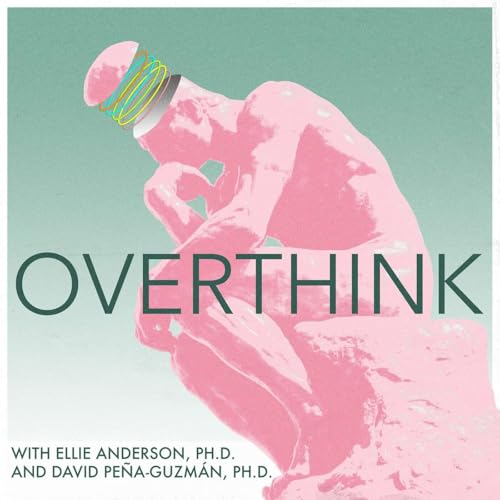
Overthink Podcast Por Ellie Anderson Ph.D. and David Peña-Guzmán Ph.D. arte de portada

Overthink

Overthink

De: Ellie Anderson Ph.D. and David Peña-Guzmán Ph.D.
Escúchala gratis

The best of all possible podcasts, Leibniz would say. Putting big ideas in dialogue with the everyday, Overthink offers accessible and fresh takes on philosophy from enthusiastic experts.

Hosted by professors Ellie Anderson (Pomona College) and David M. Peña-Guzmán (San Francisco State University).

© © 2025 Overthink 149604
Ciencias Sociales Filosofía
Episodios
  • Closer Look: Epicurus Reader
    Feb 10 2026

    What does it mean to say that the good life is a life of pleasure? Although you might think of champagne and caviar, Hellenistic philosopher Epicurus actually considered the good life to be more about appreciating the simple things in life and letting go of the things that bring us only temporary pleasure but lead to pain in the long run. Why has Epicureanism so often been misrepresented, and what did Epicurus really say? In episode 160 of Overthink, Ellie and David investigate the teachings of Epicurus in The Epicurus Reader. They explain his four-part cure on how to life a better life, including why we shouldn't be worried about death. They also offer critiques on his view of justice and its lack of application to political life. How can attaining ataraxia lead us to achieving eudaimonia and living the good life? In the Substack bonus segment, your hosts elaborate on whether or not Epicurus’s argument that we should not fear death is convincing.

    Works Discussed:

    Brad Inwood and Lloyd P. Gerson, The Epicurus Reader: Selected Writings and Testimonia

    See Privacy Policy at https://art19.com/privacy and California Privacy Notice at https://art19.com/privacy#do-not-sell-my-info.

    Más Menos
    58 m
  • Illness
    Feb 3 2026

    What does it mean to be ill? In episode 159 of Overthink, Ellie and David discuss illness. They explore how illness has been mythologized, how it may alienate us from our bodies, and how it impacts social relationships. Is science the solution to the mythologization of illness, or is the scientific model of illness its own form of mythology? How should we conceptualize illness? Is it as a “deviation” from a norm? And if so, what norm? Finally, what can we learn about illness from a phenomenological approach that centers the patient’s first-person experience? In the Substack bonus segment, your hosts think about the distinction between the mental and the physical in connection to illness and the intersection between mind and body in illness.

    Works Discussed:

    Georges Canguilhem, The Normal and the Pathological

    Havi Carel, Illness:  The Cry of the Flesh,

    Susan Sontag, Illness as Metaphor

    SK Toombs, The Meaning of Illness: A Phenomenological Account of the Different Perspectives of Physician and Patient


    Enjoy our work? Support Overthink via tax-deductible donation: https://www.givecampus.com/fj0w3v

    Join our Substack for ad-free versions of both audio and video episodes, extended episodes, exclusive live chats, and more: https://overthinkpod.substack.com/

    See Privacy Policy at https://art19.com/privacy and California Privacy Notice at https://art19.com/privacy#do-not-sell-my-info.

    Más Menos
    57 m
  • Talking Politics with Sarah Stein Lubrano
    Jan 27 2026

    Why does talking about politics so often feel useless? In episode 158 of Overthink, Ellie and David speak with Sarah Stein Lubrano, author of Don’t Talk About Politics: How to Change 21st-Century Minds, about why discourse is not the solution to political polarization. They discuss the problems with thinking about political opinions as a "marketplace of ideas," why public debates don't change our political views as much as personal relationships, and how social atrophy weakens citizenship. What is the value of political protests? How does the ideal of debate perpetuate politics as war? And should we re-imagine social media platforms like X to encourage productive dialogue, or log off of them completely? In the Substack bonus segment, your hosts dive deeper into the politics of digital spaces and question where podcasting fits into Lubrano’s critique of how we discuss politics.

    Works Discussed:

    Sarah Stein Lubrano, Don't Talk About Politics: How to Change 21st-Century Minds

    See Privacy Policy at https://art19.com/privacy and California Privacy Notice at https://art19.com/privacy#do-not-sell-my-info.

    Más Menos
    54 m
Todas las estrellas
Más relevante
fun and interesting podcast. They move from everyday social issues to philosophical analyses. The don't dumb down the philosophy too much, but also make it possible for non-specialsts.

fun and clever podcast

Se ha producido un error. Vuelve a intentarlo dentro de unos minutos.