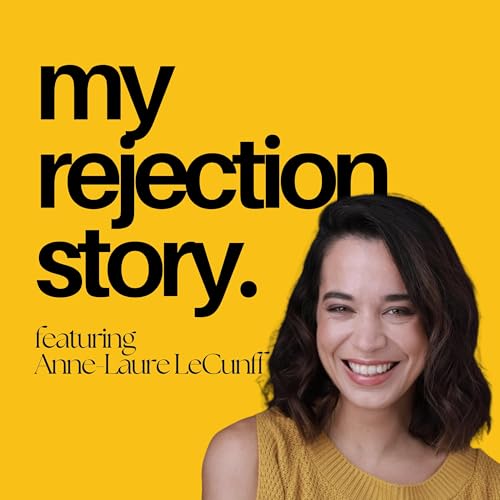
My Rejection Story Podcast Por Alice Draper arte de portada

My Rejection Story

My Rejection Story

De: Alice Draper
Escúchala gratis

In exclusive interviews, bestselling authors like Tina Wells, Kristen Butler, Jason VanRuler, and Neil Patel share how they navigated the toughest periods of their personal and professional lives, and how this shaped the success they now experience today. Studies show that the stories we tell ourselves about rejection influence whether these failures fuel our ambition and propel us forward, or stifle our growth and hold us back. If your rejection story is holding you back, it is time for a reframe.Alice Draper Arte Historia y Crítica Literaria
Episodios
  • Anne-Laure LeCunff: Overcoming Negativity Bias Through Tiny Experiments
    Mar 18 2026

    Why does one rejection have the power to override dozens of wins? Why does your brain cling to the time you were told you're not good enough — and quietly use that story to limit what you try next?

    In this episode of My Rejection Story, Alice is joined by Anne-Laure Le Cunff (neuroscientist and author of Tiny Experiments) to explore how the negativity bias shapes our response to rejection, why the brain's survival wiring keeps us playing small, and how tiny experiments can help us break free.

    Anne-Laure explains the neuroscience behind brain negativity bias: your brain records negative experiences with far more weight than positive ones because in ancestral environments, rejection meant being cast out of the group, which meant death. This negative bias psychology made sense for survival, but in modern life the negativity bias quietly convinces us that raising our hand or trying something new is a threat worth avoiding. She also introduces the self-consistency fallacy — the belief that because you've always been a certain way, you must continue that way. This negative cognitive bias narrows possibility and keeps us stuck.

    If you've seen Anne-Laure Le Cunff's TED talk or her Anne-Laure Le Cunff Big Think appearance, you'll recognize the themes — but this conversation goes deeper into the personal fear behind the framework. Anne-Laure shares her own story of leaving Google after a health scare, launching a startup for the wrong reasons, and finding liberation when it failed. That failure became the catalyst for everything that followed, including Tiny Experiments by Anne-Laure Le Cunff.

    Together they explore how to stop negativity bias from running your life — not through willpower, but through curiosity-driven experimentation and metacognition. They discuss why big goals often backfire, why tracking metrics without tracking how you feel is a trap, and how negative attribution bias causes us to internalize rejection as proof of unworthiness rather than information. Anne-Laure Le Cunff's tiny experiments framework offers an alternative: small, time-bound actions evaluated through honest reflection on both external results and internal experience. This is overcoming negativity bias not by fighting your brain, but by giving it new data.

    In this episode they explore:


    • How the negativity bias developed as a survival mechanism and why it backfires today
    • The self-consistency fallacy and how past rejection becomes a limiting identity story
    • Why you cannot rationalize your way out of fear and what actually works
    • The neuroscience of exposure therapy and rewiring brain negativity bias
    • Anne-Laure's journey from Google to burnout to building Ness Labs
    • Why big goals trigger the arrival fallacy and social comparison
    • How metacognition makes experiments meaningful
    • Intentional imperfection and communicating your limits to prevent burnout
    • The difference between toxic productivity and mindful productivity
    • This episode is an invitation to stop letting the negativity bias write your story. Your brain's job is to keep you safe — your job is to decide whether safe is enough.

    Connect with Anne-Laure Le Cunff

    Website: nesslabs.com

    Instagram: @neuranne

    Book: Tiny Experiments, https://www.amazon.ae/Tiny-Experiments-Freely-Goal-Obsessed-World/dp/0593715136

    Chapters

    00:00 The Self-Consistency Fallacy and How Rejection Shapes Identity

    02:10 The Negativity Bias and Why Your Brain Overweights Rejection

    05:25 Why Rational Thinking Cannot Override Fear

    07:57 Exposure Therapy and Rewiring the Brain

    09:33 Leaving Google and a Life-Threatening Health Scare

    13:46 How the Brain Handles Uncertainty

    17:52 When Failure Becomes Liberation

    22:02 Tiny Experiments as a Tool for Rebuilding Agency

    29:35 Metacognition and Reflecting on What Actually Worked

    34:59 Anne-Laure's Own Tiny Experiments

    41:45 Intentional Imperfection and Overcoming Burnout

    46:11 Mindful Productivity Over Toxic Productivity

    Más Menos
    48 m
  • How Abandonment Issues Can Contribute to Fear of Rejection, with Dr. Carol Chu-Peralto
    Feb 18 2026

    Why does rejection sometimes feel bigger than the moment itself? Why can a missed text, a declined invitation, or a breakup trigger something that feels far older and deeper than the situation at hand?

    In this episode of My Rejection Story, Alice is joined by Dr. Carol Chu-Peralta, clinical psychologist and trauma specialist, to explore the powerful link between rejection and abandonment. Together, they unpack what rejection abandonment really means, how early caregiver dynamics shape our fear of rejection and abandonment, and why abandonment wounds can amplify even small relational disappointments.

    Dr. Carol explains the key difference between rejection and abandonment: rejection is often situational and time-limited, while abandonment tends to be chronic, relational, and rooted in early attachment experiences. When someone carries rejection abandonment issues from childhood, everyday rejection can feel like proof of being fundamentally unworthy. What might objectively be a mismatch can subjectively register as rejection abandonment betrayal injustice trauma.

    Throughout the conversation, they explore how fear of rejection abandonment issues can develop into anxiety rejection abandonment patterns in adulthood—such as overanalyzing relationships, keeping people at arm’s length, or rejecting others first to avoid being left.

    They also dive into healing: how to pause before spiraling, how to differentiate between intuition and trauma response, and how gradual exposure, community, and movement can support overcoming rejection and abandonment. Rather than offering quick fixes, this episode offers grounded, practical insight into rejection sensitivity and abandonment—and what it takes to build resilience without shaming yourself.

    If you’ve ever wondered what does rejection abandonment mean in real life, why feelings of abandonment and rejection can feel existential, or how rejection and abandonment trauma shape your relationships today, this conversation will help you understand your patterns with more clarity and compassion.

    In this episode, they explore:

    • The psychological difference between rejection and abandonment—and why it matters

    • How fear of rejection and abandonment often stems from early caregiver dynamics

    • Why people with rejection abandonment issues may personalize neutral events

    • The link between rejection sensitivity and abandonment trauma

    • How anxiety around rejection abandonment shows up in adult relationships

    • How to pause, label, and reframe negative self-talk loops

    • How to tell the difference between red flags and trauma-triggered fear

    • Why gradual exposure (not extreme “rejection challenges”) builds real resilience

    • The role of community in healing rejection and abandonment trauma

    • How bilateral movement and somatic work support trauma processing

    This episode is an invitation to see your fear of rejection abandonment not as weakness, but as an adaptive response that once kept you safe. Healing isn’t about eliminating vulnerability—it’s about building capacity to stay present when connection feels risky.

    Connect with Dr. Carol Chu-Peralta:

    Website: www.centerforresiliency.com
    Instagram: https://www.instagram.com/centerforresiliencynj/


    Chapters

    00:00 What Does Rejection Abandonment Mean?
    03:00 The Difference Between Rejection and Abandonment
    07:00 How Abandonment Trauma Fuels Fear of Rejection
    12:00 Anxiety Rejection Abandonment in Adult Relationships
    18:00 Why Rejection Can Feel Like Betrayal or Injustice
    24:00 Pausing Before You Personalize
    31:00 Intuition or Trauma Response? How to Tell the Difference
    39:00 Exposure Therapy and Building Rejection Resilience
    47:00 Loneliness, Isolation, and the Fear of Being Seen
    53:00 Movement, Bilateral Processing, and Healing Trauma
    01:00:00 Final Thoughts: Overcoming Rejection and Abandonment Without Shaming Yourself

    Más Menos
    57 m
  • Listener Favorite: Guy Winch on How to Heal From Romantic Rejection
    Feb 11 2026

    Why does heartbreak hurt so much? According to psychologist and bestselling author Guy Winch, it’s not just emotional—it’s biological. Heartbreak hijacks your brain like an addiction, making it one of the most painful experiences a person can endure. In this episode, Guy breaks down the science of heartbreak, the biggest mistakes people make when trying to move on, and why heartbreak needs a mourning ritual—just like grief. If you’ve ever struggled to let go, this episode is for you.

    Website:

    ⁠https://www.guywinch.com⁠

    Guy’s TED Talks:

    ⁠https://www.ted.com/speakers/guy_winch⁠

    Guy’s Books:

    📕How to Fix a Broken Heart

    ⁠https://www.amazon.com/dp/1501120123⁠

    📕Emotional First Aid: Healing Rejection, Guilt, Failure, and Other Everyday Hurts

    ⁠https://www.amazon.com/dp/0142181072⁠

    📕The Squeaky Wheel: Complaining the Right Way to Get Results, Improve Your Relationships, and Enhance Self-Esteem

    ⁠https://www.amazon.com/The-Squeaky-Wheel-Guy-Winch-Ph-D-audiobook/dp/B004INR2VU/⁠

    Listen to Guy’s PodcastDear Therapists:

    ⁠https://podcasts.apple.com/us/podcast/dear-therapists-with-lori-gottlieb-and-guy-winch/id1523340696⁠

    Chapters:

    00:00 Introduction to Guy Winch

    03:32 Heartbreak as the Ultimate Rejection

    09:45 Why Heartbreak Feels Like Drug Withdrawal

    14:20 The Science Behind Rejection and Emotional Pain

    19:05 The Mistakes People Make When Healing from Heartbreak

    24:40 Why Social Media Stalking Makes It Worse

    30:15 The Importance of a Mourning Ritual for Heartbreak

    37:00 How to Stop Idealizing Your Ex

    42:18 Replacement Strategies—The Healthy Way to Move On

    48:30 Rebuilding Rejection Resilience and Dating Again

    🎧 Listen to the full episode to learn how to heal a broken heart and move forward with resilience!


    Más Menos
    50 m
Todavía no hay opiniones