Episodios

  • Integrating Injury Rehabilitation with Performance Data Outcomes
    Mar 27 2026
    Carlos del Barrio is a Physical Therapist with further training in Strength & Conditioning and Sports Science. He has a strong interest in Sports Science & performance by integrating injury rehabilitation to performance outcomes. Topics: Carlos’ background as a PT and the reasons for adding the S&C and sports science credentials to his education. What is force application (RFD) and why is it important in rehab? How you might coach for RFD and how you can use technology for more clarity of information. What is power and velocity-based training and how it is different to RFD. Methods to training for power in the gym and on the pitch. What is reactivity and why is it important? The ‘go to’ test for reactive strength index (RSI) What to look for with the numbers, yet sometimes more importantly, the force trace. Change of direction profiling Grading deceleration demands. Vertical and horizontal-based velocity training & analysis. https://www.youtube.com/watch?v=kbpm220Ec40 References Chris Bramah - SMAShttps://pmc.ncbi.nlm.nih.gov/articles/PMC11064464/ Dylan Harper: Assessment of Deceleration https://www.researchgate.net/publication/398047566_Assessing_Deceleration_Performance_Methodological_and_Practical_Considerations_Assessing_Deceleration_PerformanceD_J_Harper_et_al
    Más Menos
    Menos de 1 minuto
  • Career Series: The Transition out of High Performance Sport
    Mar 6 2026
    We chat with: Fearghal Kerin - Consultant Physiotherapist @ Kerin Performance Kathleen Sakadjian - Sports Physiotherapist AFL Rohan Hattotuwa - Sports Physiotherapist AFL We talk to: The decision to leave working in HP Sports. Determining your value in your role and organization Was the role fulfilling one's original expectations? How to prepare for the transition. What are some hidden costs of working in HP sport? What advice would you pass on to your younger self? What skills, connections, or experiences can clinicians in HP Sport leverage? What are the fears about leaving a role in HP Sport? What clinicians miss from working in HP Sport https://www.youtube.com/watch?v=BkANFOzG4Vs
    Más Menos
    Menos de 1 minuto
  • Career Series: Female Clinicians in High Performance Sport
    Feb 26 2026
    We chat with: Stefanio Rizzo: NBA Physical Therapist Lauren Hanna: Sports Physiotherapist (AFL & Matildas) Sallie Cowan: Associate Professor, University of Melbourne We talk to: How did our guests land their first role within professional sport? How gender or sexual orientation can impact opportunities in high-performance sport Does having fewer women in the HP system currently limit future women entering it? What can early-career women do if they want to improve thier networks for future opportunities? Why the research shows female clinicians are more likely to work with women, rather than male athletes. How can mixed-gender staffing be improved? Gender harassment in sport. What does this look like? How can organisations better support female clinicians around pregnancy & caring responsibilities (and their partners)? One thing you would do to improve conditions for female clinicians, what would it be? https://www.youtube.com/watch?v=jwbLR5yGnkY References You have to work twice as hard as a woman to show that you are competent. Experiences, opportunities and workplace gender harassment for Sport and Exercise Medicine practitioners working in elite sport in Australia. Sallie M Cowan, Michael Girdwood, Melissa Haberfield, Andrea Britt Mosler, Andrea M Bruder, Kate Mahony, Kirsty Forsdike, Nicola McNeil, Kate A Beerworth, Miranda Menaspa, Phillipa Inge, Sue White, Rachel Harris, Adam Castricum, Kay M Crossley VIEW Article Women navigating the sports therapy playing field Lauren Hanna VIEW Article
    Más Menos
    Menos de 1 minuto
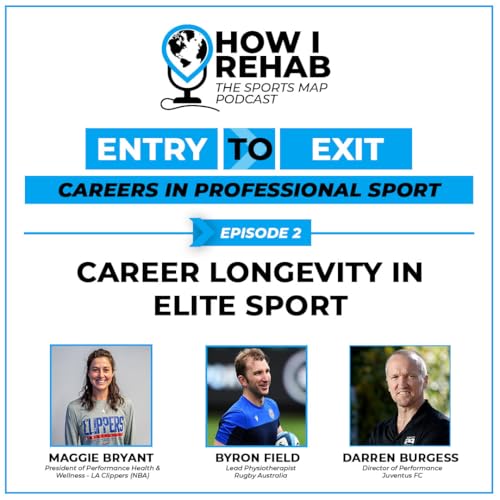
  • Career Series: Career Longevity in Elite Sport
    Feb 19 2026
    How to last a long time in Professional Sport? What does it take? What are the sacrifices? What are the rewards? Are you looking for career longevity working in Sport? Hear from our esteemed guests who are very open and share their learnings, vulnerabilities and experiences to help clinicians navigate their own career journey. A big thanks to our guests for joining us: Maggie Bryant: President for Performance Health & Wellness at the LA Clippers (NBA) Darren Burgess: Director of Performance at Juventus FC Byron Field: Head Physiotherapist at the Australian Wallabies Rugby https://www.youtube.com/watch?v=wANSLun0N8s
    Más Menos
    Menos de 1 minuto
  • Career Series: How to Get a Job in High Performance Sport
    Feb 11 2026
    In this first episode of our 4-part series, we get some great insights into how to get a job in High Performance Sport from our experts. Paula Peralta - Head of Medical Australian Opals Chris Bell - Head of Medical Western Bulldogs (AFL) David Clancy - Recruitment - Nxt Level Group https://www.youtube.com/watch?v=PvSn43hFBsY
    Más Menos
    Menos de 1 minuto
  • Clinical Cases: Hamstring Tendinopathy in a Female Hockey Athlete
    Jan 30 2026
    Aidan is an APA Sports and Exercise Physiotherapist with over 18 years’ experience working with sports medicine conditions. Aidan is a current PhD candidate (Physiotherapy for proximal hamstring tendinopathy). Aidan has a strong interest in endurance sports as a He lectures at Australian Physiotherapy Association courses and convenes the education program for Lifecare in Victoria. We chat extensively with Aidan about: Insights into Rich’s PhD on proximal hamstring tendinopathy (PHT) Case presentation Differential Diagnosis Contributing factors Education & psychological screening The use of Shockwave for PHT Early loading for PHT Where and why do isometrics fit? Balancing strength loading for both in-season and off-season management. Isotonic loading parameters How much influence do we put on the patient's pain rating (VAS) Counter augments to the ‘compression theory for tendons Addressing the kinetic chain Return to stretch-shorten cycle exercises. Graded return to sports participation Ongoing ‘prevention’ of PHT after a Return to sport. https://youtu.be/bx6oxwhVPb0 Additional References Treatment of Proximal Hamstring Tendinopathy with Individualized Physiotherapy: A Clinical Commentary Education, rapport and convenience are key to participants’ perceptions of receiving physiotherapy or shockwave for proximal hamstring tendinopathy: a qualitative study Physiotherapy Compared With Shockwave Therapy for the Treatment of Proximal Hamstring Tendinopathy: A Randomized Controlled Trial
    Más Menos
    Menos de 1 minuto
  • The Female Athlete Reducing the Injury Risk
    Dec 17 2025
    Mel Haberfield and Brooke Patterson are leading sports physiotherapists with expertise at the intersection of elite performance and cutting-edge research. Mel has worked extensively in elite sport across basketball, gymnastics, and the AFL, and is currently completing a PhD focused on knee injuries in athletes. Her work bridges high-performance sport and evidence-based injury prevention and rehabilitation. Brooke is an Australian Research Council Early Career Industry Research Fellow whose research is shaping the future of knee injury and concussion prevention in women’s Australian Football. Her PhD examined the long-term impact of ACL reconstruction on young adults, including early osteoarthritis, symptoms, and quality of life. A former elite Australian footballer and semi-professional basketball player, Brooke also brings firsthand experience as an elite-level coach, giving her a unique athlete-to-clinician perspective. In this episode of the How I Rehab podcast, Mel and Brooke share their initial motivation in dedicating their careers to improving female athlete health. As well as discussing: Gender bias in elite sport and actionable changes that are required to improve this moving forward. How clinicians can implement the Prep-to-Play program at a community and sub-elite level. What do women want when it comes to their knee health? What did the FAIR consensus tell us about modifiable risk factors for injury? Key considerations for female athlete rehabilitation post ACL Injury - the 7 key clusters. The TRAIL-W - Knee health, and associations with female-specific health, physical, psychological, and social-gendered factors in women runners. https://youtu.be/uFnVsz_ezAg Additional References Injury prevention for women and girls playing Australian Football: programme cocreation, dissemination and early adopter coach feedback. What Do Women (With Serious Knee Injury) Want to Know About Knee Health? Identifying Research Priorities with a Consumer Advisory Group Considerations for a women’s rehabilitation programme following anterior cruciate ligament reconstruction: a concept mapping approach to enhance women’s outcomes. Modifiable risk factors for lower-extremity injury: a systematic review and meta-analysis for the Female, woman and/or girl Athlete Injury prevention (FAIR) consensus Patterson et al (2024). Injury prevention for women and girls playing Australian Football: programme cocreation, dissemination and early adopter coach feedback. Patterson et al (2022). Evaluation of an injury prevention programme (Prep-to-Play) in women and girls playing Australian Football: design of a pragmatic, type III, hybrid implementation-effectiveness, stepped-wedge, cluster RCT. BMJ Open, 12(9), e062483 Prep to Play program resources
    Más Menos
    Menos de 1 minuto
  • Scaphoid Fractures, TFCC & Scapholunate Injuries in Combat Sports
    Dec 9 2025
    Ian Gatt is a highly experienced sports physiotherapist with over 25 years in elite performance environments. He spent a significant portion of his career leading the multidisciplinary services for the Great Britain Boxing Programme, supporting athletes through major international events, including multiple Olympic and Commonwealth Games. Ian is recognised as an Upper Limb Injury Specialist with the UK Sports Institute (UKSI), where he provides expert advisory support to Olympic and Paralympic sports. Ian is the current head of physiotherapy at Inspire Institute of Sport We explore three of the most common combat sport wrist injuries and expand on some of the key management principles, including: TFCC Injuries The Palmer Classification for TFCC injuries Why the location of the injury matters How diagnosis and function provide you with prognostic indicators When surgery may be indicated Scaphoid fractures and the importance of not missing them in your assessment. The importance of the site of fracture (Proximal, waist or distal) Preferred imaging modality When to refer for orthopaedic input Scapholunate ligament injuries & instability How to assess for and manage optimally Key tools to be objective during a rehab process. Strength training around the wrist https://youtu.be/6sqhoawyrbo
    Más Menos
    Menos de 1 minuto