Episodios

  • The Night School with St. Francis de Sales (1567-1622)
    Mar 17 2026

    DESCRIPTION: TNS 18, 3 - St. Francis de Sales (1567-1622) on 17 March 2026


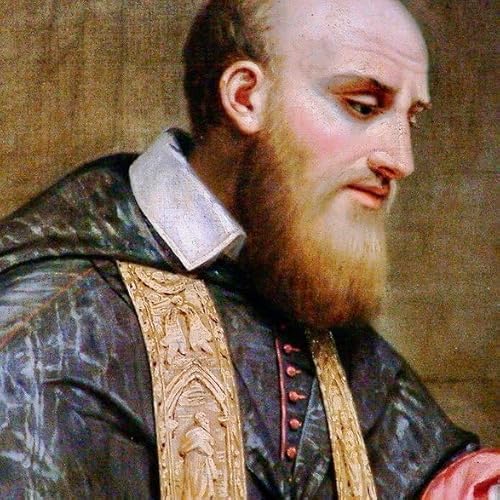
    Our Guest in this Part III of The Night School, Series 18, is one of the giants in the art of Spiritual Direction. He sought to heal the Church’s obvious ills in an Age when it was tearing itself apart, from within.


    Unlike those reformers who moved to attack vigorously the words and works of the Church’s (internal) “enemies”, St. Francis de Sales followed another Path. His way earned him the highest designation the Church can bestow on any person - being proclaimed a “Doctor of the Church” in 1877 (only 38 of them exist in the whole history of the Church).


    St. Francis was convinced that the source of the Church’s difficulties came from the “learned” Church (of which he was one), who having never fully understood the love of God, and as a result had never paid the price of becoming as loving as God is towards others, distorted the teaching of God, fomenting division and enmity within the Church.


    The internal battles became about “taking sides”, about despising one’s intellectual enemies, and even becoming murderous when dealing with them. And these distortions in the intellect quickly became calamity in the social dimensions of the Church.


    St. Francis, who interestingly had to suffer a fierce temper for much of his life, is remembered for the kindness and gentleness that “breathes” through all he spoke and wrote. He was beloved and a source of unity and patience and forbearance - a credible, costly example of divine love, demonstrating what that looks like in a person and to what effects. He wrote: “True devotion does better still. It not only does no injury to one’s vocation [by which he means primarily the “lay” vocation], but on the contrary adorns and beautifies it.” And, “In short, devotion is simply that spiritual agility and vivacity by which charity [divine love active in a cooperating human being] works in us or by aid of which we do good works quickly and lovingly.”


    Welcome to The Night School.


    Más Menos
    1 h y 31 m
  • The Night School with St. Bede the Venerable (672-735 CE)
    Feb 17 2026

    DESCRIPTION - TNS 18, 2 - St. Bede the Venerable (672-735 CE), Doctor of the Church - on the (biblical text) Song of Songs - Love as Learning


    Our Guest has been understood to have been the most learned of the Anglo-Saxon Christians. The particular Form of love that we will notice in him is his love expressed in his devotion to learning of God and of the world that God has given us.


    The age of the Anglo-Saxons extends from the time when the Romans lost control of Britain around 410 CE up to 1066 CE when the Normans invaded Britain. The Anglo-Saxons (the Angles, the Saxons, and the Jutes - invaders from modern day Germany, Denmark, and the Netherlands) were the original “English” peoples (vs. the Britons who were far older, Celtic, inhabitants of Britain), and the type of English that they spoke and wrote was what we call “Old English”.


    Bede was only 7-years old when he entered a monastery (Benedictine), spending the rest of his life there. Mostly teaching himself by his voracious reading, he had what was clearly a divine desire (what we call a “charism”) to love God through learning. And because God is lord of all, so Bede became through extraordinary effort a polymath; i.e., he became an accomplished student of many disciplines, not just the Bible and all the ways of reading it, not just of Theology, but also, and most famously, of History, and more specifically, his writing of the history of how the Anglo-Saxons came to become Christians. His Ecclesiastical History of the English [i.e., Anglo-Saxon] People is a founding document of the whole discipline of History.


    Last month at The Night School, our Guest was the author of the biblical book, Song of Songs. This month, we will appreciate how Bede’s love for learning gave him the insights he had into Song of Songs. We will explore sections of his Commentary on Song of Songs.


    Welcome to the Night School.


    Más Menos
    1 h y 32 m
  • The Night School with the Author of Song of Songs
    Jan 20 2026

    DESCRIPTION: TNS 18, 1 (Tuesday, 20 January 2026) - the Author (s) of the Song of Songs (late 4th to early 2nd centuries BCE) - Love as Eros (Erotic)


    I am aware of no biblical book that has received the attention of so many of the greatest minds and mystics, Jewish and Christian, in history than this biblical book. “If all the [biblical] writings are holy,” Rabbi Akiva proclaimed in a discussion of the Song’s canonicity, “the Song of Songs is holy of holies.” And the magnificent Spiritual Canticle of St. John of the Cross (1542-1591) is clearly a nod to this great biblical text. Robert Alter (born 1935), a Professor of Hebrew at the University of California at Berkeley and a renowned translator of the whole Old Testament puts it this way:


    "But even against that background, the Song of Songs stands out in its striking distinctiveness—a distinctiveness that deserves to be called wondrous. The delicate yet frank sensuality of this celebration of young love, without reference to God or covenant or Torah, has lost nothing of its immediate freshness over the centuries: these are among the most beautiful love poems that have come down to us from the whole ancient world."


    Welcome to The Night School.

    Más Menos
    1 h y 32 m
  • The Night School with St. John Henry Newman (1801-1890)
    Nov 11 2025

    The third of our “Johns” of Series 17 is only the second native-born Englishman since the 8th century to be raised by the Church to the status of Doctor of the Church.


    It is because of this remarkable man, and what was done by Pope Leo XIV on 1 November 2025 in Rome, that I designed Series 17 to include these three Johns: John the Evangelist, John Chrysostom, and John Henry Newman.


    It is one thing to be a profound thinker, even a holy thinker of the great Mysteries of God and God’s way with human beings. John Henry Newman was that. But it is quite another capacity for that same person to be able to stay in close to the way human beings actually are - Pope Francis spoke of pastors being “close enough to the sheep to take on their smell” - rather than as they ought to be. John Henry Newman was this also. There is a beautiful, articulate humanity that comes through in John’s writings.


    In order to get a sense of this about John, I have chosen to concentrate attention on his justly revered Parochial and Plain Sermons (eight volumes of them), paying close attention to perhaps four of those sermons.


    Welcome to the conclusion of Series 17 of The Night School.

    Más Menos
    1 h y 33 m
  • The Night School with St. John Chrysostom (c 347-407 CE)
    Oct 14 2025

    Our second John of Series 17 has been better known, and profoundly revered, in the eastern half of Christianity than in its western (Roman) half, though both halves esteem his life of holiness and brilliance as a pastor and speaker and writer, designating him a Doctor of the Church. He was so designated in the year 1568 with three other giants of holiness and intellect: St. Basil the Great (239-379 CE) St. Gregory of Nazianzus (330-390 CE) St. Thomas Aquinas, OP (1225-1274)


    About St. John Chrysostom we find remarks such as: “But at the center of his being is a dynamic and courageous faith that deserves to be praised. And feared. The fact is, John’s life and preaching not only inspire, they also convict. There was a fire in John’s gut; he loved Jesus Christ and had little patience with Christians who did not lay every ounce of body, mind, and soul at Jesus’ feet. As much as I’m drawn by his spiritual fire, I have to admit, I’m hesitant to get too close lest I get singed.” (Mark Galli in 1994) And in the learned Oxford Dictionary of the Christian Church, 4th edition: “He is, furthermore, among the fathers of the church, the one who has best understood the difficulties, the trials of an authentically lived Christian life, whether in the monastery or in the world. His apostolic activity took place in the middle of a society which was not at all in harmony with the demands of Christianity. Despite everything, his message, with its charge of love for God and of love for people, has reached even us today in light of its gospel message.”(Malingrey & Zincone in 2014)


    We will get to know John through a series of seven sermons (388-389CE) that he preached on the biting parable of Jesus recorded in Luke16:19-31 - about a rich man and about a grindingly poor man who cowers at his front door, Lazarus by name. Welcome to the Night School.

    Más Menos
    1 h y 31 m
  • The Night School with St. John the Evangelist (1st century CE)
    Sep 9 2025

    The Night School, Series 17 (September through November 2025) - Three Johns - Wise Ones from East of Us


    The Night School has always been about the “Guests” whom we invite to be with us, people often from the deep past whom we meet in the texts that they left behind when they went to be among our Ancestors.


    Why have we invited “three Johns”; that is, the Evangelist, Chrysostom, and Newman? We chose them upon learning that for the first time in this 21st century, the Catholic Church will elect someone as a Doctor of the Church. Pope Leo XIV had indicated in July 2025, that he would place St. John Henry Newman among these greatest and wisest of Christian teachers. So in celebration of this, we have placed him, in Series 17, with two other Doctors of the Church.


    What is a “Doctor of the Church”?“ A title regularly given since the Middle Ages to certain Christian theologians of outstanding merit and acknowledged saintliness. Originally the Western theologians Gregory the Great, Ambrose, Augustine, and Jerome were held to be the ‘four doctors’ par excellence; but in later times the list has been gradually increased to nearly 40. There are four female doctors, with Teresa of Ávila named first, in 1970.” [Matthew J. Mills, “Doctors of the Church,” in The Oxford Dictionary of the Christian Church, ed. Andrew Louth (Oxford, United Kingdom; New York: Oxford University Press, 2022) 565–566.]

    Más Menos
    1 h y 30 m
  • The Night School with Seneca, Light From Light (4 BCE - 65 CE)
    Apr 8 2025

    The Night School, Series 16 (February through May 2025) - Light from Light


    In the famous Creation account in Genesis 1, it was only on the fourth day of Creation that God created the sun and the moon - the light by which we see the physical world in the day and at night.


    But it was on the first day of Creation that God placed into the inmost fabric of our created world the inner light, giving humans the means to recognize God and the difference between what is good and what is bad (Genesis 1:3-4). In other words, long before the Light of the World was born of Mary, there was the inner light - the mark in all things of the Triune God who created and sustains all things - the light that guides “all who seek God with a sincere heart.”


    What this means is that long before Christ and then Christianity, great-souled human beings in all cultures and ages responded to and served the inner light. They were light from (the divine) Light, and the whole world reveres what they gave to humanity in their exceptionally accomplished lives.


    The four Parts of The Night School, Series 16, will search for the fruitfulness of the inner light in four great souls: Aristotle (384-322 BCE), Cicero (106-43 BCE), Seneca (4 BCE - 65 CE), and, the sole Christian of this group, who knew the Light of the World, the Christ, John Cassian (360-430 CE).


    Welcome to Series 16.

    Más Menos
    1 h y 6 m
  • The Night School with Cicero, Light From Light (106-43 BCE)
    Mar 18 2025

    The Night School, Series 16 (February through May 2025) - Light from Light


    In the famous Creation account in Genesis 1, it was only on the fourth day of Creation that God created the sun and the moon - the light by which we see the physical world in the day and at night.


    But it was on the first day of Creation that God placed into the inmost fabric of our created world the inner light, giving humans the means to recognize God and the difference between what is good and what is bad (Genesis 1:3-4). In other words, long before the Light of the World was born of Mary, there was the inner light - the mark in all things of the Triune God who created and sustains all things - the light that guides “all who seek God with a sincere heart.”


    What this means is that long before Christ and then Christianity, great-souled human beings in all cultures and ages responded to and served the inner light. They were light from (the divine) Light, and the whole world reveres what they gave to humanity in their exceptionally accomplished lives.


    The four Parts of The Night School, Series 16, will search for the fruitfulness of the inner light in four great souls: Aristotle (384-322 BCE), Cicero (106-43 BCE), Seneca (4 BCE - 65 CE), and, the sole Christian of this group, who knew the Light of the World, the Christ, John Cassian (360-430 CE).


    Welcome to Series 16.

    Más Menos
    1 h y 3 m