Faber Institute Podcast Podcast Por Faber Institute arte de portada

Faber Institute Podcast

Faber Institute Podcast

De: Faber Institute
Escúchala gratis

The Faber Institute, founded in Portland, OR in October 2014, is about awakening people as God does it, showing them how to intensify and to sustain inner alertness (the virtues) and training their capacities to recognize and to serve the highest good of persons who find and develop their lives within the natural world (creation) and the human world (society and culture). We train them to become quicker to recognize and to distinguish (discernment) the false modes of being a person, persuading them to choose, and to trust, the long-tested and true paths to becoming fully alive, so that they joyfully accept their responsibilities for the common good of all – becoming “God-like” after the pattern of Jesus Christ.© 2026 Faber Institute Cristianismo Espiritualidad Ministerio y Evangelismo
Episodios
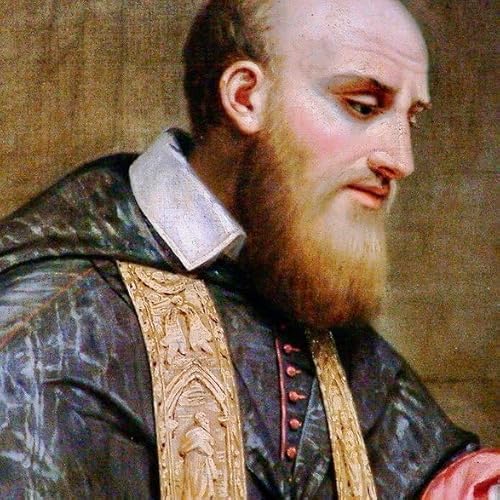
  • The Night School with St. Francis de Sales (1567-1622)
    Mar 17 2026

    DESCRIPTION: TNS 18, 3 - St. Francis de Sales (1567-1622) on 17 March 2026


    Our Guest in this Part III of The Night School, Series 18, is one of the giants in the art of Spiritual Direction. He sought to heal the Church’s obvious ills in an Age when it was tearing itself apart, from within.


    Unlike those reformers who moved to attack vigorously the words and works of the Church’s (internal) “enemies”, St. Francis de Sales followed another Path. His way earned him the highest designation the Church can bestow on any person - being proclaimed a “Doctor of the Church” in 1877 (only 38 of them exist in the whole history of the Church).


    St. Francis was convinced that the source of the Church’s difficulties came from the “learned” Church (of which he was one), who having never fully understood the love of God, and as a result had never paid the price of becoming as loving as God is towards others, distorted the teaching of God, fomenting division and enmity within the Church.


    The internal battles became about “taking sides”, about despising one’s intellectual enemies, and even becoming murderous when dealing with them. And these distortions in the intellect quickly became calamity in the social dimensions of the Church.


    St. Francis, who interestingly had to suffer a fierce temper for much of his life, is remembered for the kindness and gentleness that “breathes” through all he spoke and wrote. He was beloved and a source of unity and patience and forbearance - a credible, costly example of divine love, demonstrating what that looks like in a person and to what effects. He wrote: “True devotion does better still. It not only does no injury to one’s vocation [by which he means primarily the “lay” vocation], but on the contrary adorns and beautifies it.” And, “In short, devotion is simply that spiritual agility and vivacity by which charity [divine love active in a cooperating human being] works in us or by aid of which we do good works quickly and lovingly.”


    Welcome to The Night School.


    Más Menos
    1 h y 31 m
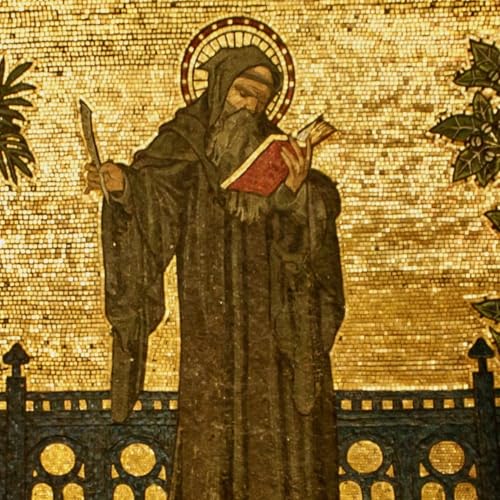
  • The Night School with St. Bede the Venerable (672-735 CE)
    Feb 17 2026

    DESCRIPTION - TNS 18, 2 - St. Bede the Venerable (672-735 CE), Doctor of the Church - on the (biblical text) Song of Songs - Love as Learning


    Our Guest has been understood to have been the most learned of the Anglo-Saxon Christians. The particular Form of love that we will notice in him is his love expressed in his devotion to learning of God and of the world that God has given us.


    The age of the Anglo-Saxons extends from the time when the Romans lost control of Britain around 410 CE up to 1066 CE when the Normans invaded Britain. The Anglo-Saxons (the Angles, the Saxons, and the Jutes - invaders from modern day Germany, Denmark, and the Netherlands) were the original “English” peoples (vs. the Britons who were far older, Celtic, inhabitants of Britain), and the type of English that they spoke and wrote was what we call “Old English”.


    Bede was only 7-years old when he entered a monastery (Benedictine), spending the rest of his life there. Mostly teaching himself by his voracious reading, he had what was clearly a divine desire (what we call a “charism”) to love God through learning. And because God is lord of all, so Bede became through extraordinary effort a polymath; i.e., he became an accomplished student of many disciplines, not just the Bible and all the ways of reading it, not just of Theology, but also, and most famously, of History, and more specifically, his writing of the history of how the Anglo-Saxons came to become Christians. His Ecclesiastical History of the English [i.e., Anglo-Saxon] People is a founding document of the whole discipline of History.


    Last month at The Night School, our Guest was the author of the biblical book, Song of Songs. This month, we will appreciate how Bede’s love for learning gave him the insights he had into Song of Songs. We will explore sections of his Commentary on Song of Songs.


    Welcome to the Night School.


    Más Menos
    1 h y 32 m
  • The Night School with the Author of Song of Songs
    Jan 20 2026

    DESCRIPTION: TNS 18, 1 (Tuesday, 20 January 2026) - the Author (s) of the Song of Songs (late 4th to early 2nd centuries BCE) - Love as Eros (Erotic)


    I am aware of no biblical book that has received the attention of so many of the greatest minds and mystics, Jewish and Christian, in history than this biblical book. “If all the [biblical] writings are holy,” Rabbi Akiva proclaimed in a discussion of the Song’s canonicity, “the Song of Songs is holy of holies.” And the magnificent Spiritual Canticle of St. John of the Cross (1542-1591) is clearly a nod to this great biblical text. Robert Alter (born 1935), a Professor of Hebrew at the University of California at Berkeley and a renowned translator of the whole Old Testament puts it this way:


    "But even against that background, the Song of Songs stands out in its striking distinctiveness—a distinctiveness that deserves to be called wondrous. The delicate yet frank sensuality of this celebration of young love, without reference to God or covenant or Torah, has lost nothing of its immediate freshness over the centuries: these are among the most beautiful love poems that have come down to us from the whole ancient world."


    Welcome to The Night School.

    Más Menos
    1 h y 32 m
Todavía no hay opiniones