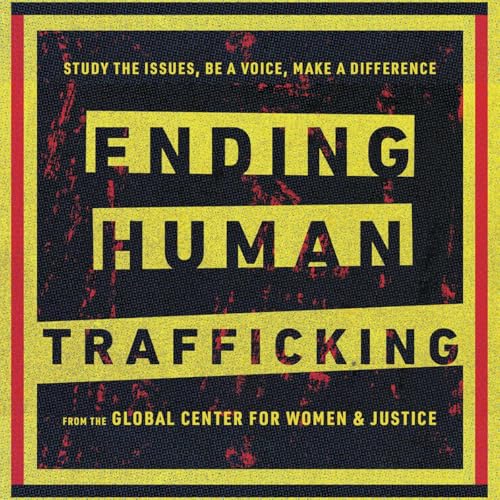
Ending Human Trafficking Podcast Por Dr. Sandra Morgan arte de portada

Ending Human Trafficking

Ending Human Trafficking

De: Dr. Sandra Morgan
Escúchala gratis

The Global Center for Women and Justice launched the Ending Human Trafficking podcast in April 2011. Our mantra is Study the Issues. Be a voice. Make a difference. We believe that if you do not study first, you may say or do the wrong thing. The National Family and Youth Services Clearinghouse promoted EHT as “a good way to get up to speed on human trafficking”. Our audience includes students, community leaders, and even government leaders. EHT listeners come from all corners of the world, which accomplishes our mission of building a global community that works together to end human exploitation.Ending Human Trafficking Cristianismo Economía Espiritualidad Gestión Gestión y Liderazgo Ministerio y Evangelismo
Episodios
  • 368: What If the Trafficker Lives Inside the Home?
    Mar 30 2026

    Zoe Bellatorre joins Dr. Sandie Morgan as they reveal why the most common form of child trafficking never makes the missing persons list — and why the quiet, compliant child sitting in the back of the classroom may be the one hiding the most.


    Chapters


    • (00:00) - Introduction: Why Familial Trafficking Gets Missed
    • (01:07) - Zoe Bellatorre: From Survivor to National Advocate
    • (04:52) - Defining Familial Trafficking and Its Unique Challenges
    • (09:41) - What Teachers and Communities Should Look For
    • (13:12) - Why Children Don't Disclose — and Aren't Believed
    • (15:09) - The Data: Statistics That Reframe the Problem
    • (19:03) - Moving Beyond Stranger Danger: Training Systems to See More
    • (29:23) - Hope for Change: What Every Person Can Do


    Zoe Bellatorre


    Zoe Bellatorre is a survivor advocate, trainer, and speaker with over a decade of experience in the anti-trafficking field, specializing in familial trafficking. She holds a Master's in Intercultural Studies with Children at Risk from Fuller Theological Seminary and a Bachelor of Science in Education from Ashland University. Zoe has served as Coordinator of Outreach with The Avery Center and as a Survivor Advocate with CAST LA and Dignity Health, providing crisis intervention within healthcare systems. A recognized subject matter expert, she has consulted with the Office for Victims of Crime Human Trafficking Collective, the National Human Trafficking Training and Technical Assistance Center (NHTTAC), and the U.S. State Department. Her published contributions include essays in the 2021 and 2023 Trafficking in Persons Reports, the 2024 co-authored work on child trafficking misconceptions, and the anthology Medical Perspectives on Human Trafficking in Adolescents. She serves on the advisory council for the Polaris Project's Resilience Fund and on the board of Ride My Road.


    Key Points


    • Familial trafficking — in which a family member or caregiver is the trafficker or sells the child to a third party — accounts for 60% of child trafficking cases, making it the most common form of exploitation, yet it remains the most overlooked.
    • Unlike pimp-controlled trafficking, children trafficked by family rarely go missing; they may attend school daily, making the conventional "missing child" framework nearly useless for identifying them.
    • The average age of entry into familial trafficking is four years old — years before most prevention education ever reaches a child — which means abuse becomes normalized long before anyone thinks to intervene.
    • Indicators for familial trafficking look very different from other forms: rather than acting out, these children tend to be unusually quiet, compliant, and eager to please adults, driven by fear of any attention being drawn back to the home.
    • Children in familial trafficking rarely disclose, and when they do, they are often not believed — after one or two failed attempts, most simply stop trying, leaving them isolated with the false belief that no one else experiences what they are living through.
    • 35% of familial trafficking cases are generational, meaning the cycle has repeated across mothers, grandmothers, and siblings — making family members who witnessed it less likely to intervene and more likely to look the other way.
    • The "stranger danger" framework has been one of the most damaging concepts in child protection, because it trains communities to look outward for threats while the exploitation happening inside trusted homes, families, and institutions goes unseen.
    • Research shows that a single trusted adult in a child's life significantly increases the likelihood of earlier disclosure or prevention altogether — meaning every person in a community has a concrete role to play, regardless of their profession.


    Resources


    • Ending Human Trafficking Podcast
    • EHT Episode 278 – Identifying and Interacting with Minor Victims of Human Trafficking, with Dr. Jodi Quas
    • EHT Episode 353 – Grooming in Trusted Spaces: A Conversation with Dr. Beth Lorance
    • Trafficking in Persons Report – U.S. Department of State
    • Medical Perspectives on Human Trafficking in Adolescents: A Case-Based Guide
    Más Menos
    38 m
  • 367: Stop Reacting to Events and Start Preparing
    Mar 16 2026

    Ray Bercini and Sara Elander join Dr. Sandie Morgan to explore what's really at stake when a city like Los Angeles hosts the World Cup — and why the biggest trafficking risk might not be what you think.


    Chapters

    • (00:00) - Introduction: What LA's Preparing for and Why It Matters
    • (01:04) - Meet Ray and Sara: Roles at Saving Innocence and the LA Task Force
    • (06:19) - Building a Legacy Committee: Planning for FIFA and Beyond
    • (09:03) - Law Enforcement Readiness: Operations, Agencies, and Coordination
    • (11:50) - Separating Myth from Reality: What the Data Actually Shows About Trafficking and Major Events
    • (16:36) - Preparing for the Surge: Tips, Leads, and Victim Services Coordination
    • (24:18) - Vetting Outside Organizations and Staying in Your Lane
    • (32:37) - What Does Success Look Like After FIFA?


    Ray Bercini and Sara Elander

    Ray Bercini serves as Task Force Coordinator and Law Enforcement Liaison at Saving Innocence. With 31 years at the Los Angeles County Sheriff's Department — including six years dedicated to human trafficking work — Ray brings deep cross-sector expertise to the intersection of law enforcement and victim services. He has been instrumental in building the LA Regional Human Trafficking Task Force into one of the largest co-located task forces in the nation, and has played a key role in preparing Los Angeles for major events including the Super Bowl, FIFA World Cup, and LA28 Olympics.


    Sara Elander is Director of Programs at Saving Innocence and Victim Service Coordinator for the LA Regional Human Trafficking Task Force. With over six years of experience in program management and trauma-informed care, Sara leads a team of crisis case managers and oversees survivor-centered services across LA County. She holds a Bachelor of Arts in Community Advocacy and Social Policy from Arizona State University and is committed to healing-centered approaches that empower survivors toward long-term recovery and stability.


    Key Points

    • The widely repeated claim that major sporting events dramatically spike sex trafficking lacks supporting data — but the absence of proof isn't proof of absence, and LA is launching a research study around FIFA to finally generate real, local data.
    • Labor trafficking is the more evidence-based concern around large-scale events, with exploitation rising sharply in the lead-up to events through construction, hospitality, and vendor supply chains.
    • The LA Regional Human Trafficking Task Force launched a Sports and Major Events Committee with roughly 30 members and six subcommittees, designed as a legacy infrastructure that can serve future events beyond just FIFA.
    • Coordinating tips during a major international event is a complex, unsolved challenge — multiple agencies including FBI, HSI, LAPD, and LASD will all have tip lines, and the team is working to centralize reporting without losing coverage.
    • One of the most important lessons from the 2022 Super Bowl was that outside organizations parachuting in with good intentions — but without coordination — can undermine local trust and misdirect survivors away from local resources.
    • Effective multi-agency collaboration requires every organization to clearly define what they uniquely bring to the table, stay in their lane, and go through a vetting process before engaging in high-stakes response work.
    • Sara's definition of success after FIFA centers on community empowerment — if hospitality workers, transportation staff, and community members leave better equipped to identify and report trafficking indicators, that's a lasting win.
    • Ray's measure of success is straightforward: survivors of all forms of trafficking — sex and labor — are identified, connected to resources, and treated with dignity, which no single agency can accomplish alone.


    Resources

    • Saving Innocence
    • LA Regional Human Trafficking Task Force
    • National Human Trafficking Hotline
    • Compass Connections
    • Blue Campaign
    • LA Regional Crime Stoppers
    • Global Center for Women and Justice
    • Ending Human Trafficking Podcast
    Más Menos
    37 m
  • 366: Why Information Alone Will Never Protect Young People
    Feb 28 2026

    Dr. Nanyamka Redmond joins guest host Ruthi Hanchett as they explore how everyday adults — parents, teachers, coaches, and neighbors — can become a powerful protective factor in young people's lives by building the kinds of relationships that help youth thrive and navigate risk.


    Chapters


    • (00:00) -
    • (00:00) - Introduction: Why Relationships Matter More Than Programs
    • (01:02) - Meet Dr. Nanyamka Redmond and the Search Institute
    • (02:48) - What Are Developmental Assets — and Why Do They Work?
    • (09:27) - Defining Developmental Relationships: The Five Elements
    • (14:57) - How Caring Adults Can Protect At-Risk Youth
    • (20:11) - Building a Culture of Belonging in Schools and Communities
    • (30:13) - Resilience Is Relational: What Adults Need to Hear Right Now
    • (32:35) - Supporting Youth Leadership Without Getting Out of the Way
    • (00:00) - Chapter 10


    Dr. Nanyamka Redmond


    Dr. Nanyamka Redmond is a Research Scientist at the Search Institute, a nationally recognized organization dedicated to advancing research and practical frameworks that help young people thrive. She holds a PhD in Applied Developmental Psychology from Fuller Theological Seminary and a Master's Degree in Clinical Psychology, Marriage and Family Therapy from Azusa Pacific University. Her work focuses on developmental relationships, youth resilience, and advancing equitable, relationship-centered approaches to youth development and wellbeing. Dr. Redmond specializes in translating developmental science into practical tools for educators, families, youth-serving professionals, and community organizations, emphasizing culturally responsive and strengths-based approaches that center young people's lived experiences. She has also served as Director of School Partnership for Character Lab, co-founded by Angela Duckworth, and is a keynote speaker at the Global Center for Women and Justice's Ensure Justice Conference.


    Key Points


    • An anti-trafficking program can teach warning signs, but it cannot replace a caring adult — if a young person doesn't feel seen, safe, and valued, information alone won't protect them.
    • The Search Institute's 40 Developmental Assets framework identifies a combination of internal strengths and external supports that young people need to thrive, and research consistently shows that the more assets a young person has, the better their outcomes.
    • Developmental relationships go beyond good relationships — they are defined by five specific elements (express care, challenge growth, provide support, share power, and expand possibilities) that research has shown to directly impact positive youth outcomes and reduce risk.
    • For youth who have experienced trauma, relationships have often been transactional or harmful, so the experience of someone who cares without strings attached can be surprising — which is why consistency and small, repeated moments of connection matter more than grand gestures.
    • Belonging is not just a buzzword — when adults work to help every young person feel genuinely seen and valued in the spaces meant for them, it builds the sense of dignity that serves as a foundation for resilience.
    • Sharing power with young people doesn't mean abandoning guidance; it means entering those relationships with a frame that sees adolescence as an age of opportunity rather than a period of storm and stress.
    • Resilience is relational — it is not something young people build alone, but something that grows when multiple caring adults across their ecosystem show up consistently over time.
    • Adults who want to support youth leadership can start with incremental steps: invite young people to co-create the questions, let them lead the conversation, and hold the barriers gently without squashing the vision.


    Resources


    • Search Institute
    • The 40 Developmental Assets Framework
    • Global Center for Women and Justice
    • Ending Human Trafficking Podcast
    • Age of Opportunity: Lessons from the New Science of Adolescence by Laurence Steinberg


    Más Menos
    39 m
Todas las estrellas
Más relevante
This podcast began in 2011 and is still going strong! I am listening to the episodes chronologically. If you want to know more, listen to one a day or one a week.

Educating myself on human trafficking...

Se ha producido un error. Vuelve a intentarlo dentro de unos minutos.