Edgy Ideas Podcast By Simon Western cover art

Edgy Ideas

Edgy Ideas

By: Simon Western
Listen for free

Welcome to Edgy Ideas, where we explore what it means to live a ‘good life’ and build the ‘good society’ in our disruptive age.

This podcast explores our human dynamics in today's networked society. Addressing topical themes, we explore how social change, technology and environmental issues impact on how we live, and who we are - personally and collectively. Edgy Ideas podcast aims to re-insert the human spirit, good faith, ethics and beauty back into the picture, offering new perspectives and psycho-social insights. We pay particular attention to how the ‘unconscious that speaks through us’, entrapping us in repetitive patterns and shaping our desires. Each podcast concludes by contemplating what it means to live a ‘good life’ and create the ‘good society’. Enjoy!

Edgy Ideas is sponsored by the Eco-Leadership Institute

A radical think tank and developmental hub for leaders, coaches and change agents.

Join our community of practice and work live with many of our podcast guests

Discover more here: https://ecoleadershipinstitute.org
Contact simon@ecoleadershipinstitute.org

Simon Western
Biographies & Memoirs Economics Hygiene & Healthy Living Management Management & Leadership Social Sciences
Episodes
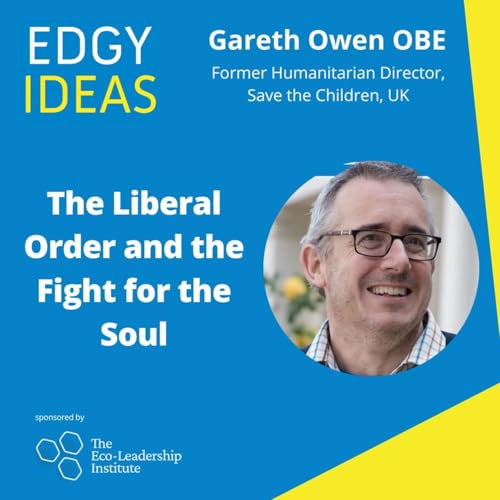
  • 105: The Liberal Order and the Fight for the Soul
    Mar 23 2026

    Show Notes
    In this episode of Edgy Ideas, Simon Western speaks with Gareth Owen OBE, former Humanitarian Director of Save the Children UK, about what it means to practice humanitarianism in a world where the global order is shifting rapidly. Drawing on more than three decades working in conflict zones - from Somalia and Angola to leadership roles shaping global humanitarian response - Gareth reflects on how humanitarian work has evolved. He describes how the aid sector grew alongside the post-Second World War liberal order, and how today that system is fragmenting under geopolitical tensions, rising authoritarianism and declining global cooperation.
    A key theme in the conversation is the growing bureaucratisation of humanitarian institutions. Gareth and Simon explore two key issues. Firstly the widening gap between frontline human suffering and the managerial systems that increasingly govern aid delivery. Secondly the breakdown of the liberal international order and what it means for humanitarian work. The discussion turns to what Gareth calls the potential “loss of the humanitarian soul” - the relational depth, moral courage and human connection that once anchored the sector. Rather than turn to nostalgia for the past, Gareth argues for a renewal grounded in solidarity, human-centred leadership, and new alliances that emerge beyond traditional institutions.
    Ultimately, the conversation asks a simple but demanding question: in an uncertain and fractured world, what are we each willing to stand up for?

    Key Reflections

    • Humanitarianism is not a role or title; it is something learned through deep proximity to suffering.
    • The humanitarian sector has become over-bureaucratised, often distancing itself from the people it claims to serve.
    • The liberal rules-based order is breaking down, and with it the structures that once gave humanitarianism legitimacy and support.
    • Aid institutions are caught between external political collapse and internal managerial systems that drain imagination and moral energy.
    • The loss of reflective space inside organisations weakens their ethical compass and disconnects them from purpose.
    • Humanitarian soul is rooted in relational depth, truth-telling, solidarity, and the willingness to remain open to pain.
    • Real hope does not come from nostalgia for the old order, but from building new alliances, mutuality, and political courage.
    • Change begins with self, but must move outward into communities, ecosystems, and collective action.
    Keywords
    Humanitarianism, liberal order, solidarity, aid sector, bureaucracy, managerialism, soul at work, ecosystems, leadership, mutuality, geopolitics, reflection, trauma, global crisis, moral courage

    Brief Bio

    Gareth Owen is the former Humanitarian Director of Save the Children UK (2007-2024). One of the sector’s most accomplished, influential and creative humanitarian practitioners; a passionate and inspirational leader of global renown; strategic thinker and critical reflector; outstanding communicator, systemic collaborator, team builder, talent developer, fundraiser and champion of change; chief architect of some of the humanitarian system’s most innovative and forward-looking collective initiatives. Over two decades, he crafted and led the growth of Save the Children UK’s humanitarian work and had a defining influence on the global Save the Children movement’s humanitarian renaissance. He built to worldwide pre-eminence a Humanitarian Department of 300 professionals then latterly initiated its consolidation and downsizing to catalyse shifting of power. In parallel, he co-founded and incubated the Humanitarian Leadership Academy, Elrha, the START Network, the Collaborative Cash Delivery Network and The Alameda Institute. A leading contemporary figure in the humanitarian sector, Gareth now offers his wealth of experience as a consultant, coach, author and lecturer.
    Show more Show less
    39 mins
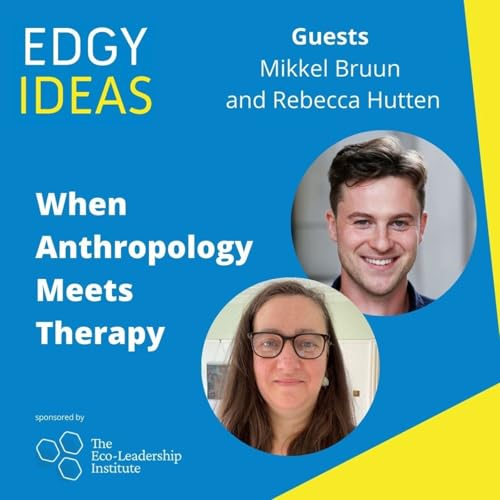
  • 104: When Anthropology meets Therapy
    Feb 20 2026

    Show Notes
    What happens when anthropology turns its gaze on psychology and coaching?
    In this episode, Simon Western is joined by social anthropologist Dr Mikkel Kenni Bruun and social scientist Dr Rebecca Hutten to explore what sits beneath contemporary mental health, therapy, and coaching practices. Together, they discuss culture, power, and the often-invisible assumptions shaping therapeutic work.
    Rather than treating psychology as universal or value-neutral, Mikkel and Rebecca show how it is culturally produced, shaped by specific histories, institutions, and ways of making meaning. From this perspective, therapy and coaching are never neutral; they are embedded in social, political, and moral worlds.
    Ethnography is central to this conversation, not just as a research method, but as a way of listening and staying with complexity. Instead of forcing distress, healing, and care into predefined psychological categories, ethnography attends to how these experiences are actually lived across contexts.
    The discussion also challenges dominant Western ideas of the self. While psychology and coaching often centre the autonomous individual, anthropological perspectives highlight relational and socially embedded selves. This raises urgent questions about what happens when Western therapeutic models travel globally - and what they may erase or misunderstand.
    Cultural competence comes under scrutiny too. Often presented as a solution, it can risk flattening culture into tidy checklists rather than engaging with lived complexity and power. As psychological language increasingly shapes public policy, workplaces, and everyday life, anthropology helps reveal the cultural and political work happening beneath the surface.

    Key Takeaways

    • Psychological and coaching practices are culturally produced, not universal
    • Therapeutic cultures vary across histories, institutions, and contexts
    • Ethnography reveals how mental health is actually lived
    • The individual self is not a universal model
    • Cultural competence can oversimplify difference
    • Psychological practice is fundamentally relational
    • Mental health discourse shapes ideas of the “good life”
    • Anthropology makes the familiar strange - and visible again


    Keywords
    Anthropology, psychology, coaching, mental health, therapeutic culture, ethnography, cultural competence, relationality, self, good life

    Brief Bios
    Dr Mikkel Kenni Bruun is a social anthropologist at the University of Cambridge, Research Associate at the Healthcare Improvement Studies (THIS) Institute, and Affiliated Lecturer in the Department of History and Philosophy of Science. His ethnographic research includes NHS Talking Therapies (IAPT) services and community mental health initiatives in the UK. He is co-editor of Towards an Anthropology of Psychology (2025) and Rhythm and Vigilance (2025).

    Dr Rebecca Hutten is an independent researcher, social scientist, and Associate Lecturer at The Open University. Trained as an anthropologist, she has worked in government policy research and Public Health at the University of Sheffield, and brings extensive fieldwork and clinical experience within NHS psychological services. She is co-editor of Towards an Anthropology of Psychology (2025).

    Show more Show less
    33 mins
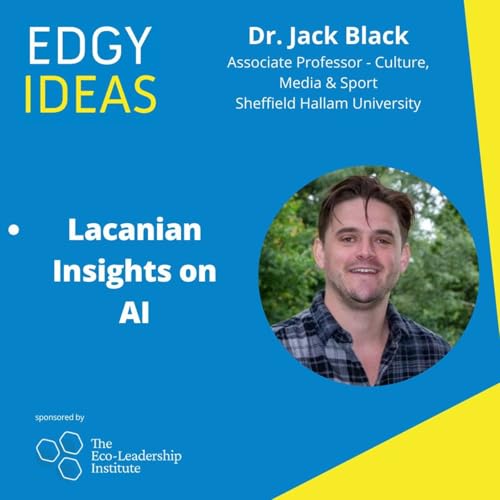
  • 103: Lacanian Insights on AI
    Jan 21 2026

    Show Notes
    In this episode Simon and Dr. Jack Black, Associate Professor at Sheffield Hallam University, think dangerously about AI through the unsettling lens of Lacanian psychoanalysis. This is a conversation about desire, discourse, power and the fantasies we project onto machines.
    Drawing on Lacan, Jack reframes AI not as a neutral tool or intelligent object, but as a relational phenomenon - one that speaks into us, structures us, and increasingly stands in for authority itself. Together, Simon and Jack interrogate how AI comes to occupy the place of the Big Other: the supposed holder of knowledge, truth, and certainty in a fragmented world.
    They explore Lacan’s four discourses, particularly the discourse of the hysteric, as a way of resisting AI’s creeping authority and the ideological narratives that present it as omniscient, objective, or inevitable. AI, they argue, does not know in any human sense - it recombines, repeats, and reflects back our own symbolic order, including its exclusions, biases and violences.
    The conversation moves into education, where AI is rapidly being positioned as a new master signifier. What happens when learning is outsourced to algorithmic systems? What kinds of subjects are being produced? And whose knowledge is being legitimised - or erased - in the process?
    Throughout the episode, AI is revealed as a site where cultural anxiety, political power, and unconscious desire collide. Rather than rejecting technology, Simon and Jack argue for a more critical, psycho-social engagement - one that keeps the human, the relational, and the ethical firmly in view.
    This is a conversation about AI, but it is also about us: our longing for certainty, our fear of lack, and our temptation to hand over authority to machines. Lacan, unexpectedly, offers not despair but hope - a way to stay with complexity and resist the fantasy that technology can save us from being human.

    Key Takeaways

    • Lacanian psychoanalysis offers a radical way to rethink AI beyond hype and fear.
    • AI is relational - it emerges within human discourse, not outside it.
    • The discourse of the hysteric provides a critical stance toward AI as authority.
    • AI does not “know”; it mirrors and amplifies existing symbolic systems.
    • Education must resist uncritical adoption of AI as a master solution.
    • Algorithmic systems reproduce social bias, including racism and exclusion.
    • Technology increasingly objectifies the Big Other.
    • AI exposes deep tensions around desire, knowledge, and power.
    • Ideology sits quietly behind the push to normalise AI everywhere.
    • Lacan helps us stay critical, hopeful, and human in a technological age.

    Keywords
    AI, Lacan, psychoanalysis, discourse, education, culture, technology, relationality, society, human experience

    Brief Bio
    Dr. Jack Black is Associate Professor of Culture, Media, and Sport at Sheffield Hallam University. An interdisciplinary researcher, working across the disciplines of psychoanalysis, media and communications, cultural studies, and sport, his research focuses on topics related to race/racism, digital media, and political ecology. He is the author of The Psychosis of Race: A Lacanian Approach to Racism and Racialization (Routledge, 2023) and co-editor of Sport and Psychoanalysis: What Sport Reveals about Our Unconscious Desires, Fantasies, and Fears (Lexington Books, 2024). He is also Senior Editor for the Journal, Sport and Psychoanalysis (Cogent Social Sciences).

    Show more Show less
    37 mins
No reviews yet