Episodios

  • EP. 32: Satellite Cells and Muscle Growth | Kevin Murach
    Sep 7 2023

    Muscle fibers are cylindrical cells that can contain hundreds of nuclei called myonuclei. On the periphery of these muscle fibers, stem cells, known as satellite cells, lay dormant in a quiescent state during resting conditions. With exercise, these cells can activate, often proliferate and may fuse to muscle fibers. Historically, this fusion of satellite cells has been thought to be to mediate the repair of focal damage to the muscle fiber. Additionally, it has been suggested that a myonucleus, which serves as a control center, can oversee only a finite jurisdiction – called the myonuclear domain. Therefore some researchers have speculated that satellite cells could supply additional nuclei to the muscle fiber during hypertrophy to keep up with the increasing domain. Interestingly, there is a recently growing body of evidence suggesting several non-fusion-related roles satellite cells can play. – Today, Dr. Kevin Murach is here to give us some insight into the interplay of satellite cells and muscle growth!

    .

    .

    .

    _______________________

    Dr. Murach received a Ph.D. in Human Bioenergetics from Ball State University in 2015 and post-doctoral training in muscle stem cell biology at the University of Kentucky Center for Muscle Biology. His research broadly pertains to adult skeletal muscle mass regulation in the context of exercise, aging, and beyond. Currently, he is positioned as an Assistant Professor at the University of Arkansas and serves as the principal investigator/project leader in the Molecular Muscle Mass Regulation Laboratory.


    Kevin's Google Scholar: https://scholar.google.com/citations?user=45UuplEAAAAJ&hl=en


    Kevin’s ResearchGate: https://www.researchgate.net/profile/Kevin-Murach


    Kevin's Twitter: https://twitter.com/KevinMurachPhD


    Kevin's Instagram: https://www.instagram.com/kevinmurachphd/

    .

    .

    .

    .

    .

    SUPPORT US!


    Directly:


    Shop our lecture catalogue: https://coachingcues.gumroad.com/


    Indirectly:


    1. 1. Keep up with the research: https://www.weightology.net/products/traffic.php?id=115
    2. Track your macros (Use the code ”CUES” and you'll get an extended free trial): https://macrofactorapp.com/
    3. Coach your clients: https://mbsy.co/3GShF2
    4. Record a podcast of your own: https://riverside.fm/?utm_campaign=campaign_1&utm_medium=affiliate&utm_source=rewardful&via=velu

    _______________________

    This is the 32nd episode of the #coachingcues podcast! If you want to have your question answered by an expert, please head to www.coachingcues.org/ask

    Más Menos
    18 m
  • EP. 31: Acute and Chronic Effects of Cluster Sets | Timothy Davies
    Mar 17 2023

    Historically, strength training has been prescribed based on set configurations where continuous repetitions are performed followed by inter-set rest periods, ranging from 1 to 5 min in duration. These configurations are referred to in the literature as traditional sets. However, it is unclear if these set configurations provide an optimal or advantageous stimulus compared to other techniques. Consequently, implementing intra-set rest periods, collectively known as cluster sets, is suggested to provide a novel stimulus to optimize resistance training adaptations. But what is the evidence behind using cluster sets for strength and hypertrophy? - Dr. Timothy Davies is here to give us some insight!

    .

    .

    .

    _______________________

    Timothy Davies, PhD, is a Lecturer of Exercise Science at Sydney University. His research interests are in the training methods, biomechanics and physiology behind improving strength, power and hypertrophy, particularly in strength athletes. Currently, his particular focus areas are related to proximity to failure, intended/actual movement velocity, volume and the effective repetitions paradigm.

    Timothy's ResearchGate: https://www.researchgate.net/profile/Timothy-Davies

    .

    .

    .

    .

    .

    SUPPORT US!

    1. Keep up with the research: https://www.weightology.net/products/traffic.php?id=115

    2. Track your macros (Use the code "CUES" ): https://www.strongerbyscience.com/macrofactor/

    3. Coach your clients: https://mbsy.co/3GShF2

    4. Record a podcast of your own: https://riverside.fm/?utm_campaign=campaign_1&utm_medium=affiliate&utm_source=rewardful&via=velu

    _______________________

    This is the 31st episode of the #coachingcues podcast! If you want to have your question answered by an expert, please head to www.coachingcues.org/ask

    Más Menos
    38 m
  • EP. 30: The Nuances of Momentary Failure | James Fisher
    Feb 28 2023

    Momentary failure can be defined as the point trainees reach where despite attempting to do so, they cannot complete the concentric portion of their current repetition without deviation from the prescribed form of the exercise. Instead of momentary "muscular" failure, the term momentary failure is used because there is no current consensus on where the lack of continued ability to carry on with the task despite attempts to do so arises. Confusing terminology, among other things, highlights the limitations of the current research on proximity to failure. - James Fisher, PhD, is here to give us some insight!

    .

    .

    .

    _______________________

    James Fisher completed his BSc (Hons) in Sports Science from the University of Chester, his MSc in Exercise Physiology from Manchester Metropolitan University, and his PhD through Nottingham Trent University. Currently, he works as a senior lecturer at Solent University.


    James's ResearchGate: https://www.researchgate.net/profile/James-Fisher-25

    .

    .

    .

    .

    .

    SUPPORT US!

    1. Keep up with the research: https://www.weightology.net/products/traffic.php?id=115

    2. Track your macros (Use the code "CUES" ): https://www.strongerbyscience.com/macrofactor/

    3. Coach your clients: https://mbsy.co/3GShF2

    4. Record a podcast of your own: https://riverside.fm/?utm_campaign=campaign_1&utm_medium=affiliate&utm_source=rewardful&via=velu

    _______________________

    This is the 30th episode of the #coachingcues podcast! If you want to have your question answered by an expert, please head to www.coachingcues.org/ask

    Más Menos
    22 m
  • EP. 29: Proximity to Failure for Hypertrophy | Martin Refalo
    Nov 22 2022

    Proximity-to-failure can be defined as the number of repetitions remaining in a set before momentary muscular failure -meaning when an individual cannot complete the concentric portion of repetition with the prescribed range of motion without deviation from the given exercise technique. At the level of one set, as one approaches failure, muscle fiber activation and, thus, mechanical tension - the key stimulus for hypertrophy progressively increases. However, the addition of neuromuscular fatigue may change this relationship at the level of an entire training session. This begs the question, how should you manipulate proximity to failure on a session basis? - Martin Refalo is here to give us some insight!

    .

    .

    .

    _______________________

    Martin Refalo is a Ph.D. Candidate at the School of Exercise and Nutrition Sciences at Deakin University. Currently, he's interested in the influence of proximity-to-failure for muscle hypertrophy in resistance training.

    Martin's ResearchGate: https://www.researchgate.net/profile/Martin-Refalo-2

    .

    .

    .

    .

    .

    SUPPORT US!

    1. Keep up with the research: https://www.weightology.net/products/traffic.php?id=115

    2. Track your macros (Use the code "CUES" ): https://www.strongerbyscience.com/macrofactor/

    3. Coach your clients: https://mbsy.co/3GShF2

    4. Record a podcast of your own: https://riverside.fm/?utm_campaign=campaign_1&utm_medium=affiliate&utm_source=rewardful&via=velu

    _______________________

    This is the 29th episode of the weekly #coachingcues podcast! If you want to have your question answered by an expert, please head to www.coachingcues.org/ask

    Más Menos
    12 m
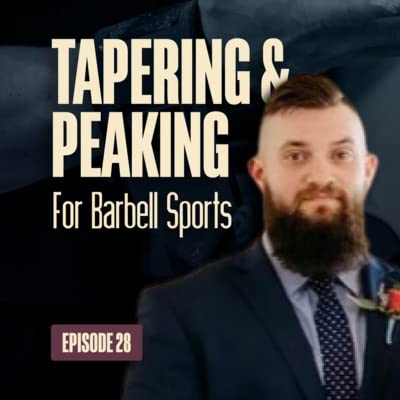
  • EP. 28: Tapering and Peaking in Barbell Sports | Kyle Travis
    Nov 10 2022

    Before major competitions - whether regional, national, or world championships or just you maxing out at the gym - lifters use tapering to achieve peak performance on a given day. Unfortunately, most tapering literature has focused on endurance sports, and the current literature on tapering and peaking maximal strength is scarce. Luckily, a group of researchers has taken it upon themselves to fill the literature gap; thus, one of them, Dr. Kyle Travis, is here to provide us with some insight!

    .

    .

    .

    _______________________

    Dr. Kyle Travis is a Postdoctoral Research Scientist at the University of Florida. His current research foci consist of skeletal muscle biology, atrophy prevention, aging, neuromuscular junction morphology, gene expression, and gene manipulation.


    Kyle's ResearchGate: https://www.researchgate.net/profile/Kyle-Travis

    .

    .

    .

    .

    .

    SUPPORT US!

    1. Keep up with the research: https://www.weightology.net/products/traffic.php?id=115

    2. Track your macros (Use the code "CUES" ): https://www.strongerbyscience.com/macrofactor/

    3. Coach your clients: https://mbsy.co/3GShF2

    4. Record a podcast of your own: https://riverside.fm/?utm_campaign=campaign_1&utm_medium=affiliate&utm_source=rewardful&via=velu

    _______________________

    This is the 28th episode of the weekly #coachingcues podcast! If you want to have your question answered by an expert, please head to www.coachingcues.org/ask

    Más Menos
    21 m
  • EP. 27: Peak Week Recommendations For Bodybuilders | Andrew Chappell
    Nov 1 2022

    In the final days of competition preparation, bodybuilders usually implement interventions to "peak" their body to maximize contest day aesthetics. These interventions aim to 3) maximize muscle glycogen content to enhance muscle "fullness," 2) minimize subcutaneous water to look dry, and 3) minimize abdominal bloating to maintain a small waistline. But how may one accomplish all these? - Dr. Andrew Chappell provides us with some insight!

    .

    .

    .

    _______________________

    Dr. Andrew Chappell is a Lecturer/Researcher at Robert Gordon University School of Pharmacy and Life Science. His interests are primarily in sports nutrition, with a specific focus on bodybuilding.


    Andrew's ResearchGate: https://www.researchgate.net/profile/Andrew-Chappell


    Papers mentioned:

    https://www.mdpi.com/2075-4663/6/4/126

    https://bmcsportsscimedrehabil.biomedcentral.com/articles/10.1186/s13102-021-00296-y

    .

    .

    .

    .

    .

    SUPPORT US!

    1. Keep up with the research: https://www.weightology.net/products/traffic.php?id=115

    2. Track your macros (Use the code "CUES" ): https://www.strongerbyscience.com/macrofactor/

    3. Coach your clients: https://mbsy.co/3GShF2

    4. Record a podcast of your own: https://riverside.fm/?utm_campaign=campaign_1&utm_medium=affiliate&utm_source=rewardful&via=velu

    _______________________

    This is the 27th episode of the weekly #coachingcues podcast! If you want to have your question answered by an expert, please head to www.coachingcues.org/ask

    Más Menos
    26 m
  • EP. 26: Nervous System Adaptations to Strength Training | Simon Walker
    Oct 21 2022

    Most of you may know that the force production of skeletal muscle depends on many different systems and tissue properties, such as muscle size or tendon stiffness. However, specific elements within the nervous system control and manipulate our muscles' force production. But can these elements be altered via resistance exercise? - Dr. Simon Walker provides us with some insight!

    .

    .

    .

    _______________________

    Dr. Simon Walker is a Senior Researcher at the University of Jyväskylä. He's taken a lead role in developing MEG-compatible voluntary force and reflex measurements for the lower limbs and continues to develop research on physical activity and central nervous system functioning.


    Simon's ResearchGate: https://www.researchgate.net/profile/Simon-Walker-17


    Simon's Twitter: https://twitter.com/simonwalkerphd?lang=fi


    JYU - 22nd International Symposium: https://www.jyu.fi/sport/en/research/congresses/ebpes

    .

    .

    .

    .

    .

    SUPPORT US!

    1. Keep up with the research: https://www.weightology.net/products/traffic.php?id=115

    2. Track your macros (Use the code "CUES" ): https://www.strongerbyscience.com/macrofactor/

    3. Coach your clients: https://mbsy.co/3GShF2

    4. Record a podcast of your own: https://riverside.fm/?utm_campaign=campaign_1&utm_medium=affiliate&utm_source=rewardful&via=velu

    _______________________

    This is the 26th episode of the weekly #coachingcues podcast! If you want to have your question answered by an expert, please head to www.coachingcues.org/ask

    Más Menos
    20 m
  • EP. 25: Sex differences in strength and hypertrophy | Brandon Roberts
    Oct 14 2022

    At this point, it's clear that males and females can increase strength and muscle mass. However, since there are several differences both between and within sexes, it begs the question: just how differently do sexes respond to training? - Dr. Brandon Roberts provides us with some insight!

    .

    .

    .

    _______________________

    Dr. Brandon Roberts is a Captain & Research Physiologist at USARIEM, doing medical research to optimize Warfighters.


    Brandon's ResearchGate: https://www.researchgate.net/profile/Brandon-Roberts-2

    .

    .

    .

    .

    .

    SUPPORT US!

    1. Keep up with the research: https://www.weightology.net/products/traffic.php?id=115

    2. Track your macros (Use the code "CUES" ): https://www.strongerbyscience.com/macrofactor/

    3. Get stronger: https://www.data-drivenstrength.com/individualized-programming

    4. Become a trainer: https://www.jpshealthandfitness.com.au/product-category/personal-trainer-education/

    5. Coach your clients: https://mbsy.co/3GShF2

    6. Record a podcast of your own: https://riverside.fm/?utm_campaign=campaign_1&utm_medium=affiliate&utm_source=rewardful&via=velu

    _______________________

    This is the 25th episode of the weekly #coachingcues podcast! If you want to have your question answered by an expert, please head to www.coachingcues.org/ask

    Más Menos
    18 m