

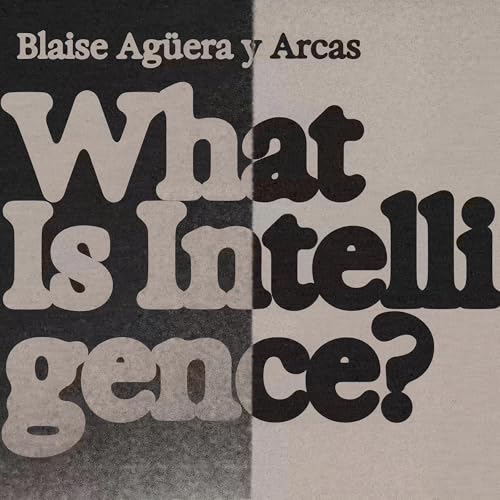
What Is Intelligence?
Lessons from AI About Evolution, Computing, and Minds (Antikythera)
No se pudo agregar al carrito
Add to Cart failed.
Error al Agregar a Lista de Deseos.
Error al eliminar de la lista de deseos.
Error al añadir a tu biblioteca
Error al seguir el podcast
Error al dejar de seguir el podcast
Obtén 30 días de Standard gratis
 ¿Miembros Prime? ¿Nuevo en Audible? Recibes una prueba de 2 meses en su lugar.
What Is Intelligence?
Compra ahora por $25.53
-
Narrado por:
-
Blaise Aguera y Arcas
What intelligence really is, and how AI’s emergence is a natural consequence of evolution.
It has come as a shock to some AI researchers that a large neural net that predicts next words seems to produce a system with general intelligence. Yet this is consistent with a long-held view among some neuroscientists that the brain evolved precisely to predict the future—the “predictive brain” hypothesis.
In "What Is Intelligence?", Blaise Agüera y Arcas takes up this idea—that prediction is fundamental not only to intelligence and the brain but to life itself—and explores the wide-ranging implications. These include radical new perspectives on the computational properties of living systems, the evolutionary and social origins of intelligence, the relationship between models and reality, entropy and the nature of time, the meaning of free will, the problem of consciousness, and the ethics of machine intelligence.
The audiobook offers a unified picture of intelligence from molecules to organisms, societies, and AI, drawing from a wide array of literature in many fields, including computer science and machine learning, biology, physics, and neuroscience. It also adds recent and novel findings from the author, his research team, and colleagues. Combining technical rigor and deep up-to-the-minute knowledge about AI development, the natural sciences (especially neuroscience), and philosophical literacy, "What Is Intelligence?" argues—quite against the grain—that certain modern AI systems do indeed have a claim to intelligence, consciousness, and free will.
©2025 Blaise Aguera y Arcas (P)2025 Blaise Aguera y ArcasLos oyentes también disfrutaron:





Las personas que vieron esto también vieron:


The book builds its case progressively through multiple fields of knowledge, but as a reader you don't need a background in any particular area because the author explains each concept and each progression in simple terms. I am a software engineer, and even as someone already familiar with the math equations of the Attention and Transformer concepts in AI, I found the explanations here notably better at connecting-the-dots than anywhere else I've seen.
I bought both the audiobook and the print one. I've never done that before, and it has been worthwhile for me to have this particular book in both formats. The audiobook has been a pleasant listening experience because the author's natural enthusiasm for his work comes through in his voice. The print, along with its diagrams, have been useful for deeper studying of the ideas.
The book is thought-provoking, and I recommend it to anyone with a curious mind. If you are hungry for intellectually stimulating material, I am sure you will enjoy this book as much as I did.
So Enjoyable I Bought it Twice (Print and Audio)
Se ha producido un error. Vuelve a intentarlo dentro de unos minutos.
Some of that suspicion survived the reading. My first objection did not.
The objection was that this is one more account of intelligence written by a member of one species out of millions, and a species that is removing other species from the Earth at a rate no one has bothered to slow. I still think that fact should be stated at the front of any book about minds. But it is not the criticism I thought it was, and it does not describe what this book actually does.
Agüera y Arcas argues that intelligence is prediction, that prediction does not depend on what it is made of, and that it runs without a break from self replicating molecules through cells and organisms and into large language models. That is not a human centered account. It gives us no privileged position in it. A bacterium modeling a gradient and a network modeling the next word are doing the same kind of work at different scales. I have spent forty years arguing against human exceptionalism, and here is a book from inside the industry arguing something adjacent to that. I should say so plainly instead of objecting to the author's employer.
Where the objection does hold is in the choice of frame. Prediction and computation are our own technologies. We built them, we are impressed by them, and we are now finding them everywhere we look, including in bacteria and in evolution itself. Decentering ourselves by promoting computation to the organizing principle of life is still a decentering carried out on terms we selected. The book does not examine this. It treats prediction as a discovery about the world rather than as a description we brought with us.
It also holds on the ethics. The book takes up the ethics of machine intelligence. It does not take up what is owed to the lineages that ended while it was being written. A book that establishes an unbroken continuity of mind from molecules upward has, by its own argument, a great deal to answer for on that question. It leaves the question alone.
I want to withdraw part of how I first put the objection, because it was lazy. Saying that an account of intelligence comes from one species among millions disqualifies every account anyone could produce, mine included. I am the same species. My position is not stronger for being less human, because it is not less human. It is stronger only if it counts more of what is alive and more of what is being lost. That is the standard I should hold this book to, and the one I should be held to.
By that standard the book does well early and poorly late. It counts more than most books count. It is genuinely interested in bacteria and in the deep history of life, and interested in them as the subject rather than as background. Then it reaches the present, where the accounting would cost something, and it turns to the machines.
It is worth reading. I expect I will come back to the early chapters and not the later ones.
It counts more than most books count.
Se ha producido un error. Vuelve a intentarlo dentro de unos minutos.
Mindblowing
Se ha producido un error. Vuelve a intentarlo dentro de unos minutos.
great book
Se ha producido un error. Vuelve a intentarlo dentro de unos minutos.