


To the Lighthouse
No se pudo agregar al carrito
Solo puedes tener X títulos en el carrito para realizar el pago.
Add to Cart failed.
Por favor prueba de nuevo más tarde
Error al Agregar a Lista de Deseos.
Por favor prueba de nuevo más tarde
Error al eliminar de la lista de deseos.
Por favor prueba de nuevo más tarde
Error al añadir a tu biblioteca
Por favor intenta de nuevo
Error al seguir el podcast
Intenta nuevamente
Error al dejar de seguir el podcast
Intenta nuevamente
Obtén 30 días de Standard gratis
$8.99 al mes después de que termine la prueba. Cancela en cualquier momento

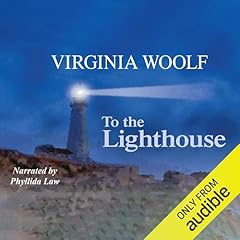
To the Lighthouse
Narrado por:
Juliet Stevenson
Compra ahora por $15.19
-
Narrado por:
-
Juliet Stevenson
-
De:
-
Virginia Woolf
To the Lighthouse is a landmark work of English fiction. Virginia Woolf explores perception and meaning in some of the most beautiful prose ever written, minutely detailing the characters thoughts and impressions. This unabridged version is read by Juliet Stevenson.
Download the accompanying reference guide.©2008 Naxos Audiobooks (P)2008 Naxos AudiobooksLos oyentes también disfrutaron:




adbl_web_anon_alc_button_suppression_t1
Reseñas de la Crítica
"British actress Juliet Stevenson makes for a better reader of Woolf's words than Nicole Kidman's Oscar-winning turn as Woolf in The Hours...Her reading is quietly, carefully precise, and that precision is a solid complement to Woolf's own measured, inward-looking prose." (Publishers Weekly)
Las personas que vieron esto también vieron:






Excellent reading
Se ha producido un error. Vuelve a intentarlo dentro de unos minutos.
Poetic
Se ha producido un error. Vuelve a intentarlo dentro de unos minutos.
Fabulous reading of a must-read book
Se ha producido un error. Vuelve a intentarlo dentro de unos minutos.
I had several false-starts in trying to figure out what the meaning of the story was. Early on, we learn that one of the main characters, Mr. Ramsay, is some sort of Berkleyian idealist who thinks all the world is made of experience, and that tables cease to exist when no one perceives them. Given the stream-of-consciousness storytelling, I thought perhaps that Woolf was going to argue that this was true, or false, or true but in some way different from how the idealist philosophers saw it. I think Woolf rather is not concerned with the nature of reality itself, but about what matters.
It's called "*To* the Lighthouse" not "The Lighthouse": the journey is the focus, not the destination. The story stops right before anyone gets there. Does it matter if you paint something that satisfies your vision, but the painting just gets stuffed in the attic? Does it matter if you marry your love, but then get blown up in the war? Is it bad for us if we want and want and want something, but never get it, when we also don't want it, or wouldn't want it if we had it, or want something contradictory also? The novel seems to say that it's enough to find ourselves in this or that, because that's all there really is-- not in a grand metaphysical sense, but just in the sense that that's all we, personally, have before us.
Towards the end, Mr. Ramsay (who is the only character I've named in this review, but who doesn't get much of an interior treatment, comparatively) recites some lines of a William Cowper poem, The Castaway: "We perished each alone / But I beneath a rougher sea." I think the "I beneath a rougher sea" is just his solipsism taking him again, but there's a real sense in which "We perished each alone" could be the tagline to the book. The world *has* other people in it, for better or worse as the case may be, but the version of life we experience is separate and incommunicable for each of us, we live it alone, and we die alone, much as we might be fully wrapped up in the ideas of those other people the entire time.
The narrator is great, and I highly recommend this.
Truly Great
Se ha producido un error. Vuelve a intentarlo dentro de unos minutos.
Woolf is so good at sympathetically and honestly exposing people's minds and so good at revealing the beautiful and awful world we live in, and her writing is so beautiful, flowing, controlled, and poetic, that spending only a couple days with her characters is an indelibly rich experience. She employs a modernist stream of consciousness narration, and fluidly moves from one character to another. Her technique in the novel has been likened to that of the lighthouse beam moving across the benighted island world, briefly illuminating one mind and then another as it goes round, but Woolf's narration feels more organic than that. I relish her long, elegant sentences comprised of multiple clauses attached by semi-colons, her original and vivid metaphors, and her insights into human nature in a variety of vessels (male, female, old, young, educated, simple, etc.). I expected To the Lighthouse to be beautiful, philosophical, and sad, and it was, but I was surprised by its constant humor. At least as often as a poignant pang, I felt a flush of pleasure, similar to what Cam feels while sailing towards the lighthouse:
"From her hand, ice cold, held deep in the sea, there spurted up a fountain of joy at the change, at the escape, at the adventure (that she should be alive, that she should be there). And the drops falling from this sudden and unthinking fountain of joy fell here and there on the dark, the slumbrous shapes in her mind; shapes of a world not realised but turning in their darkness, catching here and there, a spark of light; Greece, Rome, Constantinople."
The dense novel explores the miraculous fragility and meaning (or lack thereof) of life; the varied and complex nature of love; the losses and gains involved in making families or living alone; the fraught relationships between children and parents; the confining roles of men and women; the surprising vividness and poignancy of memory; the complex nature of perception; the doomed but necessary attempt to understand other people; and the doomed but noble attempt through art to capture truth and to avoid entropy.
Juliet Stevenson was born to read Virginia Woolf! Her voice is lovely to listen to and full of understanding, irony, and sympathy, a perfect accompaniment to the text. With skillful subtlety, she modifies her voice for the thoughts of men and women and children and adults (and for the local Scottish workers who help the Ramsays). She carried me off To the Lighthouse. The only thing, perhaps, that is lost in the audiobook is Woolf's use of parentheses and brackets and semi-colons, which visually shape the reading of the text.
To the Lighthouse, like Mrs. Dalloway and Orlando, should be read by anyone interested in gender, art, love, life, modernism, beautiful prose, and early 20th century British culture.
A Stark Tower on a Bare Rock, or a Hanging Garden?
Se ha producido un error. Vuelve a intentarlo dentro de unos minutos.